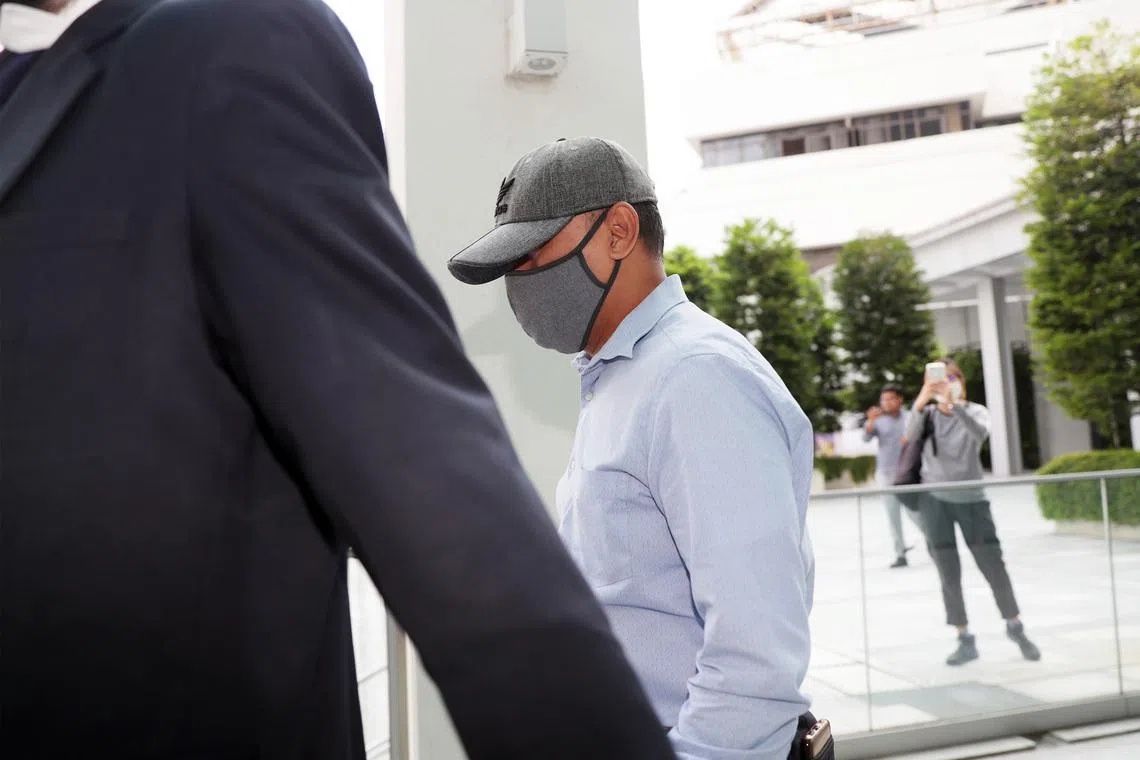
A former executive chairman of two Singapore mosques has been handed a 14-month prison sentence for orchestrating a corruption scheme that steered construction contracts worth S$223,000 to a company operated by a close associate. Abdul Rahim Mawasi, 59, who previously held leadership positions at Darul Aman Mosque on Jalan Eunos and Sallim Mattar Mosque in MacPherson, was convicted in April following trial on charges of graft related to his manipulation of tender processes at both religious institutions.
The case exposes significant governance lapses within the administrative structures of Singapore's mosque system and raises broader questions about oversight mechanisms in religious organisations across Southeast Asia. Abdul Rahim's dual role as a senior officer with the Islamic Religious Council of Singapore (MUIS), where he had worked since 2005, combined with his executive chairmanship of the two mosques' management boards, created the conditions for his breach of fiduciary duty. The scheme unfolded over more than a year, beginning in mid-2018, demonstrating how institutional authority can be systematically exploited when proper checks and balances prove insufficient.
The genesis of the corrupt arrangement lay in a business proposal between Abdul Rahim and Mohd Mustaqim Kam, a construction firm director whom he had known for over a decade. In July 2018, the two men agreed to establish a travel company focused on pilgrimage trips, with an unusual structure in which Abdul Rahim would invest no capital upfront. Instead, he would leverage his institutional position to secure construction contracts for Zeal-Con Engineering, the company where Kam held directorship, with profits subsequently converted into equity in the travel venture. This arrangement represented a textbook conflict of interest, placing Abdul Rahim in a position to prioritise his personal financial interests over his duties to the mosque management boards.
The corrupt conduct manifested through Abdul Rahim's deliberate interference in Zeal-Con's bidding for renovation works at Darul Aman Mosque. When the mosque sought vendors for yard renovation in 2018, Zeal-Con submitted an initial quote of S$128,600 on August 20. Abdul Rahim, through extensive discussions with Kam, provided crucial price intelligence that enabled the company to submit a strategically revised quote of S$118,000 on September 12. Critically, this revised figure undercut the next-lowest competing bid of S$125,500 from another firm by a significant margin, yet remained attractive enough to ensure contract award. The mosque's management board, unaware of Abdul Rahim's behind-the-scenes manipulations, subsequently awarded the contract to Zeal-Con for the lower amount on September 26, 2018.
A similar pattern of corrupt conduct repeated at Sallim Mattar Mosque, where Abdul Rahim again provided guidance to Kam on pricing strategy. Zeal-Con initially quoted S$115,700 for renovation work encompassing the roof and reception areas in September 2018, subsequently lowering the quote to S$105,000 by July 2019. According to prosecution evidence, Abdul Rahim specifically advised Kam to reduce the company's pricing to secure the contract, and the mosque duly awarded letters of contract to Zeal-Con linked to the revised amount in August 2019. Across both institutions, the total value of contracts improperly directed to Zeal-Con reached S$223,000.
To obscure the corrupt arrangement, Abdul Rahim arranged for his son to nominally hold shares in the travel venture company, Amal Travel and Tour (ATT), which Kam had registered in late 2019. The company held 100,000 shares with paid-up capital of S$100,000, of which 25,000 shares valued at S$1 each were allotted to Abdul Rahim's son in November 2019. This deliberate interposition of a family member served to create distance between Abdul Rahim and the beneficial ownership structure, allowing him to maintain plausible deniability about his participation in the travel business. The prosecution characterised this arrangement as a calculated effort to avoid detection and to conceal his undisclosed interest in the joint venture from MUIS oversight authorities.
During his trial, Abdul Rahim, represented by lawyer Satwant Singh Sarban Singh, categorically denied any involvement with ATT and claimed to hold no shares in the company. While this denial technically aligned with the documentary record—he indeed held no shares in his own name—it obscured the substance of the corrupt arrangement and his beneficial interest in the venture's profits. The strategy exemplified how sophisticated misconduct can exploit technical distinctions between legal ownership and economic interest, complicating prosecutorial efforts to establish culpability beyond reasonable doubt.
The prosecution demonstrated that both the Darul Aman Mosque and Sallim Mattar Mosque construction works were ultimately completed satisfactorily by Zeal-Con, and there was insufficient evidence that either institution sustained substantial financial losses from the arrangement. However, the absence of material harm did not diminish the gravity of Abdul Rahim's corruption offence. Deputy Public Prosecutor Bryan Wong emphasised that Abdul Rahim had committed a serious public sector corruption offence for personal financial gain, a characterisation that reflects Singapore's stern approach to institutional corruption, particularly within religious and community settings where public trust is paramount.
Akam Hock Beng, also known as Mohd Mustaqim Kam, the co-conspirator and beneficiary of the scheme, received a lighter sentence of six months' imprisonment, having been convicted and sentenced in February 2025. The differentiated sentencing reflects the courts' assessment that Abdul Rahim bore greater culpability as the insider with institutional authority and fiduciary responsibilities. His position as a MUIS officer seconded to the mosques placed him in a position of trust that he systematically violated for financial advantage.
Abdul Rahim's defence counsel sought leniency at sentencing, requesting no more than six months' jail and emphasising his client's unblemished prior record. The district judge rejected these submissions, imposing the 14-month sentence instead. Abdul Rahim's bail was set at S$30,000, and he was scheduled to commence his sentence on July 10. The case serves as a cautionary reminder of vulnerability within religious institution governance structures, particularly where individual officials combine substantial administrative authority with limited external oversight.
For Malaysian readers and policymakers across Southeast Asia, the Singapore case highlights the critical importance of robust internal controls, transparent bidding processes, and effective oversight mechanisms within religious institutions. Many mosques and religious organisations throughout Malaysia and the region operate with similar governance structures that may benefit from enhanced transparency requirements, competitive bidding oversight, and regular external audits. The successful prosecution of a high-ranking official within a prestigious institution like MUIS underscores that even well-established regulatory frameworks require constant vigilance and that corruption prevention must be embedded into institutional culture rather than relied upon as an afterthought to governance design.

