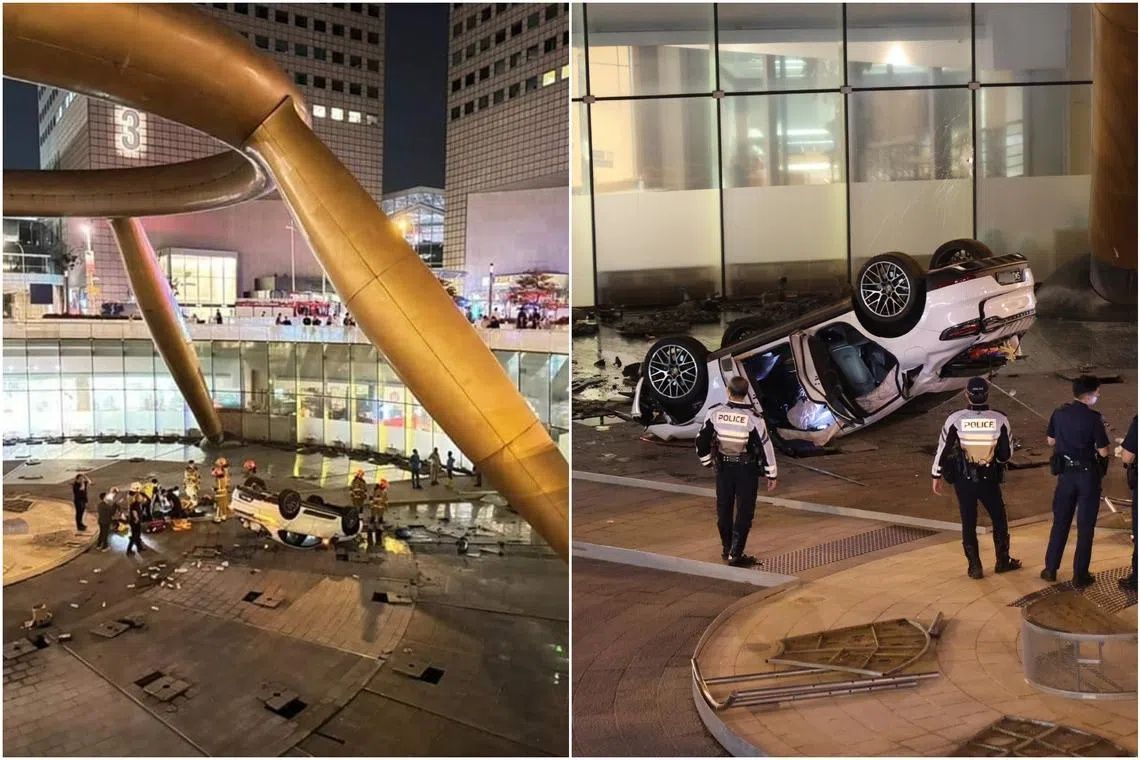
A Singapore court has imposed a stern sentence on a 58-year-old man whose vehicle crashed spectacularly into the Fountain of Wealth at Suntec City shopping mall after an extended drinking session, underscoring the judiciary's hardline stance on alcohol-fuelled driving offences. Then Shing Chong was handed down five weeks' jail time and a 2½-year driving ban from his release date following his guilty plea to driving in a manner that endangered the public. The incident on July 13, 2024, inflicted nearly S$64,600 in damage to the landmark fountain, though the defendant has since made full financial restitution for the destruction.
The sequence of events leading to the accident reveals the progression of a dangerous decision-making process compounded by alcohol consumption. On the afternoon of July 12, 2024, Then departed his residence and made his way to Suntec City to socialise with a friend. After parking his vehicle in the basement carpark at approximately 6pm, he proceeded to a bar within the shopping complex where he began consuming beer. Over a six-hour period from around 6:15pm until midnight, he consumed approximately one litre of beer before deciding to drive away from the venue.
The court heard crucial details about the moment the vehicle exited the carpark. A brief pause of about 10 seconds occurred while the gantry barrier lifted to permit passage, but Then proceeded to accelerate along Temasek Boulevard despite directional signage clearly indicating he needed to turn left at an upcoming roundabout. His compromised concentration resulted in him continuing straight through three lanes of traffic before the vehicle breached the protective barricade surrounding the Fountain of Wealth and became airborne into the basement level below.
The incident's proximity to tragedy came into sharp focus when Deputy Public Prosecutor Gladys Lim highlighted that three construction workers were actively engaged in maintenance work at the basement level at the time of the crash. The workers managed to escape the area unharmed, but the prosecutor emphasised to District Judge Koo Zhi Xuan that the consequences could have been catastrophic had they been positioned directly beneath the vehicle's impact zone. This observation became central to the prosecution's argument for a custodial sentence rather than alternative measures.
Complicating the medical and legal picture was Then's disclosure to the Institute of Mental Health that he had consumed either an antihistamine or a sleeping pill prior to the drinking session, a factor that may have intensified the depressant effects of the alcohol. However, the critical forensic evidence regarding blood alcohol content was never obtained, as Then was immediately conveyed to the emergency department of Tan Tock Seng Hospital following the crash where he sustained injuries including a lacerated scalp. This absence of definitive chemical analysis did not diminish the severity of the charges, given the clear circumstances of the incident and his admission of guilt.
The defence team from Invictus Law Corporation, comprising Josephus Tan, Cory Wong, and Devlin Mohyong, mounted a compassionate but ultimately unsuccessful argument centring on their client's mental health status. They presented an IMH report indicating that Then suffered from major depressive disorder at the time of the accident and contended that his psychiatric condition had materially contributed to the commission of the offence. On this foundation, they requested that the court call for a mandatory treatment order assessment, which would have allowed him to undergo therapeutic intervention in place of incarceration.
The prosecution objected to this submission, maintaining that the circumstances demanded a punitive rather than therapeutic approach. Deputy Public Prosecutor Lim argued forcefully that drink-driving represented such a fundamentally reckless behaviour that general and specific deterrence had to take precedence in sentencing. The psychological vulnerability of the offender, she contended, could not override the public interest in discouraging others from operating vehicles while intoxicated, particularly in a densely populated urban environment like Singapore.
Judge Koo Zhi Xuan sided with the prosecution's reasoning, emphasising that the severity of the offence warranted jail time. The judge noted that Then's actions had generated substantial property damage to a culturally significant landmark and had created a genuine risk of serious injury or death to multiple people. The decision to reject the mandatory treatment order pathway sends a strong signal that Singapore's courts view drink-driving not as a mental health matter suitable for diversion programmes, but as a serious criminal behaviour requiring custodial punishment.
The broader context for Malaysian readers lies in understanding how different jurisdictions approach sentencing for driving under the influence offences. While Singapore imposes severe penalties including imprisonment and extended disqualification from driving, the regulatory frameworks across Southeast Asia vary considerably. The case illustrates how urban density and public safety concerns in city-states necessitate rigorous enforcement of traffic laws, a principle increasingly relevant as Malaysian cities such as Kuala Lumpur and George Town experience population growth and congestion.
The financial implications merit consideration as well. The S$64,600 in damage costs represents a substantial sum that would devastate most households, yet this defendant's ability to make full restitution may have satisfied one aspect of the court's concerns about accountability. Nevertheless, the judge determined that financial compensation alone could not substitute for the deterrent effect of imprisonment, particularly given that such offences carry the potential for fatal consequences.
The disqualification period of 2½ years from the date of release represents a particularly stringent punishment in a city where personal vehicle ownership provides significant convenience, though Singapore's robust public transport infrastructure provides viable alternatives. This extended driving ban is designed not merely as punishment but as a mechanism to enforce genuine reflection on the consequences of such behaviour before reintegration into the driving population.
For the construction workers whose presence at the fountain's basement proved so fortuitous, the incident serves as a stark reminder of how seemingly distant decisions by others can suddenly threaten their safety. Their fortunate escape from potential tragedy influenced judicial thinking about the severity of Then's transgression, demonstrating how courts recognise the element of luck in accident outcomes rather than treating consequences as the sole measure of culpability.
The case ultimately reinforces a crucial message applicable across the region: the combination of alcohol consumption, vehicle operation, and compromised judgment creates compound risks that justify the most serious legal consequences. As Southeast Asian societies grapple with rising vehicle ownership and increasingly congested urban environments, the severity of Singapore's approach to drink-driving offences offers instructive precedent for how jurisdictions might calibrate their own enforcement priorities.

