A 29-year-old Singapore resident faces five serious traffic charges stemming from a March morning incident in which he drove recklessly while intoxicated, ultimately colliding with a school bus and injuring two young passengers. Aaron Tan Yao Cong appeared in court on Thursday, June 18, to answer accusations that centre on his decision to operate a vehicle whilst significantly exceeding legal alcohol limits and his subsequent dangerous conduct on public roads. The case underscores persistent concerns about repeat offenders and the catastrophic consequences when intoxicated drivers put vulnerable road users, particularly children, at risk.
According to court documents, Tan's blood alcohol level reached 148 milligrams per 100 millilitres of blood—nearly double the legal threshold of 80 milligrams—when tested following his arrest. Notably, he had initially refused to undergo a breathalyser examination at the roadside, a refusal that itself constitutes a separate criminal charge. His prior conviction for drink driving in 2019, along with a previous finding of driving without due care and attention, establishes a troubling pattern of unsafe road behaviour and disregard for traffic regulations that should have prompted heightened caution.
The incident unfolded in the early morning hours of March 6, 2024, when Tan's vehicle first breached traffic flow regulations near Cavenagh Road. At 5.50am, he ignored a straight-only traffic sign and instead veered left towards oncoming traffic, eventually stopping on the left side of the two-lane Cavenagh Road. Rather than remaining stationary, Tan accelerated away approximately ten minutes later when police officers approached his vehicle, initiating a chaotic pursuit through the pre-dawn streets.
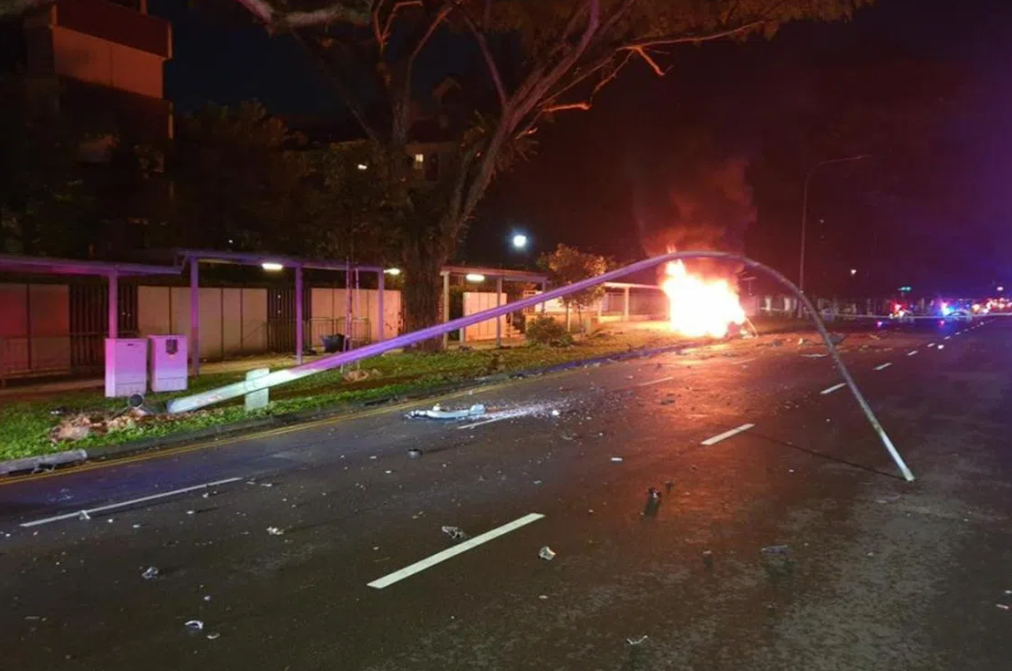
The subsequent chase saw Tan accelerate dangerously along Bukit Timah Road, averaging speeds of 114 kilometres per hour whilst weaving erratically between other vehicles. This reckless acceleration continued until 6.16am, when he approached the junction of Sixth Avenue. At that intersection, Tan disregarded a red traffic signal and crashed directly into a private bus that was executing a lawful U-turn. The violent collision resulted in his vehicle striking a lamp post, which ignited the car immediately thereafter.
Three passengers accompanying Tan in his vehicle, along with the bus driver and his two young passengers—both aged nine and ten—all required hospital treatment following the crash. The two schoolchildren sustained injuries significant enough to necessitate medical attention, though the extent of their injuries remains undisclosed in available court documents. Tan and his companions managed to escape the burning vehicle unaided, though the intensity of the fire and the high-speed nature of the collision underscored how narrowly the incident avoided more tragic outcomes.
The charges Tan faces carry substantial potential penalties reflective of the severity of his conduct. The drink-driving allegation, prosecuted as a repeat offence given his 2019 conviction, carries a maximum prison sentence of two years and fines reaching 20,000 Singapore dollars. The dangerous driving charge causing bodily harm provides an alternative maximum penalty of two years imprisonment and a fine of 10,000 dollars, or both, with repeat offender penalties extending to 20,000 dollars. Together, these primary charges could result in significant custodial time if Tan is convicted.
Additional charges for leaving his vehicle in a hazardous position, failing to provide a breath specimen when required, and driving against traffic flow each carry their own graduated penalties. The breath refusal charge, typically pursued when drivers attempt to evade alcohol testing, permits sentences of up to six months imprisonment and fines of 5,000 dollars for first offences, escalating to one year imprisonment and 10,000 dollars for repeat offenders. These ancillary charges accumulate legal jeopardy and reflect the prosecutorial approach of addressing every element of Tan's transgression.
For Malaysian and Southeast Asian readers, this Singapore case exemplifies the critical intersection between repeat offender management and road safety enforcement. Many regional jurisdictions have struggled with effectively preventing habitual traffic violators from operating vehicles after initial convictions. Tan's previous drink-driving conviction in 2019 apparently failed to deter him from re-offending five years later, raising questions about the adequacy of licence suspension periods, rehabilitation requirements, or monitoring mechanisms across the region.
The incident also highlights the vulnerability of school transportation and the potential for one individual's poor choices to endanger dozens of innocent people, particularly children. In Malaysia, where school bus incidents periodically generate public concern, this Singapore case provides a sobering reminder that comprehensive driver accountability systems must account for alcohol-related offences with particular severity. The injuries sustained by the two schoolchildren, whilst apparently not life-threatening, carry lifelong psychological implications for young victims.
Tan has scheduled a return court appearance for July 16, at which juncture he must indicate whether he intends to plead guilty to any of the five charges or proceed to trial. His legal position remains undeclared, though the detailed charge sheets and evidence of his blood alcohol levels present substantial evidentiary hurdles for a successful defence. The case will likely conclude with either negotiated guilty pleas to certain charges or full adversarial proceedings determining liability across all counts.
The broader context of drink-driving enforcement across Southeast Asia reveals inconsistent approaches to repeat offenders. Whilst Singapore maintains relatively stringent penalties, questions persist about whether maximum sentences are regularly imposed or whether mitigation frequently results in substantially reduced punishments. For Malaysian authorities and other regional road safety agencies, cases like Tan's underscore the importance of consistent, severe consequences for repeat drink-driving offences to deter potential offenders considering whether to operate vehicles whilst intoxicated.