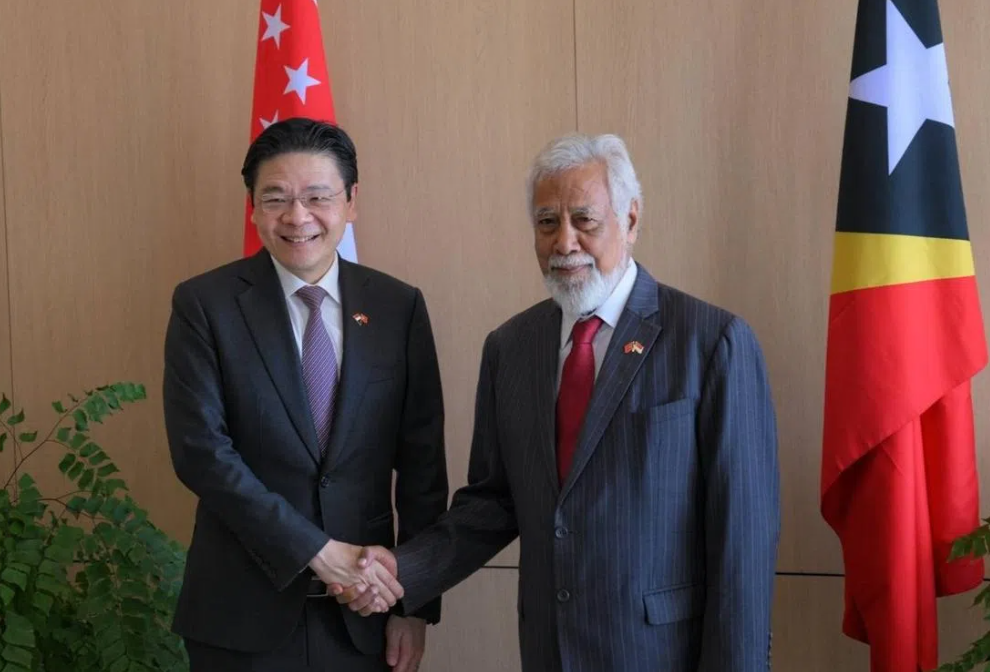
Prime Minister Lawrence Wong's inaugural visit to Timor-Leste as Singapore's leader has yielded a significant bilateral framework agreement designed to deepen economic partnerships, expand healthcare and educational collaboration, and facilitate the exchange of workers between the two nations. The accord, signed on July 3 at the Government Palace in Dili alongside Timorese counterpart Xanana Gusmao, establishes mechanisms for enhanced governmental coordination that extend beyond bilateral matters to encompass broader regional and international strategic developments.
The framework agreement creates a structured approach to Singapore-Timor-Leste relations by mandating regular consultations between foreign ministries on issues spanning diplomatic, economic, and strategic domains. This institutionalised dialogue provides both governments with a systematic mechanism to assess ongoing collaborative initiatives, evaluate their effectiveness, and identify emerging opportunities for mutual benefit. The arrangement reflects a maturation of ties between two nations whose geographic proximity and distinct development trajectories create complementary partnership potential.
Singapore's economic footprint in Timor-Leste already positions the island nation among the country's leading investors, with Singaporean enterprises actively exploring ventures across diverse sectors including wholesale commerce, renewable energy development, and infrastructure initiatives. PM Wong characterised these investments as manifestations of growing confidence in Timor-Leste's economic prospects, signalling that Singapore's business community perceives genuine opportunities despite the nation's modest scale and developing infrastructure. The expansion of such investments hinges on creating stable regulatory environments and predictable business frameworks, priorities that the bilateral agreement implicitly addresses.
A particularly consequential announcement involves Singapore's decision to open selected occupational categories and sectors to Timorese workers from 2027 onwards. The initiative will incorporate Timor-Leste into Singapore's non-traditional labour source programme, permitting construction companies, marine shipyards, and related enterprises to recruit work permit holders from the Southeast Asian nation. Singapore's Manpower Ministry has already identified substantial employer interest in hiring Timorese workers, particularly in construction sectors where labour availability constraints persist. This measure, beginning in the second half of 2027, simultaneously addresses Singapore's labour market requirements whilst generating employment and skills-development opportunities for Timorese citizens, thereby strengthening people-to-people connectivity.
Healthcare cooperation constitutes another pillar of the expanded partnership, with Singapore's National University Hospital and Timor-Leste's health ministry preparing to formalise a comprehensive five-year collaboration framework scheduled for signing later in July. This arrangement transcends simple medical tourism or treatment referrals, instead targeting systemic health sector strengthening through workforce development programmes and training systems enhancement. The collaboration will concentrate on areas identified as priorities by Timor-Leste's health ministry, including emergency care infrastructure, pre-hospital emergency response systems, paediatric services, ophthalmology capacity, obstetric and gynaecological provision, and foundational supportive care facilities. Such targeted assistance addresses critical gaps in Timor-Leste's healthcare architecture whilst leveraging Singapore's advanced medical expertise and institutional capabilities.
Educational collaboration represents the third substantive dimension of the partnership expansion. Singapore intends to support Timor-Leste's national teacher training and education professional development institute with the objective of cultivating school leaders equipped to guide educational systems and nurture succeeding generations. This capacity-building approach recognises that sustainable development fundamentally depends on quality human resource development, and that educational leadership directly influences institutional and systemic outcomes. By assisting Timor-Leste to strengthen its teacher training infrastructure, Singapore invests in the foundational human capital necessary for the nation's long-term prosperity.
Timor-Leste's accession to the Association of Southeast Asian Nations on October 26, 2025, fundamentally transformed the bilateral relationship by positioning the nation within ASEAN's institutional framework and entitling it to participate in regional decision-making structures. Singapore has methodically supported this integration through its Singapore-Timor-Leste ASEAN Readiness Support (STARS) programme, initially launched in December 2022 to equip Timorese officials with the skills and institutional knowledge required for effective ASEAN participation. Singapore subsequently enhanced the package in July 2025, and PM Wong announced on July 3 that it would undergo further expansion to encompass additional ASEAN-focused programmes.
The expansion of ASEAN support initiatives carries particular significance given Timor-Leste's upcoming assumption of the ASEAN chairmanship in 2029. PM Wong explicitly articulated this priority, noting that while Timor-Leste has achieved membership, its subsequent contribution to organisational functioning and preparation for the demanding chairmanship role demand sustained capacity development. Singapore's forthcoming chairmanship in 2027 presents an immediate opportunity for this knowledge transfer, with Singapore offering to facilitate attachments for Timorese officials to Singapore's chairmanship teams, enabling them to acquire firsthand practical experience in chairing regional mechanisms and coordinating ASEAN activities. Supplementary tailored workshops organised in Dili will provide officials with specialised instruction on chairmanship responsibilities and protocols.
The personal dimension of PM Wong's visit was underscored when Timor-Leste President Jose Ramos-Horta conferred the Order of Timor-Leste (Grand Collar) upon him in recognition of Singapore's contributions to Timorese national development and sustained support for ASEAN membership realisation. PM Wong's acceptance speech reframed the honour as belonging collectively to Singaporean professionals and technical personnel who have served in Timor-Leste, emphasising that the award recognition encompasses the broader Singapore society whose members have engaged in training provision, knowledge sharing, capacity building, and collaborative nation-building efforts alongside Timorese counterparts.
PM Gusmao characterised Singapore as a "trusted friend and partner," noting its historical support for Timorese institutions and its advocacy for the nation's ASEAN membership integration. This characterisation reflects a relationship that transcends transactional commercial arrangements to encompass substantive institutional cooperation and demonstrated solidarity with Timor-Leste's strategic aspirations. For Singapore, the investment in Timor-Leste's development carries both humanitarian and strategic rationales: assisting a neighbouring nation's institutional strengthening whilst simultaneously cultivating a stable, prosperous regional partner with whom Singapore shares maritime boundaries and economic interdependencies.
Both leaders invoked a shared conviction that national scale does not predetermine destiny or constrain possibility, emphasising instead that courage, industrious effort, and robust partnerships enable smaller nations to shape their futures meaningfully. This philosophical alignment suggests compatibility in development visions and partnership approaches. The cumulative effect of the bilateral framework, labour mobility provisions, healthcare collaboration, educational support, and expanded ASEAN capacity building represents a comprehensive partnership architecture addressing Timor-Leste's development priorities whilst advancing Singapore's regional stability and economic interests.
The timing of PM Wong's inaugural visit during Timor-Leste's early post-accession period demonstrates Singapore's commitment to facilitating the nation's successful ASEAN integration and sustainable development trajectory. The agreements and announcements constitute not symbolic gestures but substantive commitments involving institutional collaboration, resource allocation, and sustained engagement. For Malaysian observers and regional policymakers, the Singapore-Timor-Leste partnership model illustrates how established ASEAN members can constructively support newer members' institutional development whilst simultaneously advancing mutual economic and strategic interests within the regional framework.

