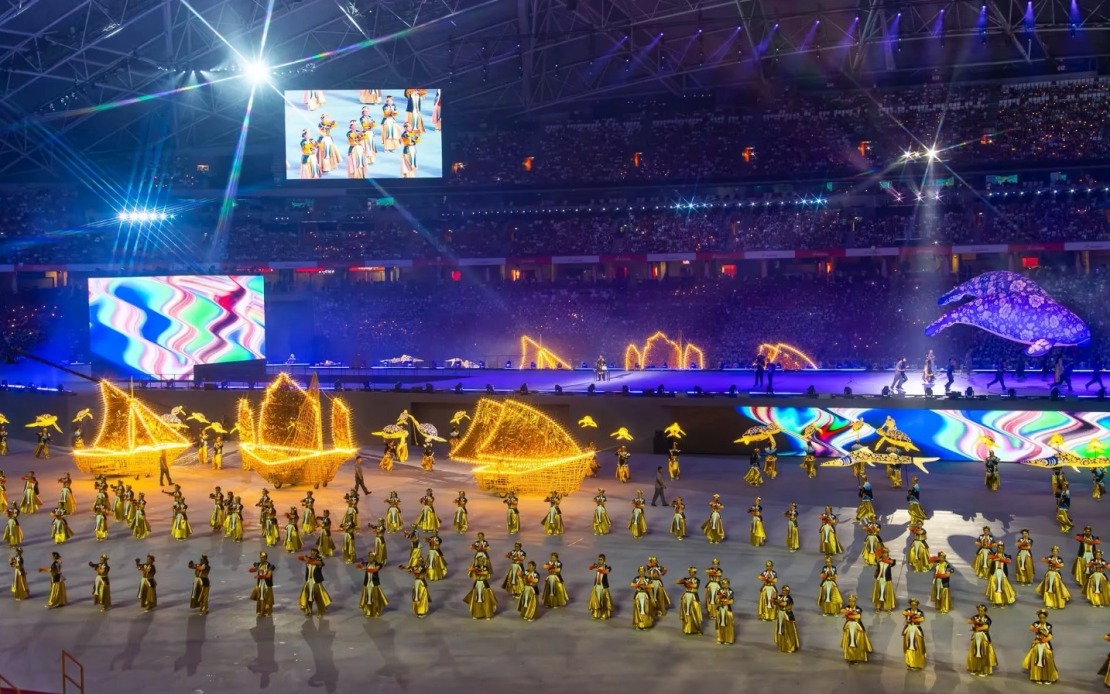
Singapore's National Day festivities reached a significant milestone this August when the republic's celebrated annual parade returned to the National Stadium after an absence of ten years. The August 9 event, themed "Majulah Singapura, Go Beyond!", drew President Tharman Shanmugaratnam and Prime Minister Lawrence Wong alongside the Cabinet, parliamentarians and approximately 42,000 members of the public dressed in the national colours of red and white. The decision to reinstate the parade at this iconic venue signals Singapore's confidence in returning to traditional grandeur after a period of adapted celebrations, reflecting broader national sentiment about moving forward.
A defining feature of this year's ceremony introduced a geographical innovation by extending ceremonial elements beyond the confines of the stadium itself. For the first time in six decades of National Day observations, the Presidential Gun Salute and State Flag Flypast took place at Kallang Basin rather than remaining entirely within the National Stadium grounds. This expansion of the traditional format demonstrated an intent to democratise the viewing experience, permitting thousands of additional spectators positioned throughout the wider Kallang precinct to participate directly in core ceremonial moments. The decision reflects evolving approaches to public engagement whereby national occasions deliberately accommodate larger portions of the citizenry.
The gun salute itself represented a substantial military commitment, with 151 personnel from the 23rd Battalion of the Singapore Artillery and 35th Battalion of Singapore Combat Engineers executing 21 rounds from 25-pounder Howitzer cannons. These weapons were ingeniously mounted on Mobility 3rd Generation rafts that traversed Kallang Basin, creating a mobile display that extended ceremony duration and allowed observers positioned around the waterway to witness the salute's pageantry. This waterborne presentation constituted a logistical and ceremonial innovation, transforming conventional parade elements into experiential moments that engaged audiences beyond traditional spectator vantage points.
The main parade and ceremony segment commenced at approximately 6 pm, operating under the thematic banner "Go Beyond Self". This conceptual framework guided the composition of 32 contingents encompassing more than 2,000 participants, representing diverse institutional and organisational elements of Singapore's society. The contingent structure included six Guard of Honour formations drawn from the Singapore Army, Republic of Singapore Navy, Republic of Singapore Air Force, Digital and Intelligence Service, Singapore Police Force and Singapore Civil Defence Force. These seventy-two individuals escorted the Singapore Armed Forces Colours Party, symbolising the military's foundational role in the nation's security architecture. Additionally, ten contingents originated from uniformed youth organisations, whilst sixteen supporting contingents contributed logistical and ceremonial functions.
The evening's performance component shifted focus toward narrative storytelling and cultural expression, featuring the participation of thirty-six lead artistes alongside more than 2,600 performers. This substantially larger ensemble deployed contemporary and traditional techniques to articulate Singapore's national identity through authentic lived experiences, technological innovation and carefully curated musical accompaniment. The scale of performer involvement reflected investment in demonstrating cultural dynamism and creative capacity across the island republic, positioning National Day celebrations as occasions for artistic expression alongside civic commemoration.
A particularly noteworthy dimension of the performance segment addressed social inclusion through deliberate casting choices. Seven dancers representing varied demographic backgrounds participated, notably including performers with autism and Down syndrome. This explicit representation functioned simultaneously as artistic contribution and social messaging, visually communicating the principle that Singapore's future development depends upon mobilising talents and capabilities across all segments of its population regardless of background, neurodiversity or physical circumstance. Such inclusive presentation carries implications for how Southeast Asian societies increasingly conceptualise national participation and belonging.
For Malaysian observers and regional analysts, Singapore's National Day approach merits attention as a case study in how city-state governance combines ceremonial tradition with adaptive innovation. The decision to reinstate the stadium parade after a decade-long hiatus, coupled with simultaneous expansion of viewing access through Kallang Basin positioning, illustrates calculated balance between preserving institutional continuity and demonstrating organisational responsiveness. The emphasis on technological integration and diverse representation within performance segments reflects Singapore's strategic positioning within contemporary Asia-Pacific discourse around progress, inclusivity and national competitiveness.
The ceremonial framework underpinning Singapore's National Day celebrations reveals sophisticated understanding of how ritual occasions reinforce collective identity whilst accommodating demographic and technological change. The return to the National Stadium symbolises restoration of conventional pageantry, yet the simultaneous expansion of participation mechanisms signals that Singapore's leadership perceives value in broadening access to shared national moments. This dialectic between tradition and innovation characterises much of Singapore's governance philosophy across policy domains ranging from urban planning to economic strategy.
Regionally, Singapore's approaches to national commemoration exercise influential effects, as other Southeast Asian societies observe how this densely-populated and administratively capable city-state manages large-scale public gatherings. The logistical complexity of coordinating 42,000 spectators, 2,600 performers and military components whilst maintaining security and ceremonial integrity demonstrates organisational capacity that few regional entities can replicate. Malaysia and other neighbouring countries with larger geographic territories and more dispersed populations necessarily develop different operational frameworks, yet innovations such as expanding viewership access through secondary venue activation offer lessons for consideration within regional contexts.
The inclusivity messaging embedded within the 2026 National Day celebration warrants particular examination given ongoing Southeast Asian discussions regarding minority rights, disability representation and social cohesion. By featuring performers with autism and Down syndrome within core ceremonial moments rather than marginalising such participants to peripheral recognition, Singapore's celebration articulated commitment to substantive rather than performative inclusion. This approach contrasts with occasional tokenistic representation observed in other regional contexts, potentially influencing emerging norms around how societies publicly acknowledge diverse capabilities and contributions.
Looking forward, Singapore's successful execution of this reinvigorated National Day format establishes precedent for future celebrations whilst simultaneously establishing benchmarks that the republic itself will presumably seek to exceed or innovate upon in subsequent years. The interplay between President Shanmugaratnam and Prime Minister Wong as joint ceremonial leaders reflects constitutional distribution of roles within Singapore's system, whilst the prominent participation of Cabinet and parliamentarians demonstrates coordination across government branches. These structural elements deserve consideration by Malaysian political observers evaluating optimal configurations for national ceremonial leadership.
The return of the National Day Parade to the National Stadium after a decade represents more than logistical restoration of previous practice. It embodies measured national confidence, technological capacity and evolving understandings of inclusive participation that characterise contemporary Singapore governance. As the city-state navigates challenges including demographic change, technological disruption and regional geopolitical complexity, such carefully orchestrated national occasions serve both celebratory and communicative functions, signalling to domestic and international audiences the priorities, capabilities and values that Singapore's leadership emphasises for the coming years.

