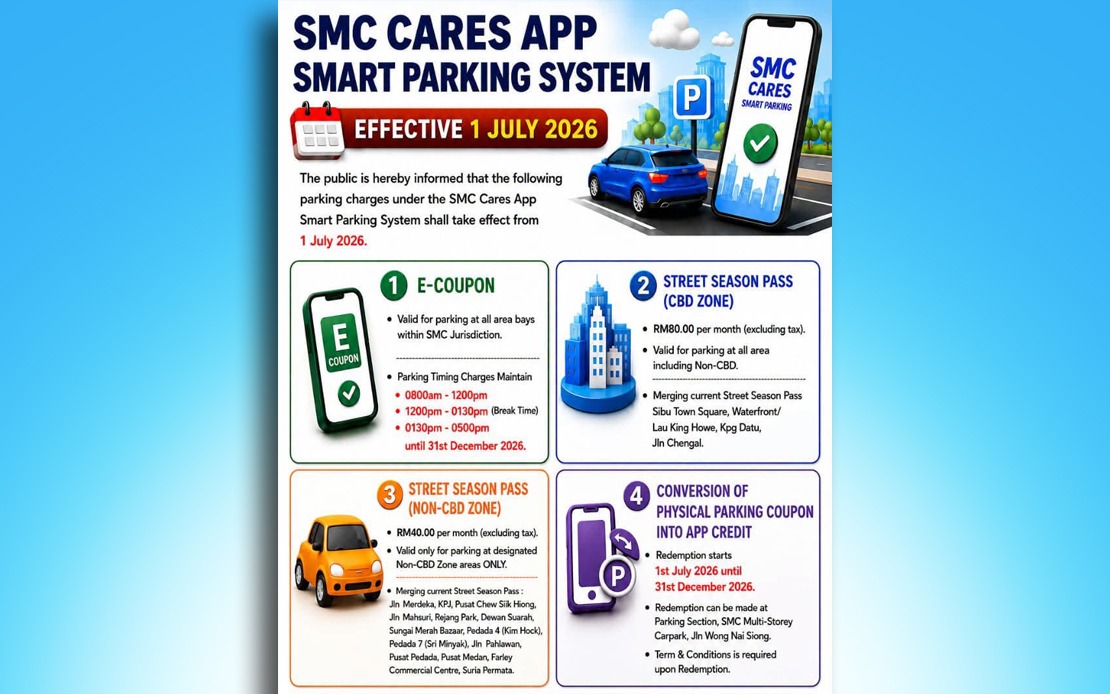
The Sibu Municipal Council has announced significant modifications to its controversial SMC Cares Smart Parking system, seeking to address mounting frustration from residents over what many perceive as an overly punitive enforcement mechanism. The council, led by Chairman Clarence Ting Ing Horh, will introduce a buffer window of between five and ten minutes before the system triggers an Over Parking Notice, giving motorists a realistic timeframe to complete the parking activation process through the mobile application. This adjustment follows sustained public complaints on social media platforms, where users have documented instances of compounds being issued almost immediately after parking periods expired.
The underlying issue that prompted this intervention speaks to a broader challenge facing municipal authorities across Malaysia as they transition towards digital payment systems. Many motorists, particularly those less familiar with technology, have encountered genuine difficulties navigating the application interface, completing the registration process, and executing payments before the system's automated enforcement mechanisms activate. The council's acknowledgement that "users need time to park, exit their vehicles and activate the app" demonstrates a recognition that the original implementation may have underestimated the practical realities of how residents interact with new digital platforms. This grace period represents a pragmatic middle ground between maintaining parking discipline and acknowledging genuine user experience barriers.
Equally significant is the council's decision to introduce a dedicated Senior Citizen Parking Pass for motorists aged 60 and above, with full details to be unveiled in August. This targeted intervention responds directly to complaints about the system's inaccessibility for elderly users, many of whom struggle with smartphone applications and digital payment methods. By creating a parallel pathway for senior citizens, the council demonstrates sensitivity to demographic realities in Malaysian cities where significant portions of the driving population may lack digital literacy or prefer traditional payment methods. The specifics of this pass—whether it involves exemptions, subsidies, or alternative registration methods—remain pending, but the initiative itself signals an important principle: technology implementation should accommodate rather than exclude vulnerable populations.
The council has also instructed the system provider, Primal Solution Sdn Bhd, to enhance the visibility and approachability of parking enforcement personnel. Wardens have been directed to remove face coverings except where medically necessary, facilitating easier identification and fostering better public interaction. Simultaneously, the council is positioning parking wardens as assistants rather than mere enforcers, encouraging them to guide motorists unfamiliar with the application rather than immediately penalizing non-compliance. This reframing of the enforcement role reflects growing understanding that technological adoption requires not just system improvements but also human support infrastructure.
To further buttress user support, the council has established a dedicated assistance counter at Sibu Public Library, where staff provide hands-on guidance for application registration and usage. This physical touchpoint is particularly valuable for residents who may hesitate to seek help through digital channels or prefer face-to-face interaction. The council's invitation for members of the public to bypass social media rumour mills and channel complaints directly to SMC also attempts to regain narrative control over the system's reception, acknowledging that misinformation has compounded legitimate grievances.
Addressing allegations that Sibu imposes the state's highest parking charges, the council provided comparative data suggesting local rates remain competitive with other Sarawak local authorities. This defence is important for contextualizing the revenue structure: all parking income flows directly to the municipal council, while Primal Solution receives separate service contract compensation. This arrangement theoretically insulates the contractor from perverse incentives to maximize penalties, though public perception of the system has clearly suffered regardless of its underlying financial mechanics.
The operational and technical difficulties that precipitated this broader response are instructive for other Malaysian local authorities contemplating smart parking implementation. Users have reported complications spanning multiple dimensions: intricate registration procedures especially burdensome for elderly residents, unintuitive interface design, sluggish system performance, unexpected automatic log-outs, delayed payment processing, and crucially, compounds being generated before payment transactions fully completed. These are not minor inconveniences but systemic issues that undermine confidence in the system's fundamental fairness. When users feel the technology itself is conspiring against them, reputational damage extends far beyond the specific parking grievance.
The council's emphasis on photographic evidence accompanying each Over Parking Notice establishes an appeals mechanism, suggesting that wrongly issued compounds—due to registration errors or other genuine causes—can be challenged and reversed. This safety valve is essential for system legitimacy, though it places the burden of appeal on already-frustrated motorists rather than on the council to validate accuracy before issuance. The existence of such grievance procedures is necessary but insufficient if public perception remains that the system operates against them.
Since its full implementation earlier this month, the SMC Cares Smart Parking system has attracted over 93,000 registered users, with the council projecting that registrations will exceed the initial 100,000-user target by year-end. These numbers suggest substantial adoption despite the documented complaints, indicating that the system addresses a genuine need for organized parking management in Sibu. The challenge now is converting this functional adoption into genuine user satisfaction by implementing the announced improvements and demonstrating responsiveness to feedback.
These modifications carry implications beyond Sibu itself. As Malaysian municipalities increasingly deploy smart city technologies and digital payment systems, the SMC experience provides valuable lessons about implementation sequencing and stakeholder management. Introducing technological systems without adequate user support infrastructure, failing to accommodate demographic diversity in digital literacy, and maintaining rigid enforcement timelines before systems stabilize can generate public backlash that undermines otherwise sound policy objectives. The council's willingness to adjust course, even if prompted by sustained criticism, exemplifies the iterative approach necessary when technology meets diverse public populations.
The grace period and senior citizen pass represent not revolutionary changes but rather recognition that well-intentioned digitalization requires human-centered design thinking. For other Malaysian cities implementing comparable systems, the lesson is clear: technology serves public convenience, not vice versa. When efficiency gains from automation come at the cost of excluding or penalizing ordinary users struggling with technical barriers, the social contract frays. Sibu's adjustments attempt to restore that balance, though months will reveal whether these modifications sufficiently address underlying user frustrations or whether deeper systemic redesign remains necessary.

