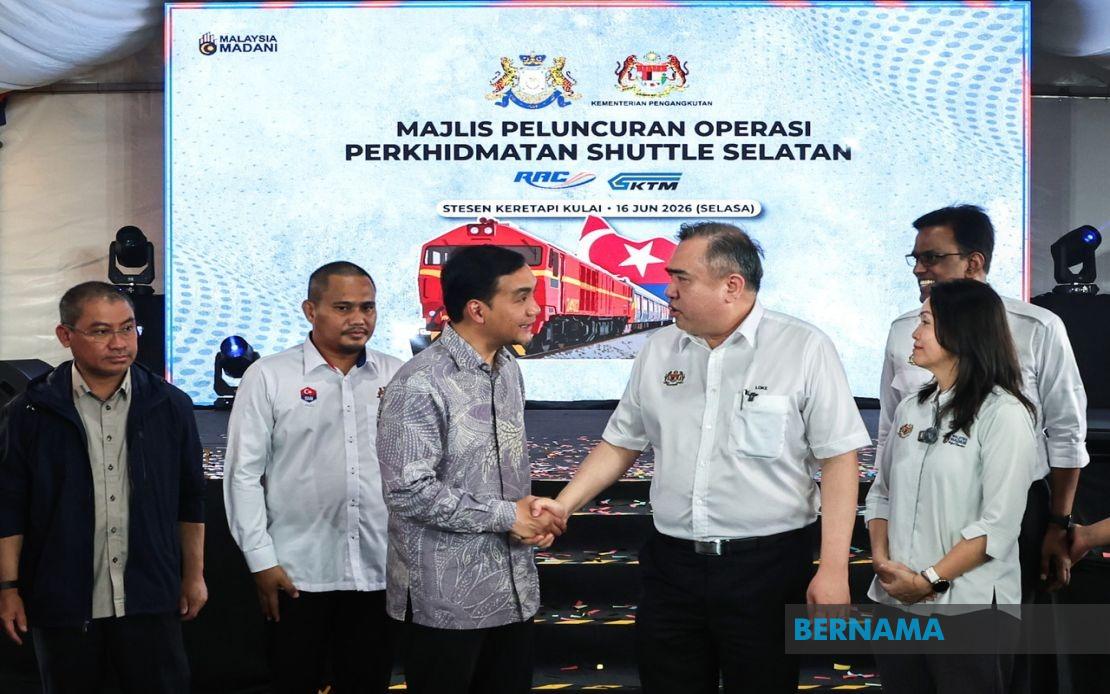
Malaysia's Transport Ministry formally launched the Shuttle Selatan rail service on June 16, inaugurating a new commuter shuttle that will connect three critical economic and residential hubs in Johor state. The service, which began operations linking Kulai, JB Sentral, and Pasir Gudang, represents a significant investment in regional public transport infrastructure and is expected to transform mobility patterns for more than two million people across these areas.
Transport Minister Anthony Loke unveiled the service at Kulai KTM station, flanked by Johor Menteri Besar Datuk Onn Hafiz Ghazi and state officials responsible for public works and infrastructure. The launch marks the culmination of planning efforts aimed at addressing growing congestion and connectivity challenges in one of Malaysia's most economically dynamic regions. The initial phase will operate two primary routes: the circular Kulai-JB Sentral-Kulai corridor and the Kempas Baru-Pasir Gudang-Kempas Baru line, both designed to serve commuters across residential, commercial, and industrial zones.
The service addresses a critical gap in Johor's transport network. Journey times on the new shuttle promise substantial time savings compared to road-based alternatives, with trips from Kulai to the central business district at JB Sentral reduced to approximately 40 minutes, while the Pasir Gudang route operates on a similar timeframe of 40 to 45 minutes. These competitive travel times position the rail shuttle as a viable alternative to private vehicles, particularly for the tens of thousands of daily commuters navigating between these urban centres.
The government has charted an ambitious expansion roadmap for the service, envisioning significant network growth in coming years. Plans include extending the shuttle corridor southward from Paloh through Kulai, with intermediate stops at Kluang, Renggam, and Layang-Layang stations. This extension would substantially increase coverage and tap into industrial communities currently underserved by public transport. Additionally, three new stations are slated for construction at Taman Daya, Bandar Baru Sri Alam, and Pasir Putih, further enhancing accessibility and ensuring that the service reaches a broader cross-section of the population.
Recognising that efficient rail networks depend on seamless first and last-mile connectivity, the ministry has implemented a comprehensive package of supporting measures. Feeder bus services will transport passengers from residential areas to shuttle stations, while coordination with Bas.My—the national bus route planning platform—ensures integrated schedules. A dedicated shuttle service operates from Kempas Baru station, and park-and-ride facilities at AEON Bandar Dato' Onn enable drivers to transition to rail-based travel at key interchange points. These complementary services address a persistent challenge in Malaysian public transport: the difficulty of reaching stations from dispersed residential and commercial locations.
To accelerate adoption during the critical early phase, the government has launched a targeted incentive scheme. The Commuter MADANI Shuttle Selatan Card offers unlimited travel over specified periods, with the RM50 card distributed free to 3,000 Johor residents. The Railway Assets Corporation has allocated over RM150,000 in funding to support this initiative, directly subsidising the transition from personal vehicle use to public transit. This approach acknowledges that behavioural change requires tangible benefits and demonstrates the government's commitment to normalising rail travel among commuters traditionally dependent on motorcycles and cars.
The timing of the launch reflects Johor's accelerating development trajectory. The state has emerged as one of Malaysia's fastest-growing regions, with expanding industrial parks, logistics hubs, port operations, education precincts, and international trade corridors. These economic anchors generate substantial daily commuter flows that existing transport infrastructure struggles to accommodate efficiently. Shuttle Selatan directly supports this growth by strengthening the connectivity web between residential suburbs, city centres, and specialised employment zones, thereby reducing bottlenecks that could otherwise constrain business activity and quality of life.
For Malaysian policymakers and regional observers, Shuttle Selatan exemplifies the strategic shift toward integrated transport planning in high-growth corridors. Rather than viewing public transport in isolation, the project embeds rail investment within a broader mobility ecosystem encompassing bus services, park-and-ride facilities, and digital journey planning. This systems-level approach enhances viability and user experience compared to standalone rail initiatives. The service also demonstrates active coordination between federal transport authorities, state governments, and statutory bodies—a governance model increasingly necessary as Malaysia's urbanisation intensifies.
The service emerged from collaborative efforts spanning the Ministry of Transport, Keretapi Tanah Melayu Berhad (KTMB), and the Railway Assets Corporation. This multi-institutional framework allowed pooling of expertise in rail operations, infrastructure management, and asset oversight. For readers across Southeast Asia, the partnership model offers instructive lessons in structuring public transport development, particularly regarding the division of responsibilities between operational agencies and asset-holding corporations.
The launch also carries broader implications for Malaysia's transport transformation agenda. Johor, as a microcosm of the urbanisation challenges confronting middle-income developing nations, demonstrates that rail-based solutions remain economically and operationally viable when properly targeted and integrated with supporting services. Shuttle Selatan's success metrics over the coming months will likely inform planning decisions elsewhere, particularly in rapidly expanding corridors such as Klang Valley extensions and emerging growth triangles in other states. The free travel card initiative similarly sets a precedent for demand-stimulation strategies that may be adapted in other contexts.
Looking ahead, the planned expansion phases will test the government's capacity to scale success rapidly. Extending service to Paloh via Kluang and Renggam would unlock connectivity for smaller towns currently isolated from major transport networks. The addition of Taman Daya, Bandar Baru Sri Alam, and Pasir Putih stations will embed the shuttle within expanding residential communities, positioning rail transit as foundational infrastructure rather than secondary mobility. These incremental expansions, if executed on schedule, could eventually establish Shuttle Selatan as a transformative regional transport backbone.