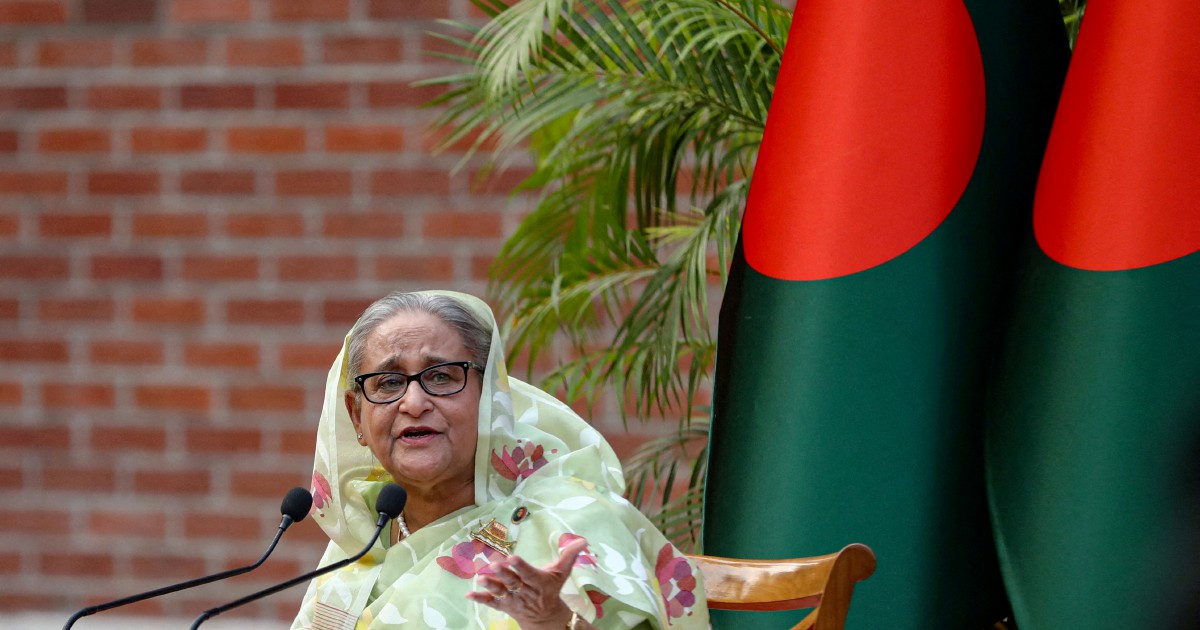
Sheikh Hasina, Bangladesh's ousted Prime Minister, faces imminent incarceration should she attempt to return from her current refuge in India, according to a stark warning issued by a senior government minister on Monday. The pronouncement comes as a direct rebuke to Hasina's recent declaration to Reuters that she intends to depart her Indian sanctuary and present herself for judicial proceedings by December. The collision between the deposed leader's return timeline and the government's explicit threat of detention underscores the deepening political rupture within Bangladesh following the tumultuous events that led to her displacement from power.
The interim administration's warning represents a significant hardening of position against Hasina, who fled Bangladesh in August amid escalating civil unrest and military intervention. Her departure effectively ended her tenure as Prime Minister, a role she had occupied through multiple terms, and thrust the nation into a period of institutional uncertainty. The fact that a high-ranking official would publicly declare an intention to incarcerate a returning former head of state reflects the severity of the charges and grievances the current government harbours against Hasina and signals that any attempt at reconciliation or negotiated settlement appears increasingly distant.
For Malaysian observers and the broader Southeast Asian region, this development carries particular significance given the intricate web of interconnections among South and Southeast Asian democracies. Bangladesh's political instability resonates throughout the region, affecting not merely bilateral relations but also the stability of shared maritime interests, transnational migration patterns, and religious and cultural networks. The treatment of a deposed democratic leader sets precedents that influence how other nations within the region evaluate their own political vulnerabilities and institutional safeguards.
Hasina's stated intention to return voluntarily and face court proceedings suggested a possible path toward domestic reconciliation and the restoration of institutional legitimacy. Her willingness to submit to judicial processes, as she communicated to international media, appeared to offer a face-saving exit strategy that might have preserved some modicum of democratic norms and rule of law. However, the government's categorical rejection of this approach and explicit threat of imprisonment indicates that the current administration has chosen a path of accountability framed not as reconciliation but as retribution, with consequences that could extend far beyond Hasina herself.
The gap between Hasina's expectations and the government's actual intentions reveals a troubling absence of political dialogue and mutual understanding between Bangladesh's fractured leadership factions. The fact that Hasina learned of imprisonment threats through public ministerial statements rather than through formal diplomatic channels or backchannels suggests that conventional mechanisms for resolving high-stakes political disputes have entirely broken down. This communication breakdown underscores the depth of mistrust pervading Bangladesh's political establishment and raises questions about the trajectory of democratic governance in a nation critical to regional stability.
India's role as Hasina's refuge adds another layer of complexity to this situation. Bangladesh-India relations have historically been substantial, encompassing trade, security cooperation, and cultural ties, yet Hasina's presence on Indian soil places New Delhi in a delicate position. While India has consistently afforded political asylum to regional figures facing persecution, hosting an ousted Prime Minister whose return would precipitate a constitutional crisis in a neighbouring democracy creates uncomfortable diplomatic ramifications. The duration of Hasina's stay in India and New Delhi's willingness to continue providing sanctuary may depend on how bilateral relations evolve and whether international pressure mounts for a negotiated resolution.
The charges underlying Hasina's potential imprisonment remain a critical consideration often obscured in coverage of her flight and the government's threats. The interim administration has indicated that Hasina faces allegations ranging from governance failures to potential culpability in deaths occurring during the unrest that precipitated her departure. The legitimacy of these charges and the fairness of any judicial proceedings would significantly influence international perceptions of Bangladesh's adherence to rule of law and democratic principles. Should the government proceed with what appears to be politically motivated prosecution, it risks international isolation and damage to Bangladesh's standing among democracies, particularly given the stakes involved and the global spotlight on how nations treat former heads of state.
The December timeline Hasina mentioned to Reuters appears increasingly unrealistic given the government's unambiguous warning. Unless dramatic political developments occur that alter the calculations of Bangladesh's current leadership, any return attempt would result in immediate detention. This reality forces Hasina into a continuation of indefinite exile, a status that provides neither resolution nor closure for Bangladesh's political wounds. The longer Hasina remains outside Bangladesh, the more entrenched the interim government becomes and the greater the likelihood that reconciliation becomes impossible, replaced instead by cycles of political vendetta that could plague Bangladesh for years.
For Malaysia and other Southeast Asian nations, Bangladesh's current trajectory offers cautionary lessons regarding the importance of maintaining institutional checks on executive power and preserving channels for political dialogue even amid profound disagreement. The absence of mechanisms to manage transitions of power peacefully, or to provide exile arrangements that preserve both the dignity of former leaders and the integrity of successor governments, creates instability that extends beyond individual borders. Bangladesh's experience demonstrates how political polarization, when untempered by institutional safeguards and commitment to democratic norms, can spiral into scenarios where even the prospect of voluntary return and submission to court is rejected in favour of punitive approaches that undermine the legitimacy of the entire judicial system.

