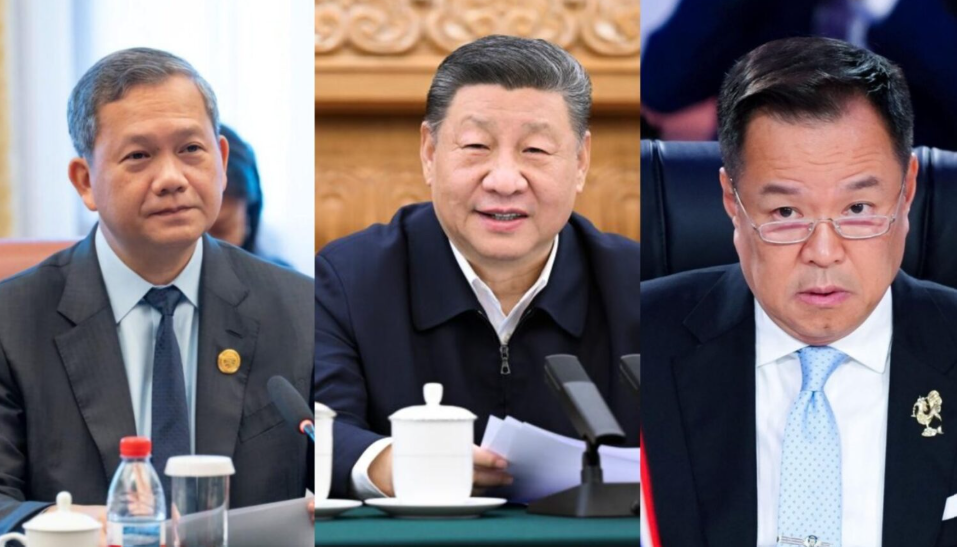
Prime Ministers Hun Manet of Cambodia and Anutin Chanvirakul of Thailand are heading to Shanghai on July 15-17 to attend the opening of the World AI Conference 2026, having been invited by Chinese President Xi Jinping. The visit carries significance beyond the conference agenda, as both leaders are scheduled to hold bilateral meetings with Xi and Chinese Premier Li Qiang—creating a rare diplomatic opening that observers believe could facilitate progress on the contentious border question that has stalled since December.
The composition of each delegation signals serious intent. Manet will be accompanied by Foreign Minister Prak Sokhonn, Defence Minister Tea Seiha, and Sun Chanthol, first vice-chairman of Cambodia's Council for the Development of Cambodia. Thailand's Anutin will bring Foreign Minister Sihasak Phuangketkeow. The inclusion of defence and development officials alongside foreign ministry representatives suggests both governments are preparing for comprehensive discussions on multiple fronts, not merely ceremonial attendance at a technology conference.
Cambodia's official framing emphasises strengthening the relationship with Beijing. The foreign ministry statement described the visit as reflecting "shared commitment between Cambodia and China to deepen their long-standing friendship and promote mutually beneficial cooperation," while pledging to advance the Comprehensive Strategic Partnership of Cooperation and the Diamond Cooperation Framework. This language underscores how Southeast Asian governments, including Cambodia, view their ties with China as foundational to their foreign policy architecture, particularly when facing regional disputes.
Thailand issued similar diplomatic messaging, characterising the visit as an opportunity to "further strengthen the Thailand-China Comprehensive Strategic Cooperative Partnership for the mutual benefit of the two peoples." The parallel formulations suggest Beijing has coordinated expectations with both capitals, framing the Shanghai meeting as part of broader strategic partnerships rather than crisis diplomacy, which could provide diplomatic cover for either side to shift positions without appearing to capitulate.
The backdrop to this summit is the failure of previous attempts at rapprochement. When Manet and Anutin last encountered each other at the third Asean Future Forum in Hanoi in early June, they exchanged handshakes for photographers but conducted no substantive negotiations on their border dispute. That encounter epitomised the stalled nature of bilateral relations—diplomatic theatre without dialogue on the core issue affecting tens of thousands of Cambodian civilians.
Experts believe China possesses considerable leverage to break this deadlock. As a major trading partner for both nations and an increasingly influential player in Southeast Asian geopolitics, Beijing can frame border resolution as essential to regional stability and bilateral cooperation. Kin Phea, director of the International Relations Institute at the Royal Academy of Cambodia, has explicitly called for China to assume a more active arbitration role, arguing that Chinese diplomatic pressure could move both governments toward meaningful negotiations.
However, Phea's analysis also identifies the real obstacle: not civilian government intransigence, but Thailand's military establishment. He contends that Bangkok's armed forces have failed to implement commitments made by their civilian counterparts, instead permitting themselves to continue encroaching on Cambodian territory and occupying areas that should be under Cambodian sovereignty. This structural problem within Thailand's governance—where military actors retain de facto veto power over civilian diplomatic agreements—represents precisely the kind of constraint that external pressure, even from China, struggles to overcome.
The December 2025 Fuxian Consensus, brokered by China itself, established a framework for resolving the dispute through diplomatic channels and international law. That agreement included provisions for Thailand to withdraw troops from occupied territory and return to negotiations through the Joint Boundary Commission. Yet months later, little movement has occurred, suggesting that Beijing's earlier mediation efforts have not translated into compliance, particularly from Bangkok's military structures.
Phea's prescription is blunt: China must enforce respect for the Fuxian Consensus, compelling Thailand to withdraw its forces and return to the negotiating table without further delay. Whether Beijing is willing to risk its relationship with Thailand by applying such pressure remains uncertain. China has long maintained close defence ties with Bangkok and has strategic reasons to maintain Thai cooperation, potentially limiting how forcefully it can advocate for Cambodia's position.
The human cost of continued deadlock is substantial and often overlooked in diplomatic calculations. Approximately 20,000 Cambodian civilians remain unable to return to their homes in areas under Thai occupation. These displaced communities represent not merely statistical victims but constituencies with ongoing grievances and destabilising potential. Prolonged displacement fuels resentment on both sides and makes eventual resolution more difficult, as it entrenches different narratives about who bears responsibility for the status quo.
From a Malaysian perspective, the Cambodia-Thailand impasse carries lessons about the limits of ASEAN's non-interference doctrine and the need for external powers to assist in regional dispute resolution. Malaysia itself has navigated complex maritime boundaries and understands how unresolved territorial questions can fester. The Shanghai summit may signal whether China views resolving this dispute as worth the diplomatic capital required, or whether it prefers maintaining working relationships with both governments over pushing for the contested settlements that conflict resolution demands.
The conference format offers both opportunity and cover. Large multilateral gatherings provide settings where leaders can hold bilateral talks while maintaining deniability about pressure or agreements. If Xi decides to lean heavily on Anutin regarding Thai military compliance, the Shanghai meeting provides an appropriate venue for such conversations. Conversely, if China prioritises smooth relations over pressing uncomfortable issues, the artificial friendliness of a conference setting allows both sides to exchange pleasantries and postpone difficult discussions once again.

