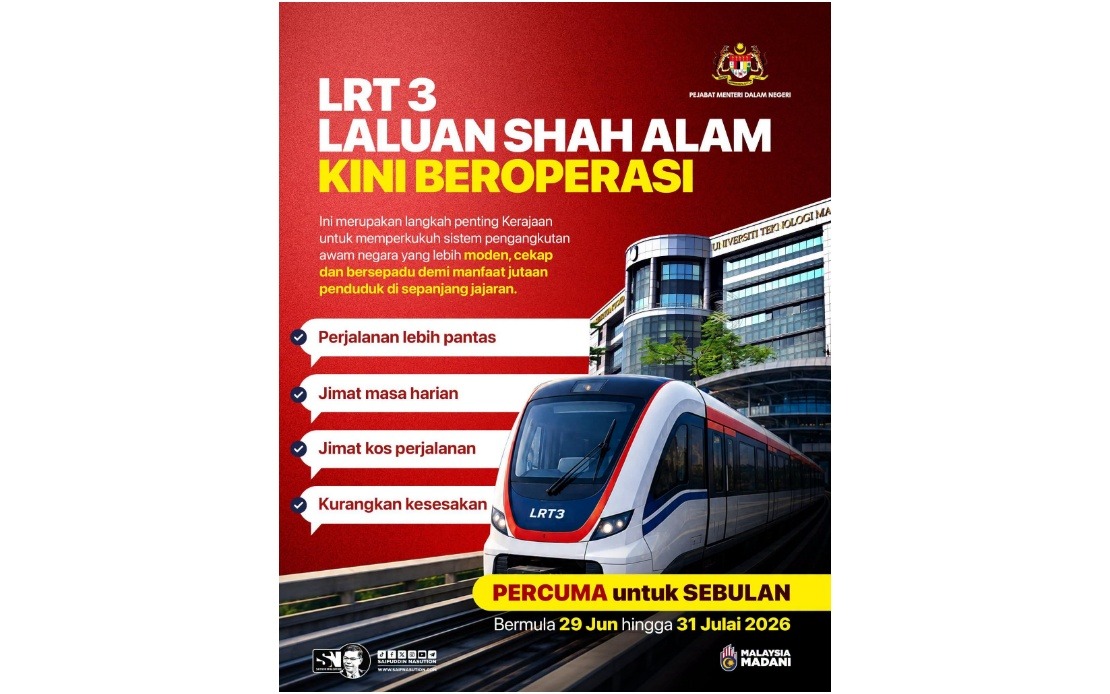
The Shah Alam Line LRT3, which commenced operations last week, represents a significant milestone in the MADANI Government's broader agenda to transform Malaysia's public transport landscape. Home Minister Datuk Seri Saifuddin Nasution Ismail has positioned the new rail corridor as a concrete demonstration of the administration's commitment to delivering efficient, integrated mobility solutions that directly benefit ordinary Malaysians in their daily routines.
Situated along one of the Klang Valley's most congested transport arteries, the LRT3 addresses a longstanding infrastructure gap that has constrained commuter flow throughout the region. The new line fundamentally restructures transport connectivity across Shah Alam, Klang, Subang and surrounding districts, offering residents a practical alternative to car-dependent travel patterns that have defined urban mobility in this area for decades.
The operational scope extends beyond the main rail corridor itself. Prasarana Malaysia Bhd's feeder bus network, specifically designed to complement the LRT3's route geometry, creates a comprehensive first-and-last-mile solution that theoretically enables seamless journeys from residential areas directly to employment hubs, educational facilities and commercial districts. This integrated approach represents a departure from previous piecemeal transport interventions that failed to address connectivity gaps between residential zones and major transport nodes.
Prime Minister Datuk Seri Anwar Ibrahim's decision to implement complimentary travel throughout June and July functions as both a promotional mechanism and a consumer behaviour experiment. The zero-fare promotional window, extending from June 29 through July 31, removes the financial disincentive that historically prevented adoption of public transport among price-sensitive commuters, particularly low-income workers and students. By temporarily eliminating ticket costs for both the main LRT service and affiliated bus operations, the government creates an extended trial period that allows potential users to assess convenience, reliability and actual time savings without economic risk.
The strategic thinking underlying this approach reflects deeper recognition that infrastructure investment alone does not guarantee behavioural transformation. Simply constructing modern rail corridors does not automatically convert car-dependent populations into public transport users. The promotional period effectively functions as a scaled pilot programme, enabling tens of thousands of commuters to develop experiential familiarity with the system, discover optimal routes for their specific destinations, and potentially establish sustained usage patterns beyond the promotional window.
Minister Saifuddin's public exhortation for residents to temporarily abandon personal vehicles speaks to persistent cultural preferences for private transportation that have embedded themselves throughout Malaysian urban centres. The appeal to try the service repeatedly, with the aspirational invocation of religious assurance (insya-Allah), suggests acknowledgment that initial user resistance remains a significant implementation challenge. The rhetorical strategy emphasises personal agency—the choice to experiment—rather than prescriptive mandates or punitive congestion pricing that might provoke political backlash.
From a regional perspective, the LRT3 completion positions Malaysia alongside other major Southeast Asian economies pursuing rapid metro expansion. Jakarta's MRT network, Bangkok's Skytrain and BTS systems, and Singapore's comprehensive metro infrastructure have demonstrated that rail-based urban transport can substantially reduce congestion, lower per-capita commuting costs and enhance quality of life measurably. The Klang Valley's status as Malaysia's economic engine demanded equivalent investment, and the LRT3 represents overdue infrastructure catch-up in a region that generates disproportionate national GDP and labour force participation.
The project's completion also carries implications for Malaysia's climate commitments and urban sustainability objectives. Public transport mode shift directly reduces vehicle emissions per commuter and decreases aggregate fuel consumption across the metropolitan region. With transport accounting for approximately one-quarter of Malaysia's overall carbon emissions, infrastructure investments enabling modal substitution from private vehicles to rail transit contribute substantively to national climate targets and air quality improvement, particularly across the Klang Valley which experiences recurring transboundary haze during seasonal conditions.
Beyond the immediate promotional period, the success of the LRT3 hinges on pricing architecture once the complimentary phase concludes. Tariff structures must balance financial sustainability for Prasarana with affordability thresholds that maintain commuter patronage. Premium pricing that undercuts private vehicle operating costs (fuel, parking, insurance, maintenance) creates logical economic incentives for modal shift. However, tariffs positioned at accessibility levels that exclude lower-income segments would underscore equity concerns and limit the system's social benefit realisation.
The integration narrative advanced by Saifuddin also warrants scrutiny regarding actual ground-level coordination between LRT operations and feeder bus scheduling, particularly regarding headways, transfer times and frequency alignment. Genuinely integrated systems require sophisticated real-time coordination that Malaysian operators have historically struggled to implement effectively. Technological barriers to seamless transfers, unreliable connection timing and poor information dissemination have undermined theoretical system efficiency in existing networks, suggesting that realising the LRT3's promised benefits demands sustained operational excellence beyond initial launch enthusiasm.
The government's investment calculus reflects broader Southeast Asian urbanisation dynamics and growing political salience of urban quality-of-life issues among middle-income voter cohorts who experience daily congestion costs. The MADANI administration's positioning of the LRT3 as central to governance legitimacy signals recognition that visible infrastructure delivery translates to electoral support among metropolitan populations. The public relations emphasis on the government's commitment, however, should not obscure underlying implementation uncertainties regarding sustained ridership, operational reliability and financial viability that will ultimately determine whether the LRT3 functions as transformative infrastructure or remains underutilised despite technical modernity.

