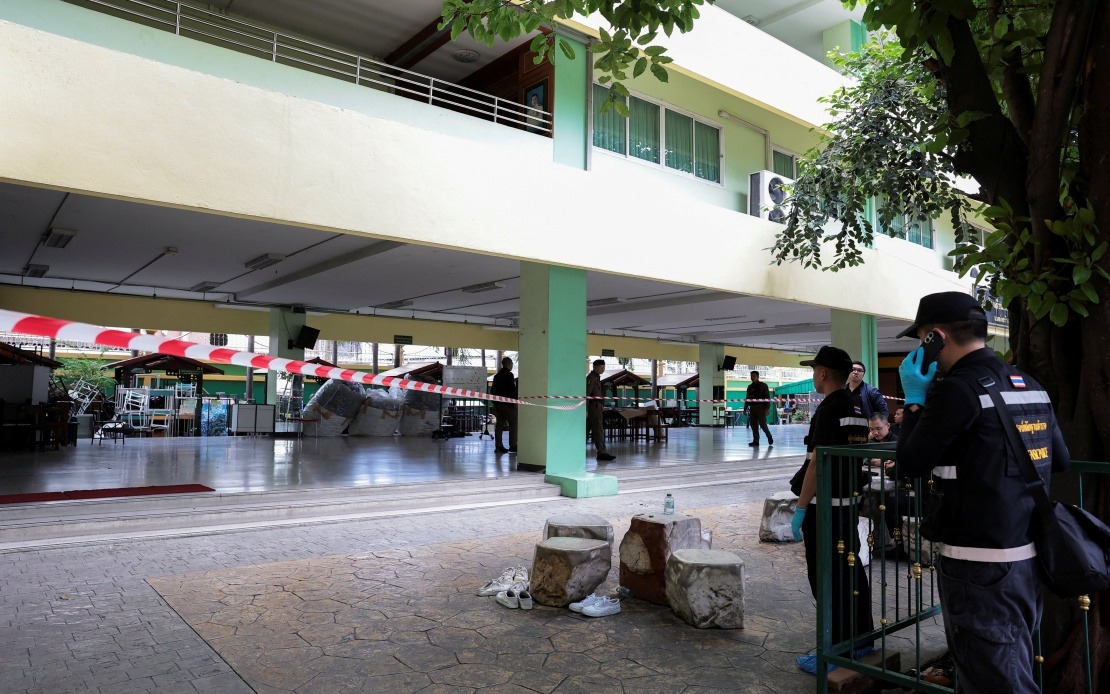
A devastating shooting at a school northwest of Bangkok has claimed seven lives, prompting immediate questions about gun control in Thailand and renewing concerns about school safety across Southeast Asia. The incident unfolded at Debsirin Nonthaburi School in Bang Kruai district on Friday morning at approximately 10 am, when a student of the school discharged a 9mm handgun inside the premises. The fatalities comprised three teachers, three students, and the shooter himself, according to Lieutenant General Trairong Piwpan, the Royal Thai Police deputy inspector-general and spokesperson. The attack left a further 15 people hospitalized, with two in serious condition, marking one of Thailand's deadliest school incidents in recent memory.
Investigations immediately revealed that the weapon used in the shooting belonged to the suspect's grandfather rather than the perpetrator himself. Police recovered the 9mm handgun and 34 rounds of ammunition at the scene, establishing a crucial detail about how the student gained access to the firearm. The discovery has prompted scrutiny of firearm storage practices among gun owners in Thailand and whether adequate safeguards exist to prevent unauthorized access by family members, particularly younger individuals. Such details matter considerably given that Thailand maintains a substantial civilian gun ownership base despite government restrictions, making questions of secure storage and household access particularly relevant.
The immediate response to the tragedy involved the evacuation of the entire school population to nearby Chanrat Wittaya School for their safety and protection. Teachers and administrative staff coordinated the movement of students while police cordoned off the affected area and began their investigation. Parents and guardians rushed to the school, creating scenes of chaos and distress as families sought to locate and collect their children. The evacuation protocol, while executed promptly, underscored the vulnerability of educational institutions to such violence and the trauma inflicted not merely on direct victims but on entire school communities.
Recognizing the psychological impact on survivors and first responders, Thailand's national police chief issued immediate orders for the Police General Hospital to deploy psychologists to provide counselling and support services. This acknowledgment of the mental health dimensions of mass violence represents an important step in crisis management, as the emotional toll of such incidents extends far beyond physical injury. Students and staff who witnessed the shooting face potential long-term psychological consequences, making professional mental health intervention a critical component of the recovery process.
Prime Minister Anutin Charnvirakul, who simultaneously holds the interior ministry portfolio, responded to the incident with expressions of sadness and condolence to affected families. He directed relevant government authorities to provide urgent assistance to the wounded and maintain a governmental presence at the scene throughout the unfolding crisis. More significantly, Anutin drew a direct connection between the shooting and the government's controversial decision not to renew permits for civilian firearms possession and carrying. This statement positioned the tragedy as validation for stricter gun control measures, though the complexity of Thailand's gun culture and the widespread circulation of firearms suggest that permit renewal policies represent only one dimension of a multifaceted problem.
The shooting occurs against a troubling backdrop of recurring school violence in Thailand. Less than six months prior, in February, an 18-year-old gunman opened fire at a school in Hat Yai, located in Songkhla province in southern Thailand. That incident claimed the life of the school director and wounded numerous others before authorities apprehended the shooter. The rapid recurrence of school shootings within such a compressed timeframe raises serious questions about underlying social factors, mental health support systems, and the effectiveness of existing preventative measures. For Malaysian observers and policymakers, the Thai experience serves as a cautionary example of how school safety cannot be assumed even in neighboring nations with similar regional contexts.
Thailand's approach to firearm regulation has long grappled with a tension between civilian ownership rights and public safety imperatives. The kingdom maintains a substantial population of registered gun owners, reflecting deep-rooted cultural attitudes toward personal protection and sporting traditions. However, instances of uncontrolled access to firearms by unauthorized individuals, particularly youth, suggest significant gaps in enforcement and household security practices. The government's position on not renewing firearm permits represents an effort to tighten controls without undertaking the politically contentious step of confiscation or wholesale prohibition.
For Southeast Asian nations including Malaysia, the Thai school shooting carries important implications regarding educational security preparedness and crisis response frameworks. Malaysian schools, while generally buffered by different legal frameworks governing firearm ownership, nonetheless face potential threats from unauthorized weapons or other means of violence. The incident demonstrates that comprehensive school safety strategies must encompass not merely physical security infrastructure but also psychological support systems, inter-agency coordination, and community engagement. The speed with which Thai authorities deployed psychologists and coordinated evacuation procedures offers lessons in crisis management responsiveness.
The broader regional context reveals that school violence, though less frequent in Southeast Asia than in some Western nations, represents an emerging concern requiring sustained attention. Malaysia, Thailand, and neighboring countries face the challenge of protecting educational institutions while preserving the open, accessible nature essential to their functioning. This balance requires multifaceted approaches encompassing teacher training, student mental health services, parental engagement, and careful firearm regulation. The Thai incident underscores that no nation in the region can regard itself as immune to such tragedies, necessitating proactive rather than reactive policy development.

