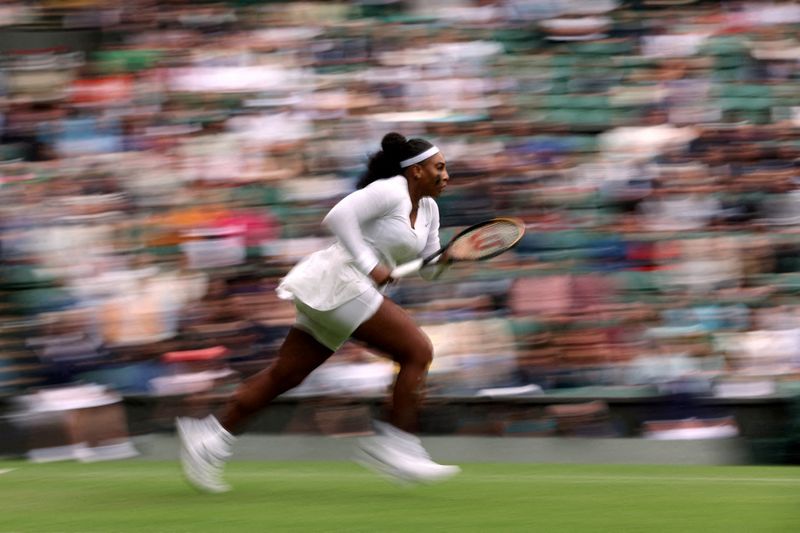
When Serena Williams steps onto Centre Court next week, she will command every headline at Wimbledon. The American legend's return to competitive singles after a four-year hiatus transforms what was already shaping into a compelling women's championship into an unmissable global sporting spectacle. Her presence alone, at 44 years old and as a 23-time Grand Slam singles champion, guarantees television ratings will spike and social media will overflow with commentary. Yet beyond the nostalgia and human-interest narrative lies a genuinely intriguing sporting question: can Williams make an immediate impact, or will her extended absence prove too steep a mountain to climb?
Williams was handed the eighth and final wildcard by Wimbledon organisers, granting her entry into the draw without having to compete in qualifying rounds. Her last competitive singles match came at the 2022 U.S. Open, making her comeback precisely four years later. The timing and location feel deliberate rather than random. Wimbledon holds profound significance in Williams' career, having won seven singles titles there—more than at any other Grand Slam venue. The grass courts where she once dominated represent both sentimental ground and familiar terrain, even if her body has changed dramatically in the interim.
The logistical groundwork for her return began months ago, long before official announcement. Williams re-entered the anti-doping pool in December, signalling serious intent. She has shed approximately 20 pounds through weight-loss medication and has been training rigorously alongside coach Rennae Stubbs. Her doubles appearance at Queen's Club offered a tantalising glimpse of her readiness, with her legendary 120-mile-per-hour serve—arguably the most devastating weapon in women's tennis history—still intact and her baseline power seemingly undiminished by time. Yet doubles and singles represent vastly different physical and mental demands, particularly on grass where players face relentless movement and explosive positioning requirements.
Former world number one Andy Roddick captured the audacity of Williams' decision in candid terms. Most players returning after such an extended absence would schedule multiple preparatory tournaments to rebuild match fitness and confidence. Instead, Williams chose Wimbledon as her re-entry point—a decision that speaks to either remarkable self-belief or calculated recognition that the prestige and competitive standards of the championship justify the gamble. Roddick noted that such confidence would have eluded him entirely during his playing career, highlighting how Williams' championship mentality transcends typical professional athlete psychology.
Fellow American Grand Slam champion Lindsay Davenport offered a more measured perspective to the BBC, suggesting that Williams would not have chosen this path unless convinced of her capacity for meaningful competitive impact. Davenport emphasized that grass presents particular challenges for returning players. The surface produces rapid, low-bouncing balls that demand intense physical exertion and precise timing. Age compounds these demands substantially. Navratilova's victory at 47 in 2004 provides rare precedent, though that achievement occurred on a different surface and against weaker competition than today's tennis landscape presents. Nevertheless, Davenport acknowledged that if anyone possessed the skill, experience, and mental fortitude to navigate these obstacles, Williams represented the strongest possible candidate.
The women's draw itself remains genuinely unpredictable, which contextualizes Williams' arrival differently than if the championship had clearly solidified around a dominant favourite. World number one Aryna Sabalenka crashed unexpectedly in the French Open quarter-finals, losing 10 consecutive games in her collapse against an opponent she should have defeated comfortably. Her Berlin preparation proved equally chaotic, surrendering a deciding set 6-0 to Jessica Pegula. Sabalenka wears her emotions visibly on court, and her emotional instability at crucial moments represents both a defining characteristic and persistent vulnerability. Wimbledon's pressure-cooker atmosphere could expose these weaknesses further, particularly if she advances deep into the tournament.
Poland's Iga Swiatek carries the distinct burden of attempting to become the first player since Williams in 2016 to capture consecutive Wimbledon titles. This represents an enormous mountain given modern tennis' competitive distribution. Coco Gauff continues her quest to finally master grass-court tennis despite multiple attempts and undeniable baseline talent. Elena Rybakina, the 2022 champion, possesses an understated yet extraordinarily potent power game that could resurface at any moment. Emma Raducanu, the British hope, rides a wave of home support and recent resurgence but remains unproven at this level. Mirra Andreeva, the 19-year-old Russian sensation who became the youngest French Open champion in 34 years, brings audacious shotmaking to the pristine lawns but limited grass-court experience.
In this fragmented championship landscape, Williams' unpredictability becomes dangerous to her potential opponents in unexpected ways. Sabalenka, should she face Williams, encounters a no-win scenario. Defeating a 44-year-old returning from four years away generates minimal credit or acclaim. Losing to such an opponent produces crushing reputational damage. Former champions and current challengers would similarly find themselves trapped between contrasting narratives. A victory over Williams means little; a defeat becomes a story of monumental proportions. This psychological dynamic favours Williams substantially, gifting her an intangible advantage that statistics and rankings cannot fully capture.
The statistical reality underpinning women's tennis since Williams' 2016 victory reinforces just how open the championship has become. Eight first-time Wimbledon champions have emerged in the decade following her last title. Players including Osaka, Gauff, Swiatek, and Barty have accumulated multiple Grand Slam crowns without achieving the dominance that characterized Williams' prime. The last six Grand Slams have been won by six different players, illustrating how thoroughly competitive depth has expanded and how elusive sustained excellence has become. Williams once represented the gravitational force around which women's tennis orbited; now, the draw looks genuinely balanced between multiple capable contenders.
Williams' return adds an entirely different dimension to this competitive landscape. Television networks will dedicate resources to her matches disproportionate to her ranking or seeding. Global audiences who abandoned women's tennis during her absence will tune in specifically to witness her comeback. Younger players, some of whom grew up watching Williams define tennis excellence, will suddenly face her across the net. The emotional resonance of a living legend attempting to recapture former glory transcends sports into cultural phenomenon territory. For Malaysian and Southeast Asian audiences, Williams' presence reinvigorates interest in a championship that might otherwise have received passing attention during a crowded sporting calendar.
The immediate narrative focuses on whether Williams can simply win a first-round match, an accomplishment that would mark her as the oldest woman to achieve this feat at Wimbledon since Navratilova in 2004. Yet the deeper storyline concerns whether her presence reshapes the championship trajectory itself. The psychological burden of facing Williams—even in diminished form—could influence other competitors' performance levels, potentially producing unexpected upsets and storylines throughout the draw. Her comeback represents more than a personal sporting resurrection; it recalibrates how the entire championship functions, transforms viewer engagement patterns, and generates narrative momentum that transcends conventional competitive analysis.
Williams' decision to return at Wimbledon, on grass, at 44, after four years away, paradoxically makes perfect sense despite appearing reckless on surface inspection. The championship's prestige, her emotional connection to the venue, the global audience attention, and her demonstrated confidence all coalesce to create a compelling sporting gamble. Whether she succeeds or falls in early rounds, her presence fundamentally alters the championship's character. The women's draw, already wide-open and unpredictable, now contains an element of genuine surprise that ranking lists and tournament seeding cannot fully encapsulate. Wimbledon has found its storyline.

