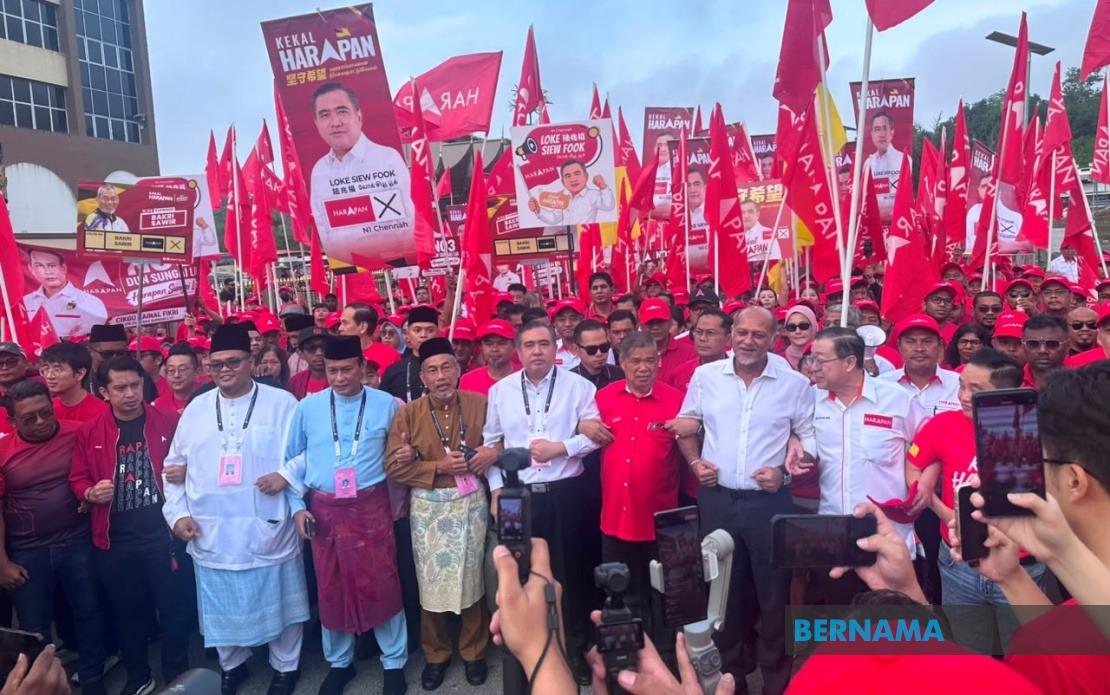
A show of organisational strength and leadership cohesion marked Pakatan Harapan's nomination day in Negeri Sembilan on July 18, with cabinet ministers and party chiefs fanning across the state to personally shepherd their candidates through the submission process. The visible deployment of heavyweight figures underscored the coalition's determination to retain control of the legislature in a crucial mid-tier state, where PH holds a comfortable but not insurmountable majority heading into the August 1 polls.
At the Dewan Besar Kuala Klawang nomination centre in Jelebu, Transport Minister Anthony Loke took centre stage as he filed papers for the Chennah state seat. The DAP secretary-general's appearance was bolstered by the presence of his party chairman Gobind Singh Deo, alongside veteran politician Lim Guan Eng, who carries significant symbolic weight within the coalition. Amanah president Mohamad Sabu's attendance further illustrated the cross-party unity that underpins PH's regional strategy, with the three-component coalition presenting a united front at a critical political juncture.
The nomination process revealed distinct patterns in how PH approached different constituencies. In Jempol district, Deputy Communications Minister Teo Nie Ching accompanied Teo Kok Seong as he filed nomination papers for the Bahau state seat, with Communications Minister Fahmi Fadzil orchestrating support for a broader slate of four candidates across Serting, Palong, Jeram Padang and Bahau. Teo Kok Seong carries the advantage of incumbency from the previous election, a significant asset in rural constituencies where name recognition and established ground networks matter considerably. The other three candidates—Yaacob Mahmood, Muhammad Zahin Zinal Abidin and Manivanan Gowin—represent fresh blood that PH hopes will energise newer voter segments.
Menteri Besar Aminuddin Harun's personal involvement in the nomination process at Port Dickson underscored the stakes for the coalition. As Negeri Sembilan PH chairman contesting the Linggi seat, his presence carried symbolic weight beyond routine procedural support. He was flanked by DAP deputy secretary-general Hannah Yeoh, PKR secretary-general Fuziah Salleh, and the Prime Minister's political secretary Farhan Fauzi—a constellation of power that signalled this was no ordinary nomination exercise but a carefully orchestrated demonstration of coalition backing. Three incumbent members—Yew Boon Lye in Chuah, Choo Ken Hwa in Lukut, and G Rajassekaran defending Sri Tanjung—were among those filing at the same venue, suggesting a strategic clustering of PH's established representatives.
The Seremban nomination centre hosted yet another significant gathering, where Entrepreneur and Cooperatives Development Minister Steven Sim facilitated the filing of six PH candidates. The attendance of Selangor State Legislative Assembly Speaker Lau Weng San, Bukit Gelugor MP Ramkarpal Singh, and PKR vice-president R. Ramanan illustrated how PH was drawing leadership from across Peninsular Malaysia to bolster the state campaign. This cross-state mobilisation reflects the coalition's recognition that state elections increasingly carry implications beyond local politics, with victories or defeats in regional strongholds affecting national momentum.
For Malaysian political observers, the visible orchestration of leadership support carries multiple messages. Internally, it signals that PH maintains disciplined party structures capable of coordinating complex logistics across several constituencies simultaneously. Externally, the parade of ministers and senior figures projects an image of a coalition confident in its candidates and unafraid of public scrutiny. In Negeri Sembilan specifically, where BN retained 14 seats and PN secured five in the 2023 election against PH's 17, such demonstrations become tools for consolidating support among wavering voters who might be tempted to switch sides.
The political context surrounding this nomination exercise cannot be overlooked. The Negeri Sembilan State Legislative Assembly was dissolved on June 5 following consent from Yang Dipertuan Besar Tuanku Muhriz Tuanku Munawir, setting the stage for what amounts to a confidence vote in PH's stewardship of the state. The coalition's majority, while clear, is not overwhelming—a loss of just three seats would eliminate its control, a mathematical reality that likely influenced the decision to deploy such extensive leadership presence during nominations. Early voting on July 28 and the main polling on August 1 will determine whether this calculated show of strength translates into electoral success.
The nomination day spectacle also reveals broader patterns within PH's approach to managing its three-party coalition. DAP's representation across multiple nomination centres reflects its continued electoral dominance within PH, particularly in urban and semi-urban constituencies. PKR's presence, though less numerically prominent in the visible coverage, includes positioning party officials at key venues, maintaining its claim as the coalition anchor. Amanah's involvement, particularly through its president's appearance in Jelebu, ensures the smaller component party maintains relevant visibility despite its reduced parliamentary footprint nationally.
For Negeri Sembilan voters, the nomination day gatherings offer practical insight into how the state government machinery functions. The presence of the Menteri Besar, multiple ministers, and parliamentary figures illustrates the depth of resources that a ruling coalition can mobilise in pursuit of electoral objectives. Whether such deployment translates into tangible benefits—better governance, infrastructure development, or economic opportunities—remains a calculation voters must undertake when they cast ballots in early August. PH's leadership clearly believes that visible backing for candidates, combined with the representation of sitting ministers and senior party figures, provides sufficient confidence and momentum to retain control.
The nomination process in Negeri Sembilan ultimately served as a microcosm of PH's current positioning within Malaysian politics. Having gained power nationally through the 2022 coalition formation that displaced Ismail Sabri Yaakob's BN government, the coalition has since experienced both consolidation and pressure, with various state-level contests testing its resilience. Negeri Sembilan, as a mid-ranking state without the economic or political dominance of Selangor or Penang but still significant enough to affect national narratives, represents exactly the terrain where coalition cohesion and candidate quality become decisive factors. The August 1 election will reveal whether the carefully orchestrated displays of leadership unity and organisational capability translate into sustained electoral support.

