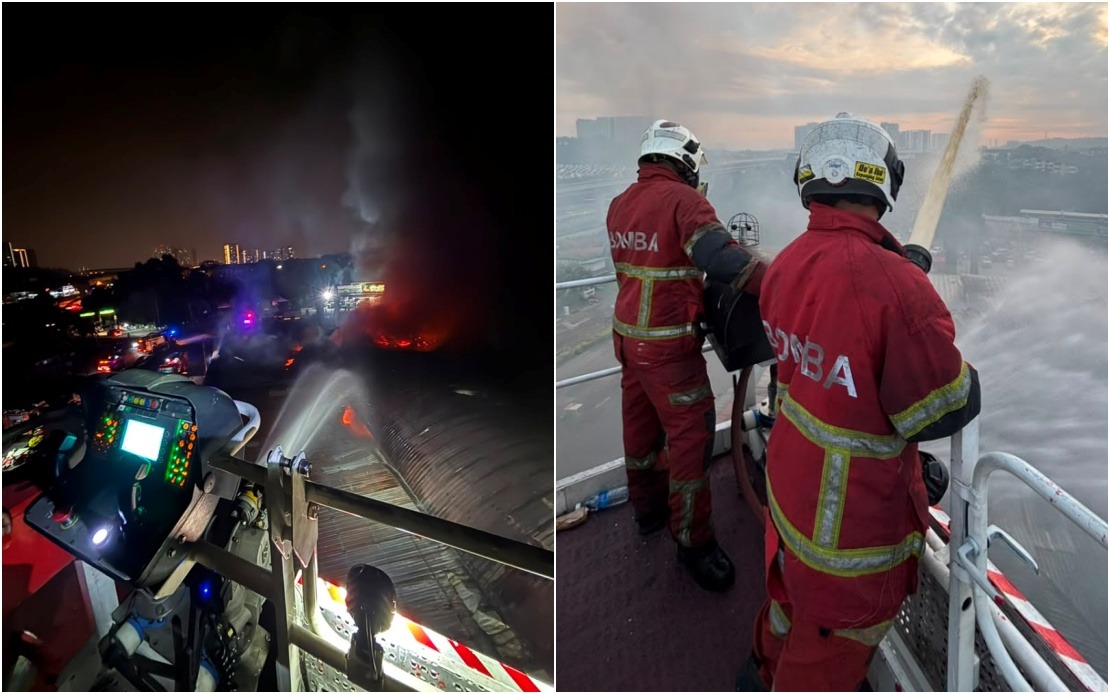
The Selangor Wholesale Market in Serdang resumed normal operations on July 24 following a major fire that engulfed three retail premises during the early hours of the previous evening, according to officials managing the facility. Despite the intensity of the blaze, which required extensive firefighting efforts, the incident did not cascade into a broader disruption across the sprawling wholesale hub, which continues to serve as a vital commercial hub for produce and consumer goods distribution across the Klang Valley region.
Datuk Izham Hashim, who chairs the Selangor Agriculture Committee, confirmed that the market operated without interruption after the fire was extinguished. Speaking to journalists at the site, he noted that all remaining retail units across the market reopened normally, maintaining the steady flow of wholesalers and traders who depend on the facility for their daily commerce. The three destroyed shoplots comprised a kitchenware retailer, an egg wholesaling operation, and a hardware merchant, representing a cross-section of the goods typically traded at the facility managed by the Selangor Agricultural Development Corporation (PKPS).
The fire itself presented a significant challenge to emergency responders, who arrived to find flames spreading with considerable velocity across the wooden structures characteristic of many older wholesale markets in Malaysia. The Selangor Fire and Rescue Department (JBPM) deployed 68 personnel to the scene after the blaze erupted around 11 pm on July 23. Assisted by volunteer firefighters, police units, and personnel from Subang Jaya City Council (MBSJ), they managed to bring the situation under control by 6.20 am the following morning, though the effort consumed more than seven hours of continuous firefighting operations.
Lee Chee Leong, 42, who operated the kitchenware shop for the past 18 years, recounted the speed with which the disaster unfolded. He received notification of the fire from one of his employees around the time it ignited and travelled to the market within approximately 20 minutes. Upon arrival, however, the intensity of the flames had already rendered any salvage operation impossible, with the fire having achieved such headway that entry to the premises became too dangerous to attempt. Lee estimated his personal losses at several million ringgit, representing an accumulation of nearly two decades of business investment in inventory and fixtures.
The rapid spread of the fire underscores persistent concerns about safety infrastructure at older wholesale markets throughout Malaysia, many of which were constructed decades ago with building codes and fire safety provisions that fall significantly short of contemporary standards. These facilities, while economically vital to their respective regions, often feature narrow access roads, wooden construction materials, and limited modern fire suppression systems. The incident at Serdang therefore carries broader implications for the vulnerability of similar commercial markets across the country to catastrophic losses.
Fortunately, the incident resulted in no fatalities or injuries, a outcome that officials attributed to the rapid response of emergency services and the absence of residents sleeping on the premises at the time of the fire. Ashrul Riezal Asbar, assistant director of the Selangor JBPM Operations Division, indicated that forensic investigations into the cause would require approximately 14 days to complete and deliver a formal report. Until those findings are released, the precise origins of the blaze remain undetermined, though preliminary observations suggest the fire originated within one of the affected shoplots before spreading to adjacent structures.
The incident has accelerated discussion around the modernisation agenda for the Selangor Wholesale Market, which PKPS has been preparing for redevelopment. Datuk Izham revealed that state government planning for a comprehensive replacement facility has reached an advanced stage, with construction anticipated to commence in the first quarter of 2025. The new market will take the form of a modern supermarket-style operation rather than a traditional open-air wholesale facility, representing a significant departure from the current layout and management approach.
This redevelopment project carries substantial strategic importance for Selangor's agricultural sector and broader food distribution networks. The existing facility, described as the largest wholesale market under PKPS management, struggles with congestion, inefficient logistics, and structural inadequacies that increasingly constrain commerce in a rapidly modernising state economy. The planned replacement addresses these constraints through centralised business infrastructure designed to accommodate significantly higher transaction volumes while simultaneously improving operational efficiency through contemporary logistics systems.
Crucially, the new facility will incorporate building safety standards and fire prevention measures that far exceed the provisions of the current market. Modern sprinkler systems, fire detection networks, improved electrical installation standards, and better-designed evacuation routes represent investments that could prevent similar catastrophic incidents. Such upgrades also position the new market to comply with increasingly stringent building codes and safety regulations that Malaysian authorities have progressively strengthened in recent years in response to repeated warehouse and commercial fires across the country.
The broader economic impact of the fire remains contained, as the market's ability to continue operations prevents disruption to supply chains for perishable goods and other wholesale commodities that depend on consistent throughput across the Klang Valley region. For traders and wholesalers, the continuity of operations at the facility ensures that their businesses remain uninterrupted despite the losses suffered by the three destroyed premises. However, the incident serves as a stark reminder of the risks inherent in ageing commercial infrastructure and the urgent need for systematic modernisation of wholesale and market facilities throughout the country.
Looking forward, the timeline for the new facility's completion will be closely monitored by stakeholders across Selangor's agricultural and wholesale sectors. The transition from the existing market to the modern replacement presents both challenges and opportunities, requiring careful coordination to maintain operational continuity whilst simultaneously implementing the infrastructure improvements that the incident has highlighted as necessary. For Lee Chee Leong and other affected proprietors, the compensation process and opportunities to relocate to the new facility will shape their capacity to rebuild their enterprises and continue participation in the wholesale market ecosystem that has sustained their livelihoods.

