Residents of Selangor face a growing threat from online scammers impersonating the state government to trick people into clicking malicious links related to the KitaSelangor Voucher incentive programme. The Selangor State Secretary's Office issued an urgent advisory on June 16, urging the public to exercise caution when receiving unsolicited SMS messages or communications purporting to be from government sources about the assistance scheme.
The timing of this warning reflects a broader pattern of digital fraud targeting government assistance programmes across Malaysia. As the public anticipates the rollout of substantial cash aid, opportunistic criminals are already attempting to exploit the programme's popularity by sending fake notifications designed to harvest personal data or direct victims to phishing websites. The state government's proactive alert signals its recognition of this vulnerability and commitment to protecting beneficiaries before the scheme officially launches.
Crucially, the Selangor State Secretary's Office clarified that formal applications for the KitaSelangor Voucher Programme have not yet opened to the public. This distinction matters significantly because scammers often create artificial urgency by claiming that registration windows are closing or that people must act immediately to secure benefits. By establishing a clear official timeline, the state government provides residents with a reliable reference point to identify fraudulent communications. The statement emphasized that citizens should obtain all information exclusively through authorised government channels and resist pressure to click links from unverified sources.
The legitimate rollout of KitaSelangor Voucher notifications will commence in phases starting June 23, according to the state government's official schedule. During this phase, eligible recipients will receive SMS messages inviting them to verify their personal details and formally apply through the dedicated KitaSelangor Voucher Portal, accompanied by required supporting documentation. This methodical, staged approach allows authorities to maintain control over the distribution process and helps residents distinguish genuine government communications from fraudulent imitations. The state government advised the public to await the official June 22 announcement before taking any action related to the programme.
The assistance programme targets specific vulnerable populations identified through comprehensive government data and records supplied by relevant agencies. Eligible beneficiaries include households registered in the eKasih database, individuals who have lost employment, persons classified as vulnerable and registered with the Social Welfare Department, and single mothers meeting the stipulated eligibility criteria. This targeted approach reflects the state government's intention to direct limited resources toward those facing the most acute financial hardship, rather than implementing a universal distribution scheme.
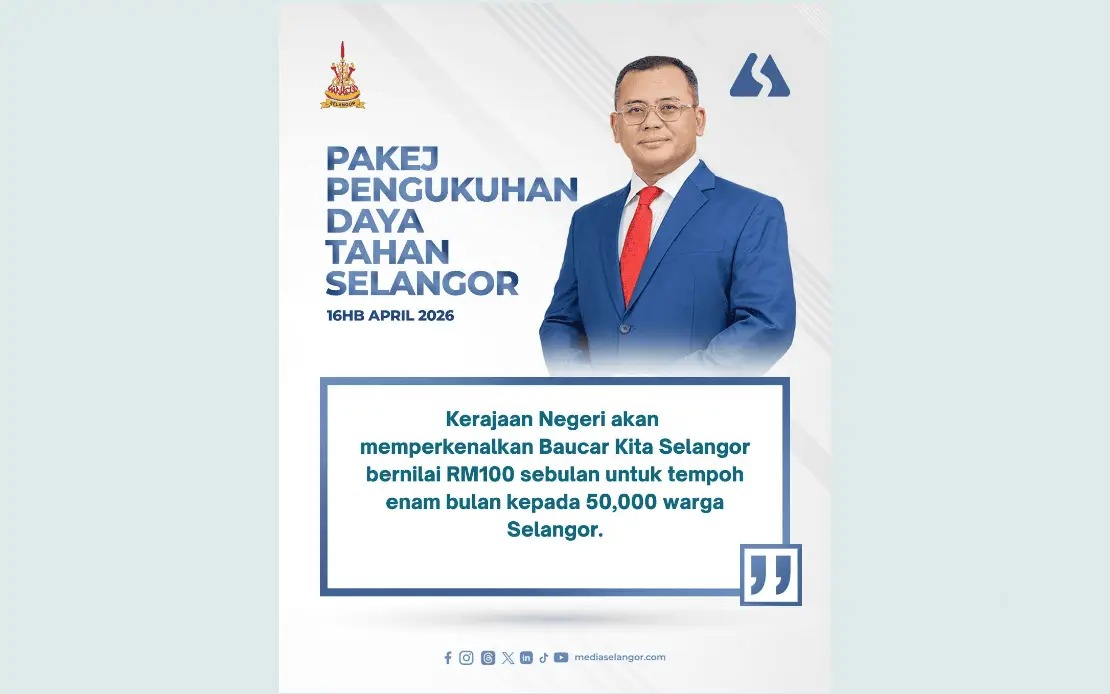
Menuteri Besar Datuk Seri Amirudin Shari announced that approximately 50,000 low-income families across Selangor will receive monthly cash assistance of RM100 for half a year through the KitaSelangor Voucher initiative. The programme commences on June 30 as a key component of the RM140 million Selangor Resilience Strengthening Package Phase 1, which the state government unveiled in April to address mounting economic pressures facing residents. The package reflects growing acknowledgement of how global economic volatility, escalating cost of living, and international supply chain disruptions have created financial stress for ordinary households throughout the state and the region.
For Malaysian readers, the KitaSelangor Voucher represents a meaningful form of targeted poverty relief that directly supplements household incomes during an economically turbulent period. The RM600 total disbursement per family, while modest, provides meaningful relief to households struggling with rent, utilities, and food costs. The programme's design—focusing on measurable assistance rather than vague promises—demonstrates a practical approach to state-level economic support that may influence policy discussions in other Malaysian states considering similar initiatives.
The prevalence of SMS-based fraud targeting government benefit schemes underscores a critical vulnerability in how public services communicate with citizens. Scammers exploit the fact that government assistance programmes generate legitimate excitement and urgency among eligible recipients, making people less cautious about verifying sender authenticity. Selangor residents should adopt a simple verification strategy: any message requesting immediate action or personal information should be independently verified by contacting government offices directly through official telephone numbers or websites rather than using contact details provided in suspicious messages.
The cyber threat to government assistance programmes extends beyond individual financial loss. When people fall victim to scams, they may suffer identity theft, fraudulent account access, or drain on their limited savings—consequences that compound existing financial vulnerability. Moreover, widespread fraud incidents can erode public trust in government digital initiatives and discourage people from accessing legitimate benefits they are entitled to receive. The state government's proactive communication strategy aims to prevent these cascading harms by establishing clear boundaries between genuine and fraudulent communications.
Residents should note that official government communications about the KitaSelangor Voucher will explicitly direct them to the dedicated portal, spell out precise eligibility criteria, and never pressure recipients into immediate action. Scammers typically employ psychological manipulation—creating false deadlines, threatening account closure, or offering unrealistic benefits—to bypass rational decision-making. The authentic programme operates transparently with published schedules and explicit government sponsorship, quite distinct from the coercive tactics characteristic of fraud schemes. By remaining informed and sceptical, Selangor residents can access the genuine assistance they deserve while protecting themselves from increasingly sophisticated digital deception.