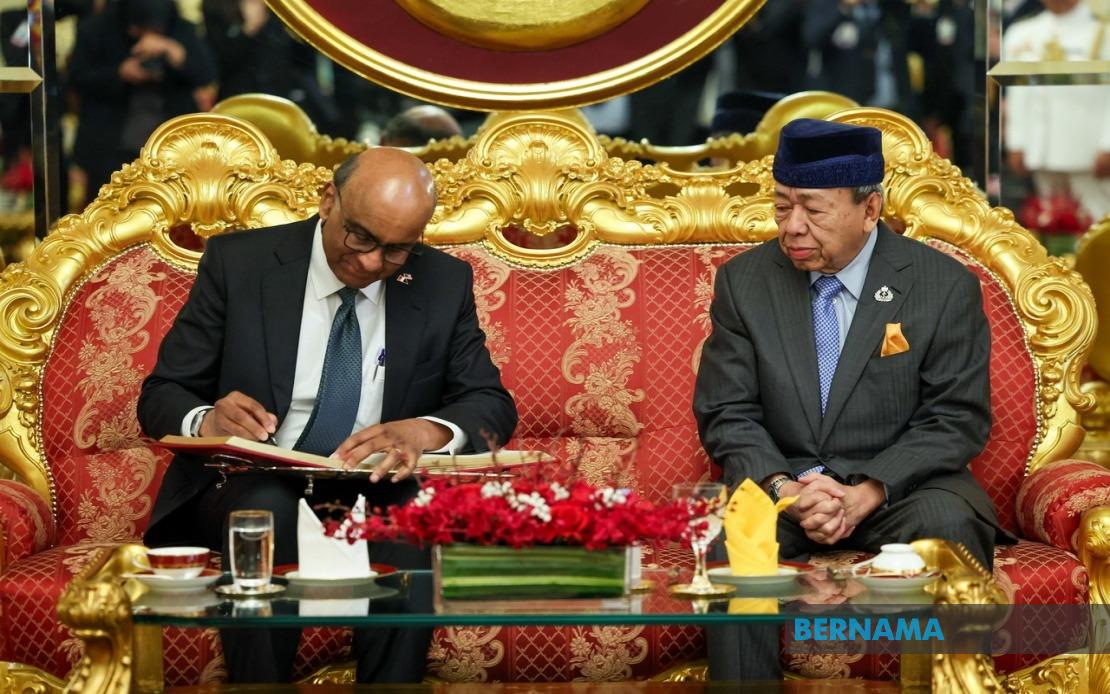
Singapore President Tharman Shanmugaratnam was received by the Sultan of Selangor, Sultan Sharafuddin Idris Shah, in a formal audience at Istana Alam Shah on July 14, marking a significant diplomatic moment during the president's three-day state visit to Malaysia. The engagement underscores the continued importance both nations place on maintaining high-level political dialogue and ceremonial recognition of their bilateral relationship.
The president arrived at the royal residence in Klang at 11 am, where he was greeted by the Raja Muda of Selangor, Tengku Amir Shah, reflecting the formal protocols observed during such state visits. The audience lasted approximately ninety minutes, concluding at 12.40 pm before the Singapore delegation departed the palace. Entrepreneur Development and Cooperatives Minister Steven Sim attended as minister-in-attendance, representing the Federal Government during the proceedings.
This visit represents a reciprocal gesture following His Majesty Sultan Ibrahim, King of Malaysia's state visit to Singapore on May 6 and 7, 2024. The exchange of high-level visits between the two heads of state demonstrates a pattern of strengthened diplomatic engagement at the apex of government, a significant development given the countries' shared maritime borders, interconnected economies, and complex historical relationship.
The three-day visit, running from July 13 to 15, occurs at the invitation of the Yang di-Pertuan Agong, reflecting the formal nature of presidential and royal engagement between Malaysia and Singapore. Such state visits typically encompass multiple meetings with federal and state-level officials, symbolic ceremonies, and substantive discussions on matters of mutual concern.
Singapore's strategic importance to Malaysia extends far beyond ceremonial considerations. The city-state remains Malaysia's second-largest trading partner globally and holds the distinction of being the largest trading partner among all ASEAN member states. This economic interdependence creates substantial incentive for both countries to maintain political stability and constructive relations despite occasional bilateral tensions.
The choice of venue at Istana Alam Shah, the official residence of the Selangor Sultan, carries particular significance. Selangor is Malaysia's most economically dynamic state and home to the Klang Valley industrial and commercial heartland. By conducting formal diplomatic proceedings at the state level, the visit acknowledges the regional importance of Selangor in the broader Malaysian-Singapore relationship.
For Malaysian readers, the visit illustrates how state-level monarchy and federal diplomacy intersect in Malaysia's constitutional framework. The presence of the Raja Muda in receiving the Singapore president demonstrates the active ceremonial and diplomatic roles played by royal institutions beyond their constitutional functions, particularly in representing Malaysia on the international stage.
The timing and structure of presidential visits between Malaysia and Singapore warrant close observation given the delicate balance both nations must maintain. With shared waters, overlapping maritime claims in certain zones, and a population of Malaysians living and working in Singapore that numbers in the hundreds of thousands, the relationship carries practical implications for millions of people. High-level political engagement helps prevent misunderstandings that could escalate into broader tensions.
For the broader Southeast Asian context, strong Malaysia-Singapore relations contribute to regional stability. Both countries are pivotal ASEAN members with significant economic influence, and their bilateral cooperation sets a tone for multilateral engagement within the association. The protocol-observant nature of these state visits sends reassuring signals to regional partners that the foundation of ASEAN cooperation remains solid.
The visit also comes at a time when both nations face similar regional security challenges, including maritime security concerns, terrorism prevention, and managing great power competition in Southeast Asia. Diplomatic channels at the highest levels become essential for coordinating responses to transnational challenges that transcend borders.
For those monitoring Malaysia-Singapore developments, the formality and regularity of such exchanges indicate that despite occasional public disagreements over issues like water supply, territorial matters, or trade disputes, both governments remain committed to institutional mechanisms for managing relations. The fact that such audiences occur predictably and without incident suggests underlying relationship stability beneath any surface-level disputes.

