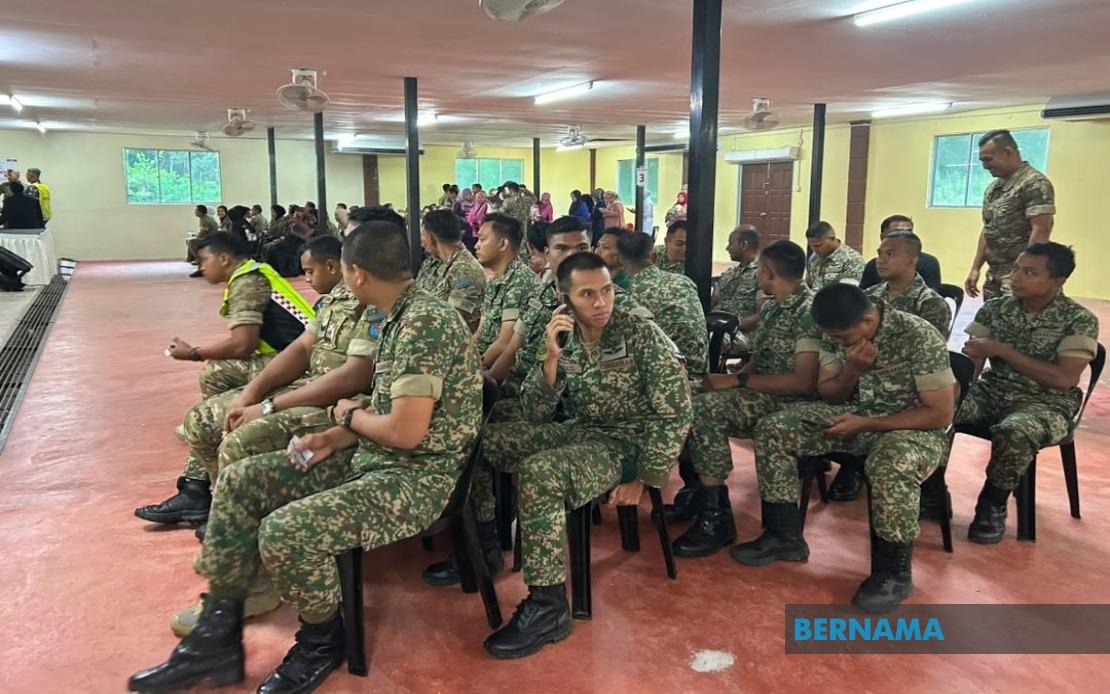
The 16th Johor State Election enters a critical phase with early voting for military and police personnel taking place across the state, with senior government figures emphasizing the importance of responsible participation in the democratic process. Home Minister Datuk Seri Saifuddin Nasution Ismail and Defence Minister Datuk Seri Mohamed Khaled Nordin have both publicly encouraged the 24,751 eligible voters—comprising armed forces members, their spouses, and police personnel alongside their families—to approach the ballot with a strong sense of civic responsibility and respect for democratic values.
Saifuddin Nasution, who holds the additional position of Pakatan Harapan secretary-general, framed the appeal as a call to exercise voting rights while maintaining the integrity that underpins democratic institutions. His message, shared through social media, underscored that voting represents more than a procedural exercise; it embodies a fundamental commitment to the principles of representative democracy. The appeal carries particular weight given the sensitive nature of early voting involving uniformed personnel, who are expected to maintain political neutrality while exercising their constitutional rights as citizens.
Development and stability form the competing electoral narratives in Johor's contest, with messaging from both major coalitions reflecting distinct visions for the state's trajectory. Mohamed Khaled's encouragement to early voters similarly anchored the voting exercise to broader questions of governance and progress, suggesting that electoral choices have direct bearing on Johor's continued advancement. This positioning reflects how state-level elections in Malaysia increasingly serve as referendums on economic management and public service delivery, particularly in a state as economically significant as Johor.
Menteri Besar Datuk Onn Hafiz Ghazi, representing the incumbent Barisan Nasional administration, made a direct appeal to early voters to place their confidence in BN candidates, framing the election as a continuation of an established agenda centred on stability, infrastructure development, and welfare provision. This messaging strategy emphasizes continuity and proven governance, a common electoral approach for incumbents seeking to maintain their mandate in a state they have governed continuously since independence.
The logistical framework for early voting reflects the complexity of accommodating uniformed personnel whose operational commitments mean they cannot participate in ordinary polling procedures. Sixty-four early voting centres activated on a single day from 8 am, with staggered closing times between noon and 6 pm tailored to voter density and institutional requirements at each location. The careful choreography of this process demonstrates the administrative sophistication required to ensure inclusivity while maintaining security and operational efficiency across multiple sites simultaneously.
The composition of early voters—12,041 members of the Malaysian Armed Forces and spouses, plus 12,710 police personnel and spouses—reflects longstanding electoral arrangements that recognize the service commitments of security sector employees. This tradition acknowledges that uniformed personnel, whether deployed operationally or stationed at headquarters, require accommodation to exercise their democratic rights. The inclusion of spouses recognizes the dependent status of many military and police families who also require equivalent flexibility to participate in the democratic process.
The broader electoral contest encompasses all 56 state assembly seats, with 172 candidates representing the two major coalitions and potentially smaller parties or independent candidates contesting individual seats. The complete mobilization of both Pakatan Harapan and Barisan Nasional across all constituencies signals the high stakes involved, as neither coalition is conceding any seat unopposed. This comprehensive contestation creates competitive pressure across the state's diverse constituencies, from urban centres to rural areas, reflecting Johor's geographic and demographic variety.
For Malaysia's regional standing and Southeast Asian observers, Johor elections carry disproportionate significance given the state's economic weight, population size, and strategic geography proximate to Singapore. The outcome influences federal-level coalition dynamics and demonstrates the continuing volatility of Malaysian electoral politics following the fundamental shifts of 2018 and subsequent elections. How constituencies respond to competing governance narratives—whether favouring incumbent administration or seeking alternative leadership—provides important signals about voter priorities across a key Malaysian state.
The emphasis from all three leaders on smooth, peaceful, and orderly voting reflects awareness that electoral integrity requires not merely technical procedural correctness but public confidence in the process itself. By encouraging responsible participation from voters and wishing election officials ease in their duties, the statements acknowledge that democratic legitimacy depends on all stakeholders—voters, officials, security personnel, and observers—recognizing their roles in sustaining democratic norms. This collective framing moves beyond partisan advantage-seeking to emphasize the meta-democratic interest in maintaining institutional credibility across electoral cycles.

