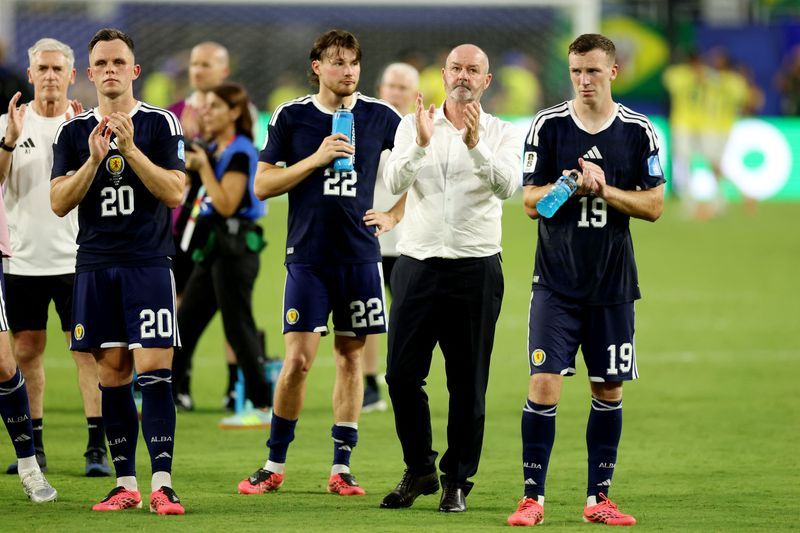
Scotland's return to the World Cup stage for the first time in 28 years appears to be drawing to a close following a one-sided 3-0 thrashing by Brazil on Wednesday in Miami, with manager Steve Clarke acknowledging that his side's elimination is now a probable outcome rather than a remote possibility. Although Scotland technically retain a mathematical chance of advancing as one of eight third-placed teams with the strongest records across the tournament's 12 groups, Clarke's assessment was unambiguous: the Scots have already conceded too much ground in this mathematical pursuit and will almost certainly finish outside the qualification zone.
When Clarke dissected the defeat in his post-match remarks, he repeatedly returned to a central theme that appeared to trouble him more than the scoreline itself. His team had fundamentally surrendered possession and structure at moments when discipline was essential, creating the precise openings that a side of Brazil's calibre exploits with clinical efficiency. The manager described the result as fair, acknowledging that when elite attacking units receive the kind of invitations Scotland provided, punishment follows inevitably. Rather than dwelling on Brazil's superior finishing or their technical brilliance, Clarke emphasised the role his own players had played in manufacturing their opponents' victory through careless transitions and poor positioning.
The specificity of Clarke's criticism extended to individual goals. He readily conceded that Scotland had effectively gifted Brazil the first two goals through defensive errors, and suggested the third likely stemmed from similar structural breakdowns rather than moments of individual genius from the Brazilians. Yet even within this pessimistic assessment, Clarke found space to note that Brazil's execution was not flawless. Goalkeeper Angus Gunn produced several important saves during the match, and Brazil also squandered opportunities where a different outcome might have been possible had the visitors capitalised on their own attacking moments.
Clark's frustration was tempered by restraint when discussing his playing group's broader performance during the tournament. Rather than directing anger at individual players, he expressed disappointment that the squad had failed to reach the performance standards they have demonstrated during their qualifying campaign and recent competitive matches. Clarke's message was clear: Scotland possess the capability to compete at this level, yet on Wednesday they fell short of their potential, and this gap between promise and execution will likely cost them continuation in the tournament.
Beyond the immediate tactical disappointment, Clarke used the post-match platform to highlight systemic challenges within Scottish football that extend far beyond the current squad. Having witnessed first-hand the physical power, athletic dominance, and technical sophistication of both Morocco and Brazil during the group stage, Clarke articulated a concern that Scottish football currently lacks sufficient infrastructure for developing young players capable of competing routinely at international level. This observation suggests Clarke believes Scotland's World Cup struggles reflect deeper structural deficiencies in player development systems rather than temporary fluctuations in form.
The former Chelsea defender's comments about youth development carry particular weight given Scotland's historical struggles to produce world-class talent consistently. His implicit suggestion is that Scottish clubs and academies must elevate their methods, intensity, and standards if the national team is to avoid repeating this cycle of qualification followed by early elimination. The contrast Clarke drew between Scotland's capabilities and those of opponents like Brazil and Morocco was not merely about this tournament but about fundamental gaps in player development, athletic preparation, and technical instruction that demand long-term investment and reform.
While Clarke's assessment of Scotland's likely exit was sobering, he made a deliberate effort to protect his players from what might be perceived as collective blame. Instead, he shifted perspective to appreciate the achievement of qualification itself, which had brought thousands of Scottish supporters to the United States and created an atmosphere that transcended typical tournament experiences. The Tartan Army, as Scotland's supporters are affectionately known, had indeed become one of the tournament's vibrant elements, and Clarke acknowledged their contribution to the overall experience.
However, Clarke's defence of his players incorporated a subtle challenge to supporters themselves. He reminded the Scottish football community that without this group of players' qualification efforts, the Tartan Army would be watching the World Cup from their sofas at home, as had been the case for nearly three decades. This framing positioned the squad as having fulfilled their primary responsibility by reaching the tournament, even if their performance once there fell short of hopes. Clarke's emphasis on this distinction was deliberate: he sought to preserve the players' reputation and morale by highlighting they had already accomplished what many doubted possible.
Looking forward, Scotland's fate now depends on results elsewhere in the tournament. With sixth place in the third-place standings currently held, Clarke has already calculated that at least two additional teams will finish ahead of them in their respective groups, pushing Scotland below the qualification line. This mathematical certainty shapes his resignation about the outcome, even as official elimination has not yet occurred. The manager's willingness to concede the likely result publicly may seem pessimistic, but it reflects the cold analysis of tournament mechanics and the difficulty of earning enough points to qualify as a third-place finisher when you have already collected only three points from two matches with one group game remaining.

