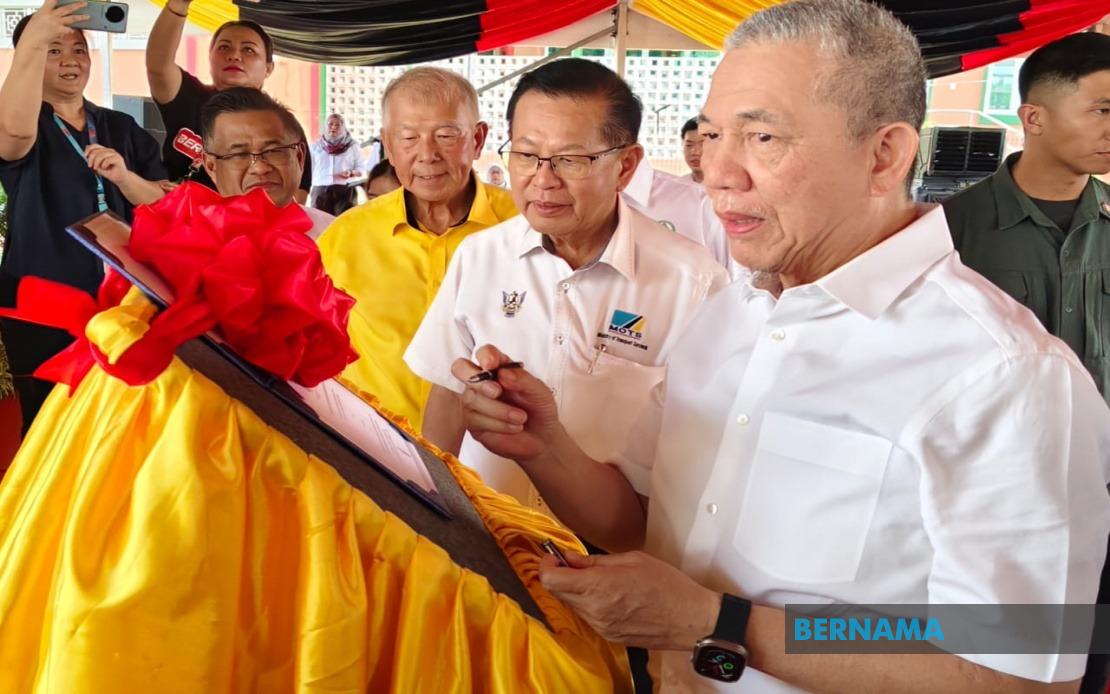
Deputy Prime Minister Datuk Seri Fadillah Yusof has unveiled an ambitious portfolio of infrastructure interventions spanning Sarawak, with 52 projects under the Cakna MADANI Programme collectively valued at RM9.46 million designed to confront mounting challenges from coastal erosion, riverbank degradation, and flood inundation. The programme reflects growing recognition among federal authorities that environmental hazards pose significant threats to communities and economic assets across the state, necessitating coordinated investment in protective infrastructure and watershed management.
The deployment of these initiatives reveals varying stages of execution across Sarawak's diverse geography. Twelve schemes have already reached completion, while thirteen are presently under active construction, indicating that implementation momentum has gathered pace. A further twenty-seven projects remain in preparatory phases, suggesting that the full impact of this initiative will unfold gradually over coming months and years. This staggered approach allows for adaptive management and learning from early outcomes.
Fadillah, who also holds the portfolio of Energy Transition and Water Transformation Minister, inspected a riverbank stabilisation undertaking in Miri District to assess progress firsthand. The Tab Cinaq Cemetery project, budgeted at RM134,682, exemplifies the targeted nature of these interventions. The scheme involves constructing a fifty-metre retaining wall intended to arrest ongoing erosion processes while simultaneously safeguarding the cemetery itself and adjacent infrastructure from damage caused by fluvial dynamics. Work commenced in May with completion targeted for November, demonstrating relatively compact project cycles that enable rapid deployment of solutions.
Beyond these immediate interventions, the Malaysian government has committed substantially larger sums to longer-term flood management strategies across Sarawak. Twenty-nine comprehensive flood mitigation projects have received approval, collectively representing an investment envelope of RM3.834 billion. This figure dwarfs the Cakna MADANI allocation, underscoring official assessment that systematic flood control requires sustained, substantial capital deployment rather than ad-hoc interventions. The portfolio encompasses multiple strategies including the Flood Mitigation Plan, High Priority Flood Mitigation initiatives, coastal erosion defence schemes, and river conservation efforts.
Within this larger framework, eighteen projects constitute continuation efforts—ongoing works that build upon previous phases of development. These schemes account for RM3.567 billion of the total budget, reflecting the substantial scope of established programmes. Concurrently, eleven new projects have been incorporated into the approved pipeline at a cost of RM267 million, enabling authorities to address newly identified vulnerabilities and extend protective coverage to previously underserved areas. This combination of consolidating existing efforts while introducing fresh initiatives demonstrates strategic planning across multiple administrative cycles.
The Sungai Miri Flood Mitigation Plan represents a significant component within Sarawak's flood defence architecture. This continuation project, budgeted at RM31 million, commenced construction in October 2023 and has achieved fifty-eight percent physical progress to date. Planners anticipate full completion by November 2026, indicating that such comprehensive river management schemes operate across extended timeframes reflecting their engineering complexity and the scale of intervention required. The multi-year trajectory allows for phased implementation and staged mobilisation of labour and resources.
For Malaysian policymakers and regional development specialists, the Sarawak initiatives carry broader significance. The state's vulnerability to both riverine and coastal hazards stems from its geography—extensive river networks, low-lying deltaic zones, and tropical precipitation patterns create persistent inundation risks. Climate variability adds further uncertainty to future flood frequency and intensity. By concentrating federal resources on Sarawak, authorities signal commitment to addressing regional disparities in infrastructure resilience and acknowledging that eastern Malaysian communities warrant proportionate investment in protective measures.
The Cakna MADANI Programme itself merits examination as a governance instrument. By creating dedicated funding streams for community-level environmental infrastructure, the initiative empowers state and local authorities to address place-specific hazards without exhausting consolidated national budgets. The programme's focus on erosion and flood risks aligns with observable climate challenges across Southeast Asia, where intensifying weather patterns threaten agricultural productivity, urban settlements, and economic zones. Sarawak's experience may provide instructive lessons for neighbouring jurisdictions confronting similar environmental pressures.
The deployment of retaining walls, embankments, and river conservation measures reflects reliance on engineered solutions to manage hydrological forces. While such approaches offer tangible protection benefits, they also invite consideration of complementary strategies including watershed restoration, mangrove conservation, and land-use planning reforms that address root causes of erosion and flooding. Sustainable long-term risk reduction typically requires integrated approaches combining structural defences with natural systems management and community preparedness initiatives.
From an economic perspective, investing RM3.834 billion in flood mitigation across Sarawak represents prudent risk management. Unchecked flooding imposes substantial costs through property damage, agricultural losses, infrastructure disruption, and humanitarian response expenses. By contrast, preventive infrastructure investments generate returns through protected assets, sustained agricultural output, and reduced disaster recovery burdens. For Malaysia's broader development agenda, protecting Sarawak's economic zones and communities strengthens national economic resilience while demonstrating equity in distributing federal resources.
The programme's staging across multiple implementation phases provides opportunities for monitoring effectiveness and adjusting approaches based on field experience. Early-completion projects offer valuable data regarding design performance, cost efficiency, and community acceptance—intelligence that should inform subsequent phases. Transparent reporting of outcomes and integration of stakeholder feedback can enhance programme credibility and ensure that capital deployment genuinely addresses identified vulnerabilities.
Looking ahead, sustaining momentum in Sarawak's environmental infrastructure development depends on consistent budgetary allocation, technical capacity within executing agencies, and community engagement throughout project lifecycles. As climate patterns shift unpredictably, flexibility to scale interventions and adapt strategies becomes increasingly important. The current portfolio of approved schemes provides essential foundation, yet decision-makers must remain vigilant regarding emerging hazards and prepared to mobilise additional resources should risk trajectories intensify beyond current projections.

