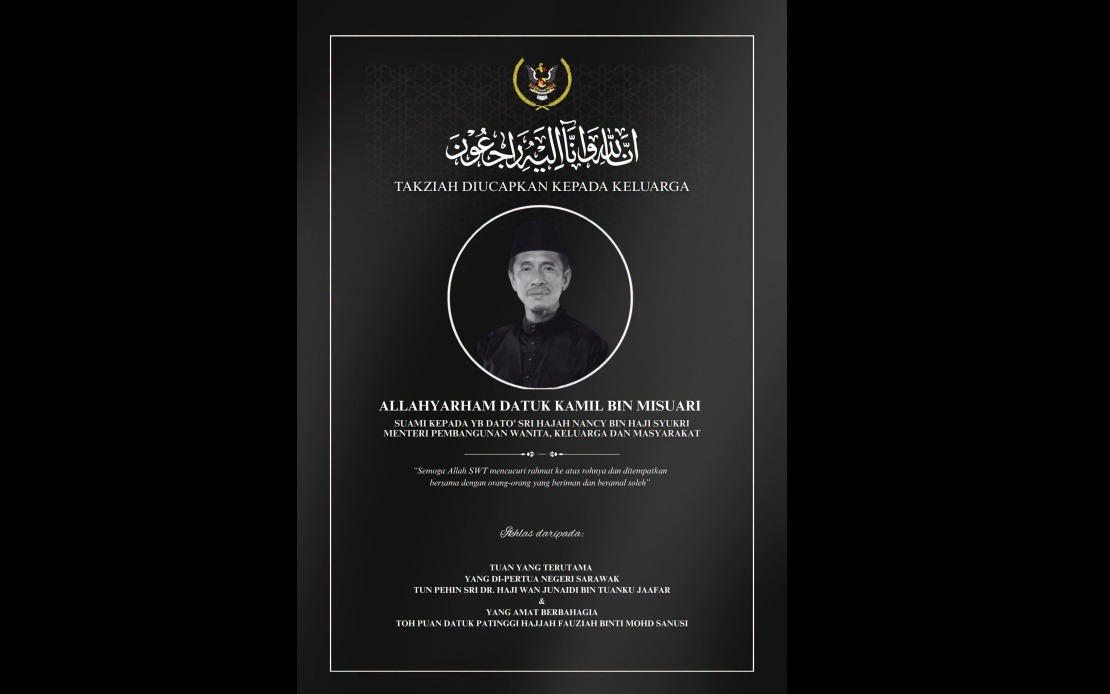
Tun Dr Wan Junaidi Tuanku Jaafar, the Yang Dipertua Negeri Sarawak, has extended formal condolences to federal Women, Family and Community Development Minister Datuk Seri Nancy Shukri following the passing of her husband, Datuk Kamil Misuari, 65, who died at a hospital in Kuala Lumpur on June 18. The statement from Astana Sarawak conveyed the governor's and his wife Toh Puan Fauziah Mohd Sanusi's sympathies during this period of family loss for the cabinet minister.
In the official message of condolence, the Sarawak head of state requested divine blessings for the late Kamil, expressing faith that his good deeds would be acknowledged and his soul placed among the righteous. The phrasing reflects the solemn tone typically observed in Malaysian state-level expressions of sympathy, drawing on both Islamic spiritual sentiments and formal protocol governing such official statements.
Beyond spiritual invocations, Wan Junaidi and his wife also prayed for Nancy Shukri and her extended family to find inner strength and emotional resilience as they navigate the immediate aftermath of bereavement. Such expressions of fortitude and patience hold particular weight in Malaysian cultural context, where family bonds and collective mourning practices remain deeply significant across communities.
The Office of the Minister of Women, Family and Community Development had announced Kamil's death earlier that evening through an official statement. The timing of this announcement, coming through ministerial channels rather than immediate family disclosure, underscores the intersection of personal grief and public duty that cabinet ministers in Malaysia often navigate, particularly when their family circumstances intersect with their official roles.
Arrangements for the late Kamil's funeral proceeded with deliberate efficiency. His remains were scheduled to be transported to Kuching the following day, with burial taking place at Samariang Muslim Cemetery. This logistical pathway—from Kuala Lumpur hospital to Sarawak—reflects the family's deep roots in the state, and suggests that despite Nancy Shukri's prominent position in federal politics, familial ties and burial traditions in Sarawak remained paramount to the family's wishes.
Kamil and Nancy Shukri had maintained a marriage spanning nearly four decades, having wed in 1985. Over this period, they raised three children together, establishing a family unit that appears to have balanced Nancy's rising political prominence with private domestic life. The longevity of their union marks them as part of Malaysia's established professional and political circles, where spousal partnerships often navigate the demanding schedules and public scrutiny inherent to high office.
The age of the deceased—65 years old—places his death within the context of health vulnerabilities that increasingly affect Malaysia's older generations. While the specific cause of death was not disclosed in available statements, the passage from hospital environment to funeral arrangements occurred rapidly, suggesting either acute illness or a medical condition that had reached critical status.
Nancy Shukri's position as Women, Family and Community Development Minister carries particular resonance during moments of personal family loss. Her portfolio addresses matters intimately connected to family structures, caregiving, and spousal relationships—areas where personal experience necessarily informs policy perspective and public perception. The convergence of her ministerial responsibilities with sudden bereavement creates a complex emotional and professional circumstance that Malaysian leaders have occasionally navigated publicly.
The condolences from Sarawak's highest state office signal the interconnected nature of Malaysia's political establishment, where expressions of sympathy flow through formal channels and ceremonial protocols. Such gestures, while rooted in genuine compassion, also serve to reinforce the bonds of collegial respect among senior government figures across federal and state levels. Wan Junaidi's statement positions Sarawak's administration as recognizing the personal dimensions of federal ministers' lives, even as they discharge national duties.
For Malaysian observers, the sequence of events illustrates how death in prominent political families intersects with media coverage, official protocols, and state ceremonial functions. The involvement of Astana Sarawak in articulating condolences demonstrates how state institutions engage with significant life events affecting their citizens who hold national office, blending personal sympathy with institutional formality in ways characteristic of Malaysian governance traditions.

