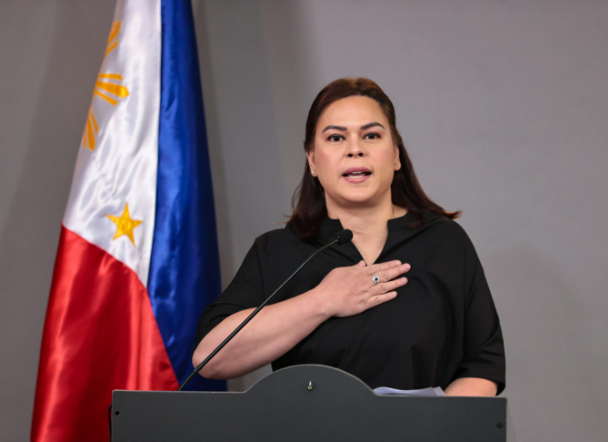
Vice President Sara Duterte seized on a major demonstration along Epifanio de los Santos Avenue on Tuesday to deliver a scathing critique of President Ferdinand Marcos Jr's government, framing the thousands who assembled as embodying a deepening public disillusionment she has repeatedly articulated since 2024. The convergence of thousands of Iglesia ni Cristo members on the capital's main thoroughfare provided Duterte with a visible platform to amplify her message that the Marcos administration has been fundamentally undermined by what she termed "poor governance" and a failure to grapple with the nation's most pressing challenges.
Duterte's intervention marked an escalation in her public opposition to the sitting president, coming at a particularly consequential moment as her own constitutional fate hangs in the balance. She characterized the government under Marcos as increasingly detached from the material realities confronting ordinary Filipinos, particularly those struggling with inflation pressures, employment instability, and the relentless climb in living expenses that have eroded household purchasing power across the archipelago. Rather than responding to these economic pressures with tangible solutions, Duterte contended that the administration has opted to stifle criticism through mechanisms ostensibly designed to ensure accountability but which she argued actually function as instruments of political silencing.
The Iglesia ni Cristo gathering that prompted Duterte's statement carried its own specific grievance. The religious organization mobilized its membership to protest what it characterized as "selective justice" and "distortion of law," ostensibly in response to an announced plunder complaint targeting Senator Rodante Marcoleta. This framing by the INC, one of the Philippines' most organized and politically influential religious groups, suggested that legal proceedings against certain political figures were arbitrary rather than principled applications of law—a perception that Duterte amplified through her broader critique of the administration's approach to political opposition and accountability.
Duterte's comments reflected a strategic pivot in how she contextualizes her conflict with Marcos. Rather than centering the dispute as a personal or constitutional matter, she sought to position it within a larger narrative about institutional degradation and the erosion of democratic norms. She specifically cited the administration's treatment of those who question alleged corruption within Malacañang, voice criticism of government performance, or level accusations against the president himself. According to Duterte's account, the government responds to such dissent not with substantive counterargument but with intimidation tactics that chill legitimate democratic participation and expression.
Central to Duterte's indictment was her assertion that the Marcos administration exhibits what she labeled "failures of character and leadership" that have fostered an increasingly repressive political environment. She argued that a government which responds to criticism through intimidation rather than dialogue fundamentally betrays the democratic institutions it is constitutionally obligated to uphold and strengthen. This line of argument sought to reframe the conflict as one transcending partisan politics, instead positioning it as a struggle over the institutional integrity and democratic legitimacy of the Philippine state itself.
Duterte's strategic framing also reflected awareness of how her impeachment trial and potential removal would be perceived internationally and domestically. By anchoring her critique to broader governance failures and threats to democratic norms rather than focusing narrowly on her own legal predicament, she attempted to insulate herself from accusations that she was merely defending personal interests. The vice president characterized the underlying issue as fundamentally concerning "the honor of the State and the future of a people," elevating what could be dismissed as factional conflict into a matter of national consequence and constitutional principle.
The economic dimension of Duterte's critique holds particular resonance for Malaysian observers watching Philippine developments. Inflation and cost-of-living pressures that have accumulated across Southeast Asia in recent years have proven politically destabilizing in multiple regional democracies, and the Philippines appears no exception. Duterte's invocation of economic hardship as a foundation for legitimate political grievance reflects how inflation has become inseparable from broader assessments of governmental competence and legitimacy across the region. A government perceived as indifferent to such pressures faces mounting vulnerability regardless of its formal democratic legitimacy.
The timing of Duterte's comments also carries significance given that her impeachment trial was scheduled to commence on July 6, merely days after the Edsa rally. The vice president appeared to be constructing a political narrative suggesting that her impeachment represented not a justified constitutional process but rather a component of the broader suppression of dissent she was denouncing. Whether such framing would resonate with senators evaluating her impeachment case remained an open question, but the rhetorical strategy illuminated how Duterte intended to defend herself—not primarily through addressing specific charges but through recontextualizing the proceedings as politically motivated within a larger pattern of authoritarian drift.
Duterte's public opposition to Marcos occurs within a Philippine political landscape increasingly characterized by institutional fragmentation and the breakdown of consensus among the elite. Unlike democracies where institutional checks function through shared commitment to procedural legitimacy, the Philippines' system appears vulnerable to weaponization by competing political factions, a pattern that Duterte's impeachment trial exemplifies. For regional observers, the spectacle of a sitting vice president under impeachment while simultaneously denouncing the government and attempting to rally public support illustrates the precarious balance between democratic contestation and institutional stability that characterizes contemporary Philippine politics.
The Edsa gathering itself carried symbolic weight within Philippine political memory. The avenue's association with the 1986 People Power Revolution that ousted Ferdinand Marcos Sr.—the current president's father—invested the venue with historical resonance that opposition movements consciously deploy. Duterte's invocation of the rally as expressing genuine popular sentiment attempted to position herself alongside democratic aspirations, though her own record as Davao mayor and as vice president has drawn considerable criticism regarding civil liberties and due process concerns from international human rights organizations.
Moving forward, the success of Duterte's rhetorical strategy will likely depend on whether ordinary Filipinos perceive the vice president as genuinely advocating for their interests or as opportunistically instrumentalizing legitimate grievances for her own political survival. The distinction matters considerably for how the broader public evaluates both her impeachment trial and the administration's governance record. If Duterte can sustain the impression that she represents principled democratic opposition rather than mere factional conflict, she may successfully transform her constitutional crisis into a referendum on Marcos administration performance. Conversely, if she is perceived as leveraging institutional mechanisms for personal preservation, her critique risks being dismissed as predictable political self-interest.

