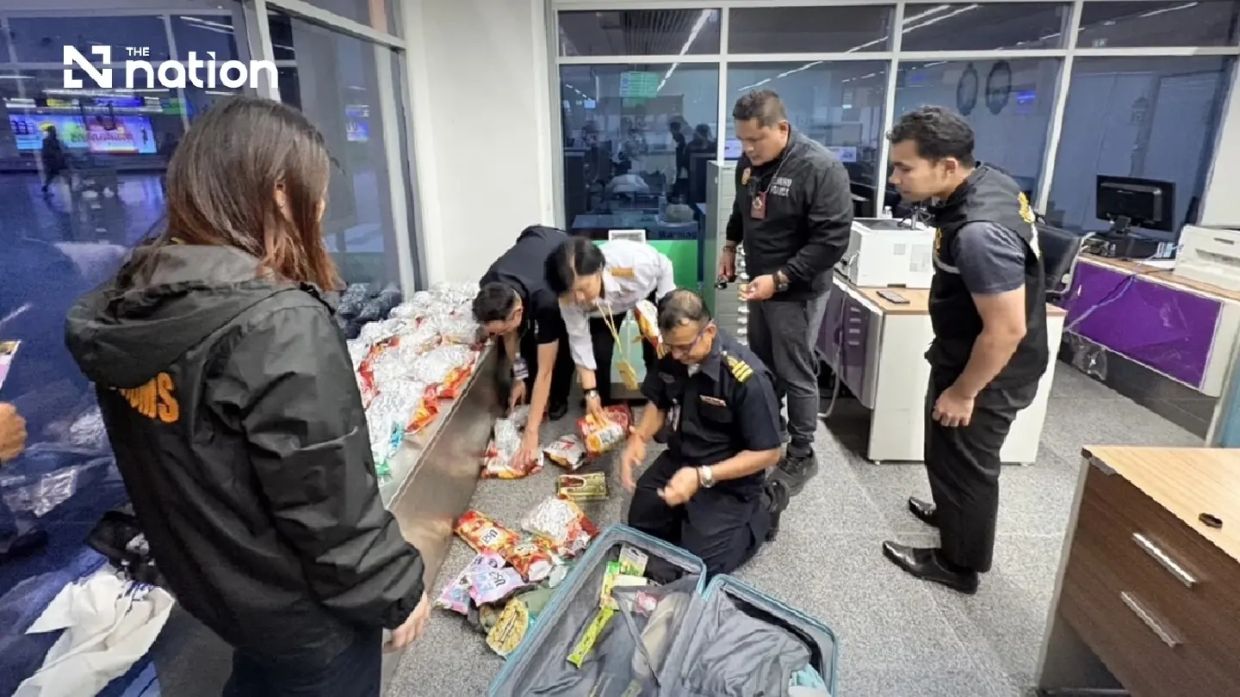
A Russian national has been detained at Phuket International Airport following the discovery of substantial quantities of cannabis concealed in his baggage, marking another significant drug seizure at Thailand's popular tourist gateway. Sergei Chalabari, 30, was apprehended on Wednesday (July 8) in the international departure terminal while attempting to leave the country with the contraband carefully packed into two blue BP WORLD suitcases.
The interception came as customs officer Rawin Kanokakorn and an arresting team conducted routine inspections of departing passengers at the airport's Mai Khao subdistrict facility. Upon examining Chalabari's two wheeled suitcases, which weighed a combined eight kilograms, inspectors uncovered a meticulously organised drug shipment that would have represented a significant trafficking operation had it successfully left Thailand's territory. The discovery underscores the ongoing vigilance required at border control points where international travellers regularly attempt to move contraband through established checkpoints.
The seized materials comprised two distinct forms of cannabis. Officers found 35 vacuum-sealed packages of cannabis flowers totalling 11.4 kilograms distributed throughout the luggage. Additionally, they confiscated 12 separate packages of cannabis resin with a combined weight of 6.2 kilograms, bringing the total haul to 17.6 kilograms. The methodical packaging suggested the shipment had been prepared for transportation rather than personal consumption, indicating potential involvement in commercial drug distribution networks that exploit Thailand as both a production and transit point for Southeast Asian narcotics trafficking.
During initial questioning at the airport, Chalabari acknowledged ownership of both the suitcases and their contents, effectively admitting to possession of the seized items. However, he has not yet provided substantive details regarding the intended destination, distribution contacts, or organisational structure behind the smuggling attempt. Thai authorities are pursuing additional lines of investigation to determine whether he was acting independently or as part of a larger trafficking organisation operating across Southeast Asia and potentially involving Russian or Eastern European criminal syndicates.
The suspect now faces charges of attempting to smuggle goods out of the kingdom without fulfilling customs declaration procedures, a serious criminal offence under Thai law that carries substantial penalties. The evidence seizure and his confession provide prosecutors with a strong foundation for pursuing conviction. Following the initial arrest and processing at Phuket International Airport, Chalabari was transferred to Sakhu Police Station for comprehensive investigation and preparation of legal proceedings that will determine his sentence.
The operation was coordinated across multiple Thai law enforcement agencies, reflecting the institutional infrastructure tasked with combating international drug trafficking at Thailand's borders. Pol Col Salan Sankhisasanakun, superintendent of Sakhu Police Station, and Pol Lt Col Rattanawut Nukaew, deputy superintendent for investigation, provided supervisory oversight of the arrest. The customs component was led by Nucha Jeeradit, chief of the Phuket Airport Customs House, alongside Thanomjit Burirak of the customs control division and Charoenporn Jaengwansuk from the investigation and suppression section.
This seizure exemplifies the persistent challenge Thailand faces in managing drug trafficking through its major international airports serving the tourism industry. Phuket, as a primary gateway for millions of annual visitors from across Europe, Russia, and other regions, remains an attractive transit point for organised narcotics networks seeking to move products through established travel routes. The airport's high passenger volume and international connections create operational vulnerabilities that criminal organisations continuously attempt to exploit, even as detection capabilities and enforcement protocols improve.
The involvement of a Russian national aligns with documented patterns of Eastern European participation in Southeast Asian drug trafficking networks. Intelligence services across the region have identified increasing cooperation between Russian and other former Soviet country nationals in orchestrating cannabis and synthetic drug operations centred on transit through Thailand, Vietnam, and Cambodia toward markets in Western Europe and the Middle East. The arrest suggests these networks continue testing enforcement capacity at major commercial travel hubs despite heightened security awareness.
Thailand's pharmaceutical cannabis regulations remain among Southeast Asia's most stringent, with severe penalties for unauthorised possession, transportation, and export of cannabis in any form. The government maintains strict policies despite evolving global attitudes toward cannabis legalisation, viewing any relaxation as potentially encouraging trafficking operations that would destabilise the region. This enforcement philosophy means Chalabari's case will likely proceed through courts with substantial recommended sentences should conviction be secured on all charges.
The case also reflects ongoing cooperation between Thai airport security, customs agencies, and police investigative units in coordinating responses to international drug smuggling. Pol Capt Chaphinya Surithamkul, deputy investigation inspector at Sakhu Police Station, received custody of the suspect for continued investigation and preparation of legal documentation. This institutional coordination across agencies demonstrates Thailand's commitment to maintaining strict border controls and extracting intelligence from apprehended suspects regarding larger trafficking organisational structures operating in the region.

