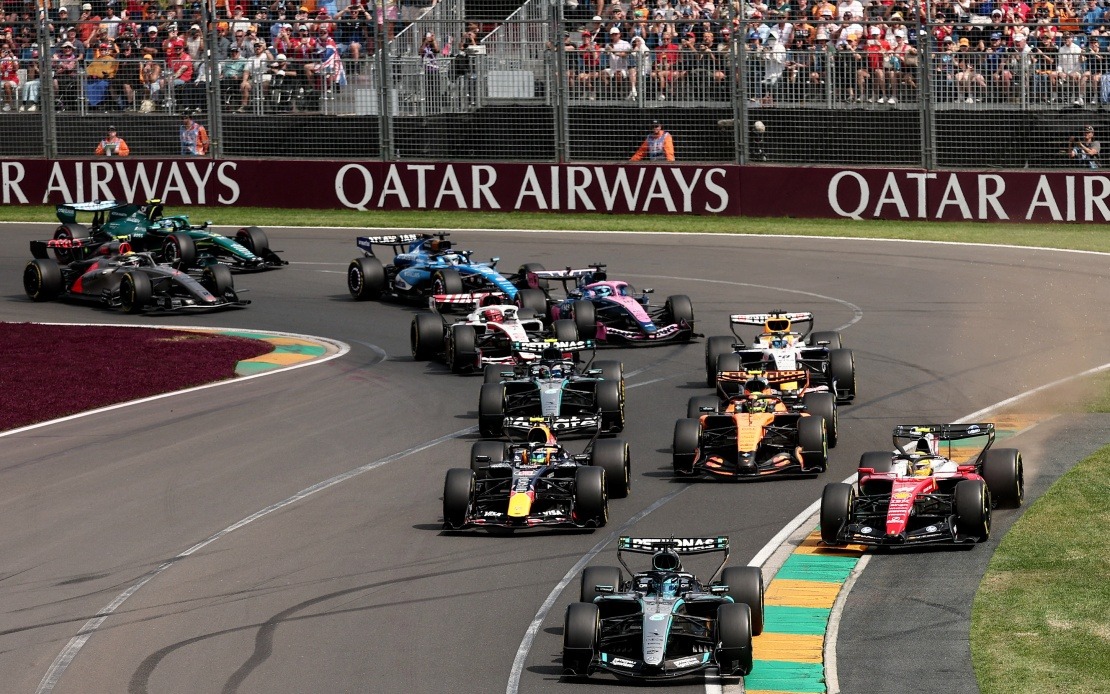
George Russell's frustration boiled over at Spa-Francorchamps on Sunday after a combination of mechanical gremlins and a collision with Lewis Hamilton ended what was shaping as a critical race for his world championship campaign. The Mercedes driver's unfiltered radio rant revealed the mounting pressure on a competitor whose title hopes have been progressively undermined by a succession of technical failures. With Kimi Antonelli, his teenage teammate, now leading the standings by 50 points following his sixth victory this season, Russell faces an increasingly uphill battle to salvage his championship ambitions.
The precise nature of Russell's mechanical problems at the Belgian circuit exposed one of the more intriguing technical challenges facing modern Formula 1. An energy deployment issue affecting his battery management system surfaced during qualifying, where he found himself half a second adrift of Antonelli. The problem manifested itself down the straights, where drivers typically harvest and deploy electrical power through the hybrid system to gain crucial performance advantages. Initially, Mercedes engineers attributed the shortfall to Russell's driving approach, a suggestion that was quickly discarded when further investigation revealed the root cause lay within the power unit itself rather than pilot technique.
The timing proved particularly damaging because a first-lap engine glitch had already exposed Russell to the chasing pack, leaving him vulnerable when contact with Hamilton occurred. This sequence of events—initial mechanical failure creating a performance disadvantage, followed by collision damage—made recovery impossible. What transpired on the track underscored how unforgiving modern Formula 1 has become, where a single mechanical malfunction can spiral into race-ending consequences within laps.
Russell's on-the-spot commentary revealed the depth of his exasperation, as he questioned why the battery charge state had failed precisely when he needed maximum electrical power on the straights. His use of unfiltered language reflected not merely momentary anger but accumulated frustration spanning a season marked by mechanical setbacks. The driver's subsequent admission that he now feels "numb to disappointment" suggests a psychological toll beyond the points deficit, hinting at doubts about whether Mercedes can deliver the reliability required for a credible championship challenge in the remaining races before the summer break.
Toto Wolff's measured response acknowledged the emotional turbulence Russell experiences while attempting to reframe the situation as a normal challenge faced by elite competitors. The team principal's intervention served a diplomatic function, validating Russell's frustrations while simultaneously reminding the driver of the privilege inherent in driving for one of Formula 1's most storied organizations. Wolff's public backing—stating the team stood "100 per cent" behind Russell—appeared calibrated to prevent the driver's morale from deteriorating further, recognizing that championship bids are won as much through psychological resilience as mechanical excellence.
Wolff's technical explanation provided valuable insight into why the Belgian Grand Prix exposed Mercedes' weakness so starkly. The complexity of modern power unit management, involving sophisticated algorithms controlling energy harvesting and deployment across multiple braking zones and acceleration phases, creates numerous failure points. Mercedes' new regulations package, while possessing genuine strengths elsewhere, has evidently struggled with reliability in its energy management systems. The fact that engineers had identified a specific deficiency in Russell's power unit capacity at turn 18—a crucial corner demanding substantial electrical assistance—indicated the problem was both diagnosable and theoretically fixable.
Wolff's observation that Budapest, the next destination before the summer break, would not have provided ideal conditions for identifying this particular fault proves instructive. The Hungarian Grand Prix circuit is not energy-dependent in the way that high-speed, straightforward courses like Spa demand constant battery deployment. This fortuitous identification, while too late to salvage Russell's Belgian weekend, potentially offers Mercedes a pathway toward resolution. Nevertheless, Wolff acknowledged that even with the problem partially explained, Russell had lost roughly half the qualifying deficit to Antonelli simply through reduced energy deployment capability—a substantial performance gap.
The broader championship context makes Russell's predicament increasingly concerning for Mercedes' constructors' championship ambitions as well. Antonelli, the precocious 19-year-old, has claimed six victories from ten races contested, establishing a commanding lead that suggests he possesses both machine and mental fortitude superior to his senior partner. For a team competing at Mercedes' level, such disparity between drivers raises uncomfortable questions about either chassis setup optimization or whether the younger driver simply possesses superior racecraft under current conditions.
The collision with Hamilton, arriving as it did in the context of already-compromised machinery, represented the final indignity for Russell's weekend. While teammate collisions occasionally provide useful data regarding relative performance and setup philosophy, they also represent wasted opportunities in a championship context where points are increasingly precious. The fact that this occurred after Russell had already been disadvantaged by mechanical failure suggests the sequence of events spiraled beyond his control, leaving him powerless to influence the outcome.
With the summer break approaching, Mercedes faces a technical and psychological reckoning. The identification of the battery deployment fault offers a concrete problem to solve, and Wolff's commitment to finding a solution before Budapest provides a tangible timeframe for remedial action. However, the damage to Russell's championship position and confidence has already been done. A 50-point deficit represents approximately two victories' worth of points, and with Antonelli demonstrating consistent success, overtaking the teenager appears unlikely without some significant miscalculation from the Italian teenager.
Russell's plea that he is "praying" Mercedes can resolve the technical issues speaks to the powerlessness some drivers experience when machinery fails. Unlike tactical or driving errors, mechanical failures remove agency from the cockpit, reducing drivers to passengers subject to engineers' problem-solving capacity. For a competitor of Russell's caliber, accustomed to controlling outcomes through skill and determination, this dependency on others represents a particular psychological burden that extends beyond simple performance metrics.
As Formula 1 heads into its summer recess, Russell's championship dream, while mathematically alive, depends heavily on Mercedes' ability to deliver technical solutions while Antonelli maintains focus after establishing such a commanding position. The underlying technical issues Russell has experienced suggest that the championship outcome may ultimately be determined not by driver quality but by the reliability and performance balance between the two Mercedes machines—a sobering reminder that in modern Formula 1, engineering excellence frequently trumps human skill.

