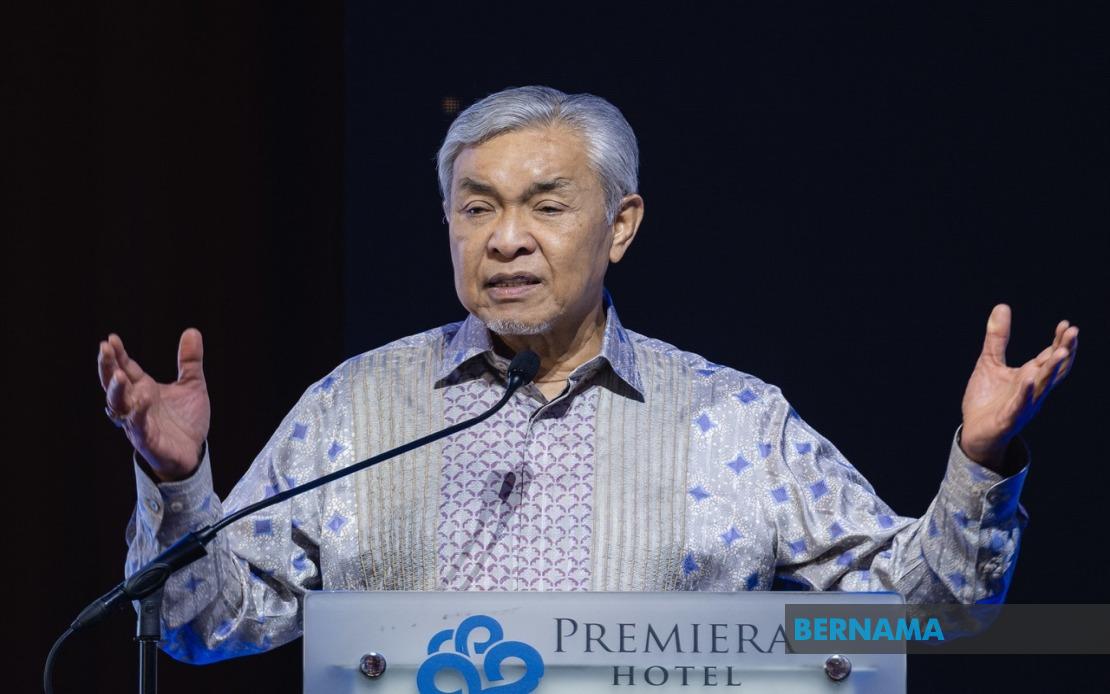
Deputy Prime Minister Datuk Seri Dr Ahmad Zahid Hamidi has indicated that the Ministry of Rural and Regional Development will assess applications for new road construction in remote communities across Sabah and Sarawak when preparing Budget 2027, provided the projects address identified connectivity gaps between isolated settlements and major urban centres.
Speaking after presiding over the Ministry's 2025 Excellent Service and Appreciation Awards ceremony in Kuala Lumpur, Ahmad Zahid emphasised that rural road infrastructure falls squarely within his ministry's mandate. The distinction is crucial: the ministry prioritises projects that genuinely bridge the divide between peripheral communities and town centres, rather than routine maintenance or upgrades to existing routes. This focus reflects a strategic priority to unlock economic and social opportunities in underserved regions across Malaysia's largest states.
The Deputy Prime Minister acknowledged, however, that approval for any new road projects will remain conditional on clearance from the Ministry of Finance and the Public Works Department, underscoring the multi-layered governance process that shapes infrastructure spending. While the statement opens a potential avenue for previously rejected or pending proposals, the bureaucratic pathway ahead involves consultation with these coordinating bodies and adherence to established financial and engineering protocols. The ministry will refine specific project details only after these consultations conclude, suggesting that the 2027 budget allocation process remains preliminary.
Beyond the immediate question of road funding, Ahmad Zahid used the occasion to introduce what he framed as a "new discipline" within the ministry's operations. This reflects mounting pressure to demonstrate tangible returns from rural development spending and to eliminate programmes that fail to generate measurable community benefits. The philosophy signals a departure from routine project implementation towards outcome-focused administration, a shift that carries implications for how rural development agencies across the region prioritise their work.
The Deputy Prime Minister articulated this philosophy with striking directness: initiatives that prove successful should be scaled up, lagging programmes must accelerate, and underperforming schemes require either substantive overhaul or discontinuation. This approach addresses longstanding criticism that rural development budgets sometimes finance projects with limited real-world impact or that proceed at glacial pace despite urgent community need. For Malaysian policymakers monitoring governance efficiency, the statement reflects broader government intent to tighten project management and demand accountability.
Crucially, Ahmad Zahid reframed rural development beyond the traditional infrastructure-centric model. While roads, electricity, and water supply remain foundational, he positioned the ministry's expanded role as creating ecosystems that generate income and jobs within rural communities themselves. This mirrors economic thinking across Southeast Asia, where analysts increasingly argue that infrastructure without corresponding livelihood opportunities merely enables outward migration rather than sustainable community development. For Sabah and Sarawak specifically, where geographic remoteness and limited economic diversification have historically constrained growth, this reorientation could signal new emphasis on agricultural support, micro-enterprises, and value-added production.
The Deputy Prime Minister also broached the broader question of public service reform, stressing that modernisation extends far beyond digitisation of administrative processes. He called for cultural and psychological shifts among ministry staff, including willingness to make difficult decisions, embrace change, and cultivate learning orientations. These remarks acknowledge that infrastructure projects often falter not due to financial or technical constraints alone but because implementing agencies lack adaptive capacity or operate under risk-averse institutional cultures. Malaysian bureaucratic reform advocates will recognise this as a significant signal from the national leadership.
Ahmad Zahid's explicit calls for integrity and accountability suggest awareness of reputational risks surrounding rural development spending. Across Malaysia and the broader region, rural infrastructure programmes have occasionally attracted scrutiny regarding value for money, project selection processes, and implementation quality. By publicly emphasising these values, the Deputy Prime Minister signals commitment to stronger oversight and raises internal expectations within the ministry, though sceptics may note that rhetoric alone requires complementary institutional mechanisms to prove effective.
For Sabah and Sarawak specifically, the remarks hold both promise and practical constraints. These states have longstanding infrastructure deficits, with numerous communities lacking reliable road access that would facilitate commerce, healthcare access, and educational opportunity. However, the budgetary process outlined—requiring Finance Ministry approval and Public Works Department vetting—means that regional aspirations must compete nationally. Previous budget cycles suggest that Sabah and Sarawak consistently receive less rural infrastructure investment per capita than peninsular states, reflecting both demography and political economy factors that a single ministerial statement cannot immediately alter.
The timing of this announcement, occurring roughly two years before Budget 2027's formal presentation, suggests the government intends to signal openness to regional infrastructure proposals without making binding commitments. This provides opportunity for state governments, local authorities, and community organisations to submit well-documented requests that articulate connectivity gaps and anticipated developmental benefits. Successful applications will likely require demonstrating not only infrastructure need but also alignment with the ministry's emerging emphasis on livelihood generation and economic ecosystem development.
Looking forward, the interplay between Ahmad Zahid's stated priorities and actual budget allocation will indicate whether this represents genuine policy reorientation or rhetorical positioning ahead of electoral cycles. Malaysian observers will monitor whether the promised "new discipline" translates into tangible changes in project selection, implementation timelines, and outcomes measurement. For rural communities in Sabah and Sarawak awaiting improved connectivity, the statement represents an opening—but one whose realisation depends on bureaucratic execution and sustained political commitment across multiple government agencies.

