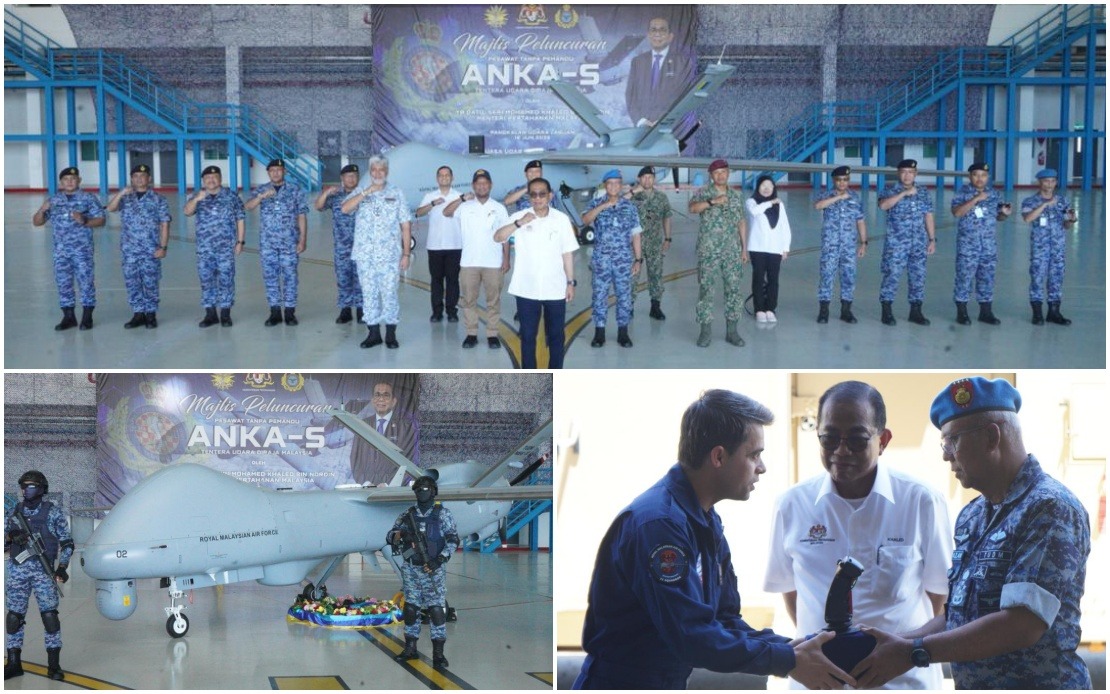
Malaysia has taken a decisive step in modernising its defence infrastructure with the operational launch of the ANKA-S Medium Altitude Long Endurance unmanned aircraft system at the Royal Malaysian Air Force base in Labuan. Defence Minister Datuk Seri Mohamed Khaled Nordin characterised the deployment as a watershed moment for the nation's ability to monitor and protect its maritime interests, particularly across the strategically vital South China Sea where Malaysia maintains competing territorial claims and must contend with increasing regional activity.
The three-aircraft acquisition, valued at RM423.8 million inclusive of ground control stations and comprehensive personnel training provisions, represents a substantial commitment to technological modernisation within Malaysia's defence apparatus. This investment reflects growing recognition among policymakers that traditional surveillance methods—whether crewed aircraft patrols or surface vessel deployments—carry prohibitive operational costs and limited endurance when tasked with monitoring the expansive maritime zones under Malaysian jurisdiction.
The ANKA-S platform brings considerable technical advantages to regional surveillance operations. Each aircraft can remain airborne for extended periods exceeding 24 hours continuously, operating at altitudes reaching 30,000 feet where detection becomes considerably more difficult. This endurance capacity directly translates to persistent coverage across maritime areas that previously required rotating deployments of manned aircraft or repeated costly vessel sorties. For a nation managing an archipelago spanning thousands of kilometres, the ability to maintain continuous aerial presence without constant rotation represents a meaningful force multiplication.
Beyond simple surveillance capability, the system's integrated intelligence gathering architecture enables the Royal Malaysian Air Force to transform raw observational data into actionable operational intelligence. The platform excels at identifying and tracking vessel profiles with precision, allowing strategic planners to distinguish between routine maritime traffic and potential security concerns. This targeting accuracy permits more focussed resource allocation to genuine intrusion locations rather than dispersing limited assets across unfocused patrol areas where threats may never materialise. The efficiency gains compound when considering that fighter aircraft or large maritime patrol vessels carry substantially higher per-hour operational costs.
Finance represents a critical consideration in Malaysia's defence planning, particularly given competing budgetary pressures across multiple security domains and broader economic commitments. The shift toward unmanned systems reflects international defence trends toward achieving greater operational coverage through technological leverage rather than pure asset multiplication. Where deploying additional crewed aircraft or patrol vessels would demand corresponding increases in maintenance infrastructure, fuel consumption, and personnel requirements, the ANKA-S provides augmented capability with more constrained resource demands. Defence planners characterise this approach as essential for maintaining surveillance effectiveness amid budgetary constraints.
Mohamed Khaled deliberately emphasised that Malaysia has opted not to equip the ANKA-S platforms with weapons systems, despite the aircraft's technical capacity for armament. This strategic choice carries significant diplomatic signalling value throughout Southeast Asia, where military modernisation programmes frequently trigger sensitivity regarding regional intentions. By explicitly selecting a surveillance-only configuration, Malaysia projects a defensive posture that emphasises sovereign protection rather than regional power projection. This messaging proves particularly salient given ongoing sensitivities surrounding territorial claims in the South China Sea, where any suggestions of military escalation invite scrutiny from competing claimants and larger powers monitoring regional stability.
The Labuan Air Base deployment location carries its own strategic logic. Positioned at Malaysia's northern maritime frontier, the installation provides optimal geographic coverage for monitoring approaches to the South China Sea from the northwest whilst maintaining accessibility for maintenance and personnel rotation. The base's existing infrastructure reduces implementation costs whilst its established security protocols facilitate integration of sensitive intelligence operations. Beyond these practical considerations, Labuan's positioning on Borneo places surveillance assets closer to disputed maritime zones, reducing transit time for urgent response deployments should circumstances warrant escalated monitoring.
Government statements indicate preliminary thinking toward a second phase acquisition of three additional aircraft, to be pursued under the established national development planning framework. Doubling the initial fleet would extend coverage across broader maritime areas and provide redundancy for maintenance cycles, ensuring persistent surveillance capability even during aircraft servicing. The phased acquisition approach balances budgetary prudence with demonstrated capability validation, allowing defence planners to assess operational experience from the current deployment before committing to expanded procurement.
For Malaysia's broader defence posture, the ANKA-S deployment reflects deepening recognition that contemporary maritime security challenges demand technological sophistication beyond traditional approaches. Rising regional activity in the South China Sea, intensifying competition for maritime resources, and evolving non-traditional security threats ranging from smuggling to unauthorised intrusions all necessitate enhanced monitoring capabilities. The unmanned platform addresses these multifaceted challenges through persistent presence that crewed alternatives cannot practically sustain.
The system's integration into No. 11 Squadron operations also signifies institutional commitment to unmanned systems development within the Royal Malaysian Air Force. Personnel training provisions built into the acquisition package ensure that operators develop genuine expertise in exploiting the platform's technical capabilities rather than approaching unmanned operations as merely modified conventional flying. This human capital investment proves essential for translating raw technological capability into genuine intelligence advantage. Over coming years, accumulated operational experience will inform doctrine development and potential future capabilities expansion.
Regionally, Malaysia's ANKA-S deployment carries implications extending beyond bilateral security concerns. Enhanced maritime surveillance capability positions Malaysia to contribute more effectively to regional awareness mechanisms and international maritime security cooperation frameworks. The platform's sophisticated intelligence gathering architecture enables Malaysian defence planners to participate in information sharing arrangements with partner nations, potentially strengthening cooperative arrangements for managing shared maritime challenges. This dimension proves particularly relevant given Malaysia's role in multilateral regional security dialogues and maritime governance initiatives spanning the Strait of Malacca and broader Southeast Asian waters.