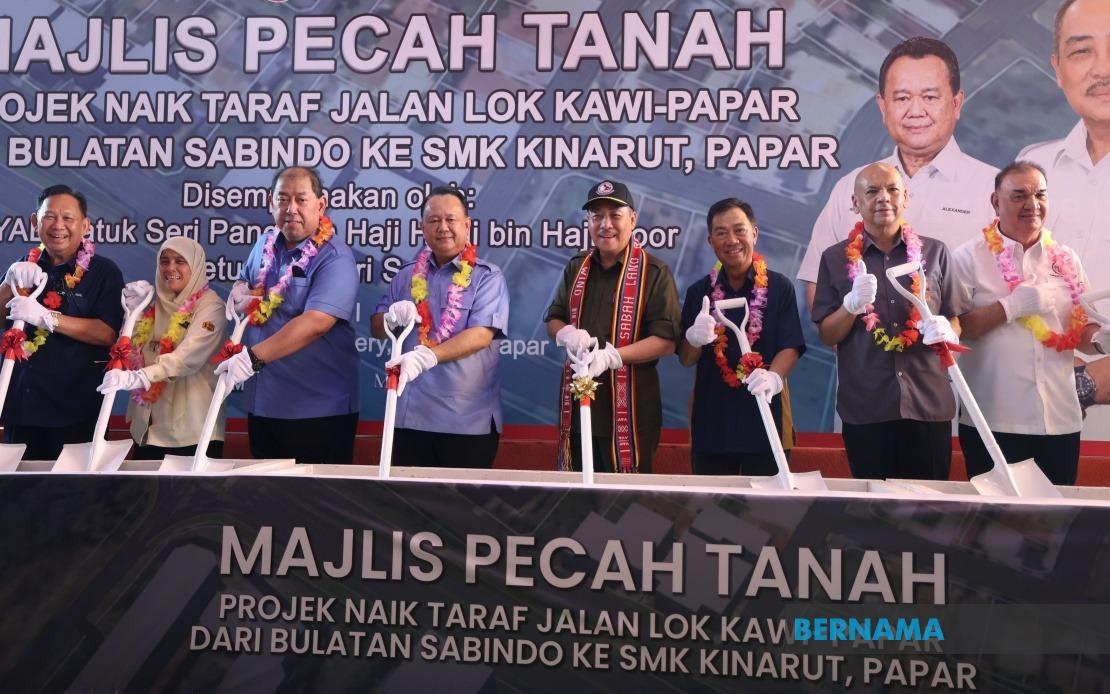
Sabah's government is moving ahead with a RM70.6 million infrastructure project aimed at tackling traffic congestion and enhancing road safety on Jalan Lok Kawi, a key route in one of the state's fastest-growing regions. The upgrade will transform the 1.3-kilometre stretch extending from Sabindo Roundabout to SMK Kinarut into a modern four-lane dual carriageway, addressing capacity constraints that have intensified as the Lok Kawi-Pengalat-Papar corridor undergoes rapid residential and commercial expansion.
Chief Minister Datuk Seri Hajiji Noor launched the groundbreaking ceremony for the project in Papar, framing it as evidence of federal commitment to strengthening transportation infrastructure across Sabah. The Works Ministry is spearheading the initiative, with support from Works Minister Datuk Seri Alexander Nanta Linggi and Papar Member of Parliament Datuk Armizan Mohd Ali, reflecting the project's importance to multiple governance levels. The undertaking signals recognition from federal leadership that rural and semi-rural Sabah regions require comparable infrastructure investment to support economic development and improve livelihood outcomes.
The Lok Kawi-Pengalat-Papar area has experienced remarkable transformation over recent years, with new residential subdivisions, educational facilities, government offices, and tourist destinations reshaping the local landscape. This development trajectory, while economically beneficial, has created pronounced traffic challenges, particularly during morning and evening peak periods when commuters, school traffic, and commercial vehicles converge on limited road capacity. Congestion not only frustrates road users but undermines the area's attractiveness to potential investors and visitors, creating a bottleneck that could constrain future growth if unaddressed.
Beyond simply widening the existing thoroughfare, the RM70.6 million project incorporates comprehensive safety and accessibility features reflecting contemporary urban planning principles. The scope includes construction of an overhead pedestrian bridge to safely separate foot traffic from vehicular movement, a covered walkway directly serving SMK Kinarut students, designated bus stops, and motorcycle parking shelters. These amenities acknowledge that road development should prioritise vulnerable users, particularly schoolchildren and public transport commuters who represent significant portions of daily traffic in suburban growth zones. The inclusion of such facilities demonstrates a design philosophy that treats road upgrades as opportunities to improve overall mobility ecosystem rather than simply increasing vehicle throughput.
Hajiji underscored the government's determination to prevent bureaucratic delays from derailing implementation, emphasizing that swift resolution of land acquisition and utility relocation matters is essential to maintaining the project timeline. His remarks highlight a persistent tension in Malaysian infrastructure development where coordination between federal and state agencies, combined with property acquisition complexities, frequently extends project durations beyond initial estimates. By publicly committing to expedited processes and calling for inter-agency cooperation, Sabah's leadership is attempting to establish accountability mechanisms and signal to contractors and the public that this initiative will not become mired in administrative obstacles common to comparable undertakings.
The transportation infrastructure enhancement forms part of broader strategy to position Papar as an emerging economic and tourism hub within Sabah. Officials anticipate that improved road connectivity and reduced travel times will stimulate commercial activity, encourage private investment, and enhance the area's accessibility to visitors from neighbouring Brunei and Sarawak. This regional connectivity aspect gains additional significance as the Pan Borneo Highway nears completion, creating multi-modal transportation opportunities that could establish Papar as a strategic stopover for cross-border commerce and leisure travel. The intersection of improved local roads with enhanced regional linkages amplifies the economic multiplier effects of individual infrastructure projects.
Concurrently with the Jalan Lok Kawi initiative, Sabah announced approval for the Second Papar Bridge project alongside riverbank protection and embankment stabilisation works along the Kogopon Intake. These complementary projects, collectively responding to requests from local parliamentary representation, indicate a coordinated approach to infrastructure development addressing multiple needs within the Papar constituency. River management works assume particular importance in Sabah's tropical climate where annual monsoon patterns and flash flooding pose ongoing risks to communities and infrastructure. Bundling road, bridge, and water management projects acknowledges integrated development thinking rather than siloed sector-specific planning.
The RM70.6 million expenditure reflects substantial investment in what remains a regional Sabah location, suggesting confidence in Papar's development potential and recognition of infrastructure backlogs across the state. For Malaysian readers across other regions experiencing similar traffic pressures and congestion challenges, the Sabah project offers instructive lessons regarding dual carriageway conversions, pedestrian safety integration, and coordinated multi-project implementation. The emphasis on completion according to schedule and resistance to bureaucratic delays particularly resonates in contexts where infrastructure projects frequently experience cost overruns and timeline extensions, undermining public confidence and economic planning certainty.
From a broader Southeast Asian perspective, Malaysia's approach to upgrading secondary regional roads demonstrates strategic thinking about inclusive development. Many neighbouring nations concentrate infrastructure investment in major metropolitan corridors, leaving secondary cities and growth corridors underdeveloped. By directing substantial resources toward emerging centres like the Lok Kawi-Pengalat-Papar area, Sabah's administration pursues decentralised prosperity rather than concentration of economic activity in primary urban zones. This pattern, if sustained across multiple constituencies and sectors, could influence regional distribution of economic growth and settlement patterns across Sabah.
The project timeline and implementation success will indicate whether Malaysian authorities can effectively deploy federal resources while maintaining responsive coordination with state-level governance. Successfully completing the Jalan Lok Kawi upgrade according to schedule would validate the infrastructure development models and inter-agency cooperation frameworks currently championed by Sabah's leadership, potentially establishing replicable templates for comparable undertakings across other Malaysian states navigating rapid urbanisation in previously rural constituencies. Conversely, delays or budget pressures would reinforce persistent concerns about project delivery capacity, even when political commitment and funding approval appear assured at senior governmental levels.

