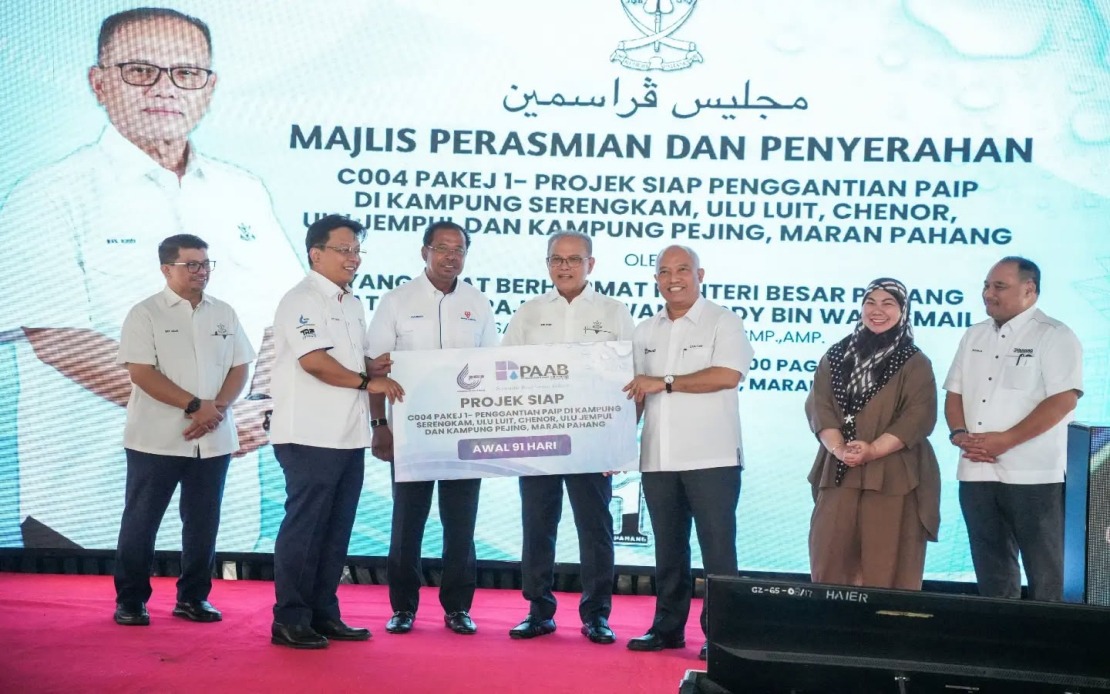
The water crisis that has plagued Maran for nearly 20 years is finally coming to an end. Pengurusan Aset Air Berhad (PAAB), the federal asset management company for water services, has completed a RM11.19 million pipe replacement initiative that directly addresses the chronic supply disruptions residents, particularly in Chenor sub-district, have endured for far too long. The project, which finished three months ahead of schedule, represents a significant milestone in Pahang's broader infrastructure transformation and underscores renewed commitment to resolving water woes across the state.
The scope of the undertaking was substantial. Across multiple villages including Kampung Serengkam, Ulu Luit, Pejing, Ulu Jempul and Chenor, PAAB replaced 29.6 kilometres of aging and corroded piping infrastructure. What may seem like a straightforward technical exercise carries profound implications for everyday life in these communities. For two decades, residents have contended with recurring pipe bursts, erratic pressure fluctuations, and intermittent supply—conditions that disproportionately affect vulnerable populations and constrain economic activities. The remedial work tackles the fundamental cause rather than offering temporary fixes, positioning the district for sustainable water security.
Beyond merely restoring supply, the project delivers measurable operational improvements across the distribution network. Non-revenue water losses—a persistent challenge across Malaysian water utilities where significant volumes leak before reaching consumers—should decline noticeably. Water pressure stabilisation, particularly critical during peak demand periods such as the dry season and festive holidays when population concentrations spike, addresses a recurring headache for households and small businesses. The elimination of frequent burst pipes eliminates both the acute service disruptions and the ongoing expense of emergency repairs that drain municipal budgets.
Almost 10,000 residents across Maran now benefit directly from these improvements. While the figure may appear modest in national terms, the concentrated impact on a district-level community cannot be understated. Access to reliable clean water underpins public health, educational outcomes, and economic productivity. Residents no longer need to maintain expensive backup water storage arrangements or restrict consumption patterns based on supply uncertainty. This foundational improvement enables families to invest time and resources into other priorities rather than managing water insecurity.
The project's completion attracted high-level political recognition. Pahang Menteri Besar Datuk Seri Wan Rosdy Wan Ismail officially handed over the infrastructure at the Chenor Water Treatment Plant, with participation from Deputy Energy Transition and Water Transformation Minister Datuk Seri Abdul Rahman Mohamad and Deputy Economy Minister Datuk Mohd Shahar Abdullah. This presence reflects water services' prominence within Malaysia's broader development agenda, positioning infrastructure investment as central to state-level progress.
Maran represents merely one component of an expansive strategic framework. Over the subsequent three years, PAAB and its state counterpart Pengurusan Air Pahang Berhad (PAIP) intend to pursue coordinated water infrastructure development across multiple districts. At the Jengka Utama Water Treatment Plant, electrical system upgrades will enhance the clean water pumping station's capacity, resolving supply issues affecting Felda Jengka communities. These complementary initiatives demonstrate progression from reactive problem-solving to proactive network modernisation.
Two additional major projects underscore this trajectory. A RM35.7 million undertaking will replace 76.2 kilometres of deteriorating pipes across Jerantut and Lipis, extending to areas around Pulau Tawar and Kuala Tahan. Simultaneously, an RM13 million project will replace 11 kilometres of water pipes in Felda Keratong, enhancing the water supply system's operational efficiency throughout Rompin. Collectively, these initiatives address infrastructure deficiencies that have persisted for decades while positioning the state's water sector for improved resilience.
The financial commitment substantially reflects this priority. As of July, PAAB had allocated RM1.17 billion specifically for Pahang's water infrastructure development. Of this allocation, RM69.79 million had reached completed projects, RM66.94 million supported ongoing construction, while RM981.04 million remained earmarked for planning and design phases. This distribution suggests that initial project commencement has accelerated, with substantial additional work anticipated in coming years. Such sustained investment indicates confidence that water security will be progressively strengthened across the state.
These local initiatives align with broader federal strategy. The Ministry of Energy Transition and Water Transformation (PETRA) oversees PAAB, which was established in 2006 under the Water Services Industry Act 2006 as part of the National Water Services Industry Restructuring Plan. This institutional framework positions water security within long-term national infrastructure transformation rather than as episodic emergency response. PAIP's 2020 signing of the Pahang State Water Supply Services Restructuring Agreement formalised state-level participation in this federal vision.
For Malaysian water consumers and policymakers, the Maran outcome offers both practical reassurance and strategic validation. Specific challenges can be systematically resolved through sustained investment and coordinated institutional action. The two-decade wait for basic supply reliability represents unacceptable infrastructure neglect, but completion ahead of schedule demonstrates that adequate funding and professional management can accelerate remediation. As Southeast Asia's economies intensify development pressures on water resources, Malaysia's experience with infrastructure modernisation carries instructive lessons regarding sustained commitment requirements.
The success also highlights interdependencies between federal resource allocation and state-level implementation capacity. PAAB's funding, combined with PAIP's operational expertise, created conditions for effective project delivery. This public sector partnership model, when functioning effectively, can achieve outcomes neither entity could accomplish independently. Extending such collaboration across multiple districts and years requires institutional discipline and political consistency—resources proving increasingly valuable as water stress intensifies regionally.
Moving forward, the challenge extends beyond individual project completion toward establishing comprehensive, anticipatory infrastructure frameworks. Maran's resolution offers a foundation, but systematic upgrading across all Malaysian districts demands sustained fiscal commitment and technical capability development. The RM1.17 billion Pahang allocation, while substantial, represents just one state's requirements. National water security demands comparable investment intensity across all regions, with particular urgency in rapidly urbanising areas confronting concurrent demand surges and aging infrastructure.

