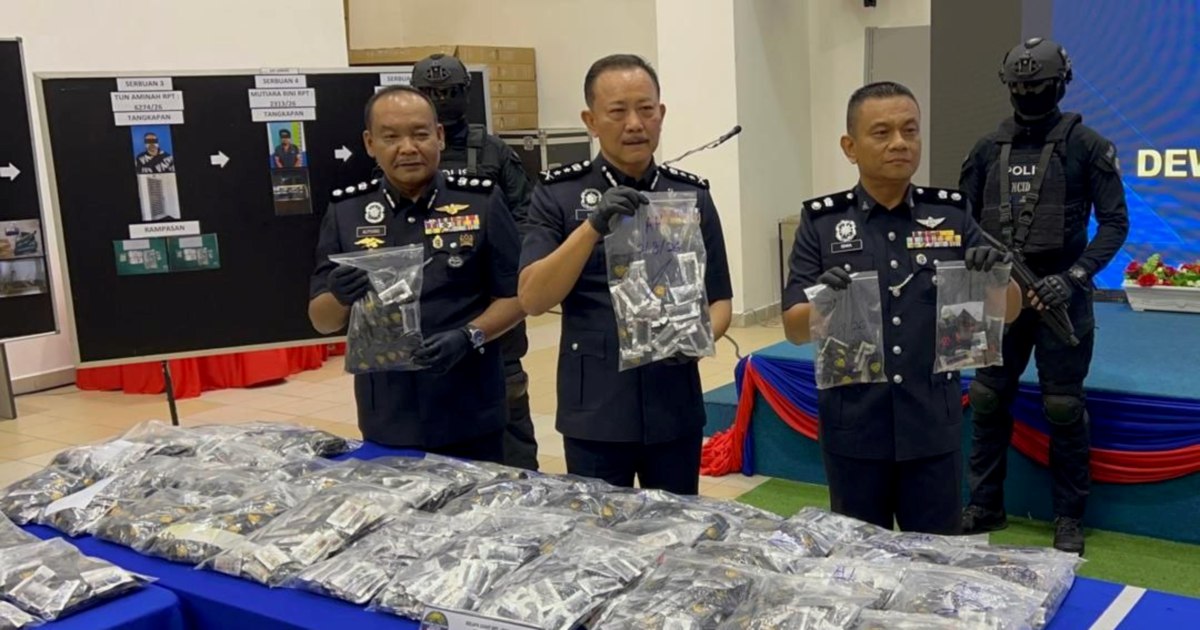
Police in Johor have successfully brought down a sophisticated drug manufacturing and distribution network that specialized in producing illicit vape cartridges. The operation, which culminated on Sunday with the arrest of seven individuals across five coordinated locations throughout the state, represented a major enforcement success against an emerging category of drug-related crime that has increasingly concerned authorities across the region.
The confiscated inventory totalled RM10.68 million in street value, underscoring the substantial financial scale of this particular criminal enterprise. Such figures illustrate not merely the volume of contraband involved, but the profitability driving these operations and the lucrative black market demand for designer drug products among young consumers. The use of vape devices as delivery mechanisms for controlled substances has presented law enforcement with novel investigative challenges, as the items themselves remain legal in most jurisdictions, making detection and interdiction significantly more difficult than traditional contraband.
The synchronized nature of the raids—conducted simultaneously across five separate locations—demonstrates the intelligence-gathering capacity and operational coordination that Malaysian police have developed to combat organized drug trafficking. Such precision interventions typically require extensive surveillance, informant networks, and cooperation between federal and state authorities. The multi-location approach was clearly designed to minimize warning time for network members and prevent evidence destruction or dispersal of remaining inventory.
The emergence of drug-infused vaping products represents a troubling evolution in how criminal syndicates adapt to changing consumer preferences and technological landscapes. Unlike traditional smoking methods, vape cartridges offer discretion, ease of transport, and reduced detectability—factors that make them increasingly attractive for illicit drug distribution. This trend has been observed across Southeast Asia and internationally, with law enforcement agencies struggling to develop appropriate regulatory and enforcement frameworks for products that blur the boundary between legitimate consumer goods and drug paraphernalia.
For Malaysian readers and policymakers, this case highlights the interconnection between lifestyle trends, technology adoption, and emerging drug threats. Young Malaysians' growing familiarity with vaping culture—often perceived as less harmful than traditional cigarettes—may inadvertently create receptive markets for criminal actors seeking to integrate controlled substances into seemingly innocuous consumer products. The psychological appeal of designer or flavored products, combined with social normalization of vaping, creates conditions where drug-infused variants can circulate within peer networks with minimal suspicion.
The arrest of seven individuals likely represents a cross-section of the distribution chain, from manufacturing operators to street-level dealers, though official statements regarding the specific roles of each suspect remain pending. Understanding the hierarchical structure of such organizations is crucial for prosecution strategy and for identifying any remaining network connections that law enforcement may need to pursue. The scope of the operation—spanning five different locations—suggests either a vertically integrated organization or partnerships between multiple criminal entities, both scenarios requiring distinct enforcement responses.
The seizure also raises questions about supply chain origins and the source of precursor chemicals or base formulations used in the manufacturing process. Such operations typically rely on imported components or uncontrolled chemical supplies, suggesting possible international trafficking connections that may warrant investigation at a customs and border security level. Regional cooperation through mechanisms like ASEAN would be valuable in tracing such supply networks and disrupting them at source.
Beyond the immediate criminal enforcement dimension, this case underscores the importance of public health communication and education. Many young Malaysians may lack awareness of the specific risks associated with drug-laced vaping products, viewing them as safer alternatives to traditional consumption methods. Health authorities would benefit from targeted campaigns explaining how illicit vape products can deliver unpredictable dosages of harmful substances, increasing risks of overdose, addiction, and severe health complications. The discrete nature of vaping also complicates parental monitoring and harm recognition.
The RM10.68 million valuation reflects not only the quantity seized but also the profit margins typical in this sector, which far exceed those of conventional drug distribution. This economic incentive ensures that disrupting one syndicate will likely prompt others to attempt similar operations unless structural enforcement and regulatory approaches are strengthened. Johor's position as a major commercial and logistics hub—coupled with its proximity to Singapore and international ports—may make it particularly vulnerable to such networks seeking efficiency in transshipment and distribution.
Moving forward, sustained vigilance and intelligence-led policing will be essential to prevent reconstitution of this or similar operations. The interdiction also serves as a reminder that modern drug threats often employ sophisticated adaptations to exploit regulatory gaps and consumer trends. Continued cooperation between federal narcotics authorities, state police, customs, and health agencies—along with coordination with neighboring countries and international drug enforcement bodies—will be fundamental to combating this evolving challenge and protecting vulnerable populations from the dangers of illicit drug consumption.

