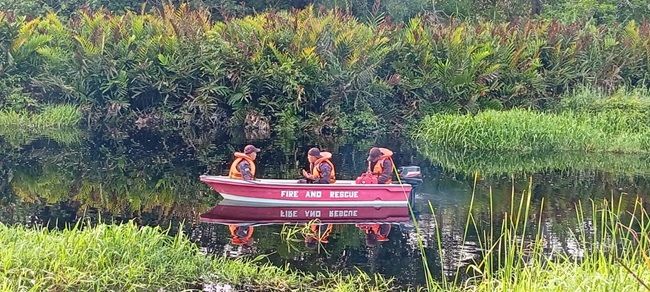
Authorities in Brunei are pressing forward with an intensive search effort for a man believed to have been attacked by a crocodile in Kampong Baru Sungai Bera, with rescue operations now spanning three days and yielding no sign of the victim. The incident underscores the persistent dangers posed by wildlife in the riverine environments of Southeast Asia, where crocodile encounters remain a hazard for fishing communities and residents living along waterways.
The Fire and Rescue Department (FRD) has mobilized significant resources to locate the missing individual, deploying multiple search methodologies to comb the affected area. River patrols using FRD vessels have been systematically traversing Sungai Bera, while teams have simultaneously conducted ground-level searches along the riverbanks to locate any trace of the victim. Aerial reconnaissance has been incorporated into the operation, with the department's unmanned drone systems providing overhead coverage of the water and surrounding terrain—a technological approach increasingly common in Southeast Asian rescue operations seeking to improve coverage and reduce response times in remote or difficult-to-access zones.
The coordinated nature of the response reflects Brunei's multi-agency approach to search and rescue incidents. Beyond the FRD's core involvement, the Royal Brunei Police Force (RBPF) has committed personnel to the operation, including specialized units such as the Marine Police (POLMAR) and officers from Seria Police Station. The Wildlife Division has also been integrated into the response framework, a crucial addition given that understanding crocodile behaviour and habitat is essential for predicting where an injured or satiated animal might move. This convergence of emergency services, law enforcement, and wildlife expertise demonstrates a coordinated approach that could serve as a model for cross-agency responses throughout the region.
Operations are being directed by Senior Superintendent Amirul Hadi Junaidi, the Commanding Officer of the Operations Branch, who oversees the strategic coordination of personnel and resources deployed across the water and land elements of the search. The structured command hierarchy ensures that decisions about resource allocation, search patterns, and tactical adjustments are made systematically rather than in an ad-hoc manner—a critical factor when operations extend beyond the initial hours into multiple days.
The incident was reported on Wednesday, June 24, when the FRD received a distress call indicating a male victim had been attacked by a crocodile. An initial response team comprising two fire engines and nine personnel, led by Acting Station Officer Mohd Zulkifli Md Tahir, was dispatched to the location. Upon reaching the scene, preliminary investigations conducted with the victim's family confirmed that he had been fishing in the river when the attack occurred—a detail that reinforces the vulnerability of individuals engaging in subsistence or recreational fishing activities in crocodile-inhabited waters.
The establishment of a Tactical Command Post at the site allowed the FRD to coordinate its response operations from a centralized location, facilitating real-time communication and decision-making as the search evolved. This infrastructure enabled the rapid deployment of firefighting assets and personnel in support of search activities, moving beyond traditional fire suppression capabilities to encompass the broader rescue mission. The integration of drone technology into the search operation reflects contemporary emergency response practices, allowing rescuers to obtain visual intelligence without placing personnel in potentially dangerous positions.
Crocodile attacks in Southeast Asia, while relatively uncommon relative to the region's large population and extensive waterway networks, carry significant consequences when they occur. The incident in Sungai Bera highlights the ongoing tension between human activities—particularly subsistence fishing—and wildlife conservation in areas where large predators coexist with human communities. For Malaysian readers familiar with similar freshwater ecosystems across the peninsula and in Sabah and Sarawak, the incident serves as a sobering reminder of the risks inherent in fishing and water-based activities in crocodile habitat without appropriate precautions.
The continuation of the search into its third day reflects both the commitment of Brunei's emergency services and the inherent challenges in locating a missing person in a river environment. Currents, underwater terrain, and the behaviour of the suspected crocodile all complicate the search effort. Extended searches of this nature impose significant demands on personnel and resources, yet abandoning the operation prematurely risks missing critical opportunities to locate the victim or gather evidence about what transpired.
The incident also raises broader questions about wildlife management and public safety in the region. As human settlements expand and more individuals engage in water-based activities in areas inhabited by crocodiles, governments and communities must balance conservation imperatives with the safety of citizens and visitors. Education campaigns, designated safe fishing zones, and warning systems can all play roles in reducing encounter risks. The experience of agencies like Brunei's FRD and RBPF in managing such incidents provides valuable lessons for other jurisdictions throughout Southeast Asia grappling with similar challenges.
As the search continues, the professionalism demonstrated by the multiple agencies involved offers some reassurance to families and communities affected by wildlife incidents. However, the absence of any trace of the victim after three days suggests that outcomes in such cases often reflect the tragic nature of crocodile encounters—incidents where the balance of power lies decisively with the animal. The determination of rescue teams to pursue the search reflects both institutional commitment to the missing individual and respect for the trauma experienced by his family and community.

