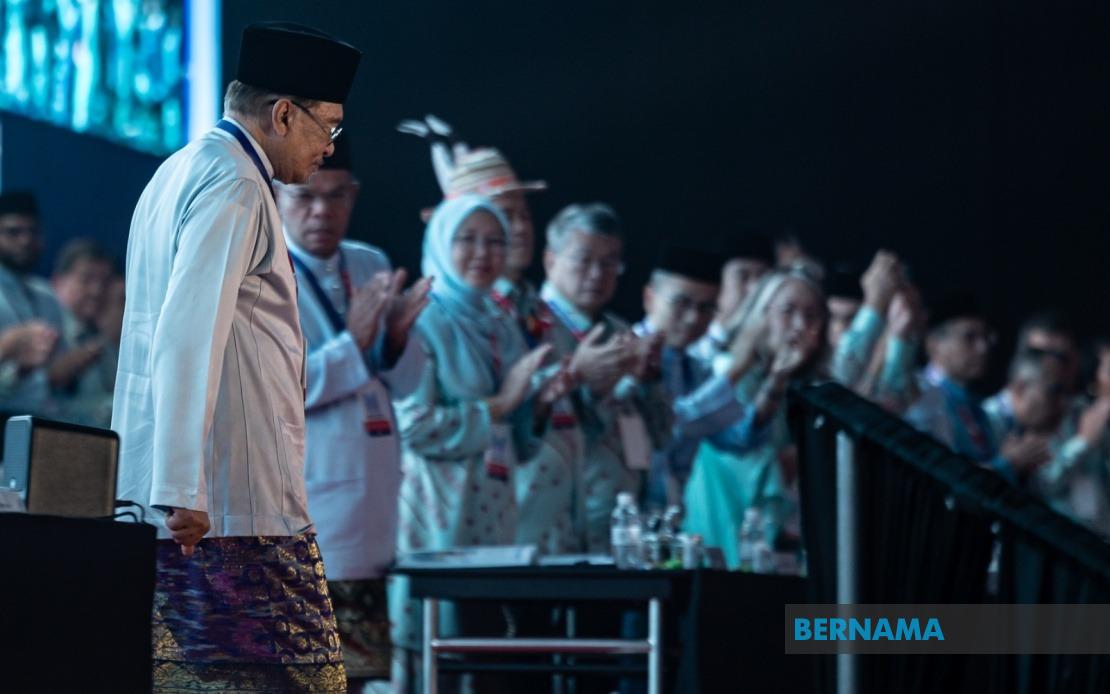
Prime Minister Datuk Seri Anwar Ibrahim mounted a robust defence of his administration's reform record at the PKR National Congress in Melaka yesterday, emphasizing that tangible progress has been made even as demands for accelerated change continue to mount. Speaking in his capacity as both head of government and party president, Anwar acknowledged the tension between those seeking comprehensive transformation and the practical realities of governing through consensus, arguing that crediting past achievements should not preclude calls for additional reforms.
The Prime Minister outlined an impressive roster of legislative accomplishments that he positioned as evidence of substantive institutional change. These included amendments to the Audit Act 1957, modifications to the Parliamentary Service Act, passage of the Public Finance and Fiscal Responsibility Act 2023, creation of a Special Task Force on Agency Reform, and enactment of twin pieces of progressive legislation covering consumer credit and the rights of gig workers. For Malaysian observers tracking the trajectory of governance reform, these represent areas where the government has moved decisively to address longstanding gaps in accountability, parliamentary oversight, and worker protections that had remained unaddressed across six decades of previous administration.
Anwar's framing of reform progress must be understood within the specific context of Malaysia's political architecture. The formation of the Unity Government following the 2022 general election required delicate negotiations between parties with divergent priorities and constituencies. As chairman of Pakatan Harapan, Malaysia's principal coalition component, Anwar has had to balance the reform aspirations that propelled his coalition to power against the need to accommodate coalition partners with different reform priorities and timelines. This constraint has shaped both the pace and sequencing of legislative initiatives, creating the appearance of gradualism that critics attribute to political caution or lack of will.
The Prime Minister's remarks reveal an important analytical distinction between rhetorical commitment to reform and the institutional mechanics of implementation. Anwar argued that transformative change cannot simply be legislated wholesale but rather requires careful foundation-building to ensure new frameworks take root within existing bureaucratic structures. This speaks to a recognized challenge in governance reform across the region: legislative amendments frequently exceed the capacity of administrative systems to properly implement them, rendering new laws ineffective or subject to circumvention. Malaysia's experience with previous reform initiatives supports this cautious approach, even if it frustrates those seeking immediate, comprehensive change.
The political economy of coalition governance in Malaysia adds another layer to understanding Anwar's defensive posture. The Unity Government represents an unprecedented alignment of ideologically disparate parties whose consensus extends primarily to governance stability and incremental institutional reform rather than transformative restructuring. For Malaysian readers familiar with the political calculations at play, Anwar's emphasis on phased implementation and foundation-building reflects hard negotiation with partners who might otherwise block or dilute reform measures. The Prime Minister's acknowledgement that "not all steps taken by the government had been perfect" signals both realistic assessment and implicit communication that acceptable compromises have been necessary.
The three-year timeframe that Anwar invoked carries significance in Malaysia's reform trajectory. Successive administrations have made reform promises that languished unfulfilled for years, creating constituency fatigue and skepticism about government intentions. By contrasting the current period against the "60 years before this," Anwar positioned recent achievements as remarkable relative to historical paralysis. This comparative framework is rhetorical but not entirely hollow: the cumulative legislative record does represent meaningful movement on previously intractable issues, even if the pace falls short of what reform advocates demand.
The consumer credit legislation and gig worker protections that Anwar highlighted merit particular attention for Southeast Asian audiences. These measures address modern economic vulnerabilities that traditional regulatory frameworks failed to anticipate or address. The gig worker legislation, in particular, represents Malaysia's attempt to formalize protections for digital economy participants at a time when regional governments are still grappling with how to regulate platform-based employment. While the effectiveness of these measures remains to be demonstrated through implementation, their passage reflects governmental capacity to identify emerging policy challenges and respond legislatively.
Yet Anwar's speech implicitly reveals the limits of the reform agenda as currently configured. The reforms he catalogued focus primarily on institutional transparency, parliamentary procedure, fiscal responsibility, and regulatory modernization. They do not encompass the more fundamentally disruptive changes that some reform advocates seek, particularly regarding judicial independence, executive accountability mechanisms with real enforcement capacity, or restructuring of security force oversight. The gap between Anwar's reform record and the more ambitious agenda sought by civil society organizations suggests that the Unity Government's reform framework, while real, remains fundamentally conservative in ambition.
The political sustainability of Malaysia's reform trajectory will depend partly on whether the administration can demonstrate tangible citizen benefits flowing from legislative changes. Reforms that remain confined to elite institutional spheres or produce results visible only to policy specialists risk losing momentum among broader constituencies. The consumer credit protections and gig worker rights, if effectively implemented, could help bridge this gap by producing observable improvements in ordinary Malaysians' economic security. Conversely, implementation failures could fuel cynicism about whether legislative reform translates into genuine change.
For governance observers across Southeast Asia, Malaysia's experience offers a useful case study in the challenges of reform within multi-party coalition systems. The tension Anwar articulated between those demanding rapid, comprehensive transformation and those advocating measured, phased change reflects a broader regional pattern where democratic openings create heightened expectations that governmental capacity and political consensus often cannot immediately satisfy. Malaysia's approach of pursuing achievable reforms within coalition constraints, while frustrating to those seeking deeper change, may ultimately prove more durable than more ambitious agendas that exceed the political bandwidth available for implementation.
Anwar's speech ultimately represented an argument that progress, while incomplete, should neither be erased nor used as justification for complacency. This middle-ground positioning may frustrate purists on both sides: those who believe Malaysia requires far more fundamental institutional reconstruction, and those who view the reform agenda as destabilizing to necessary administrative continuity. Yet it reflects the practical calculus that governs reform implementation in plural democracies where consensus must be continuously negotiated.

