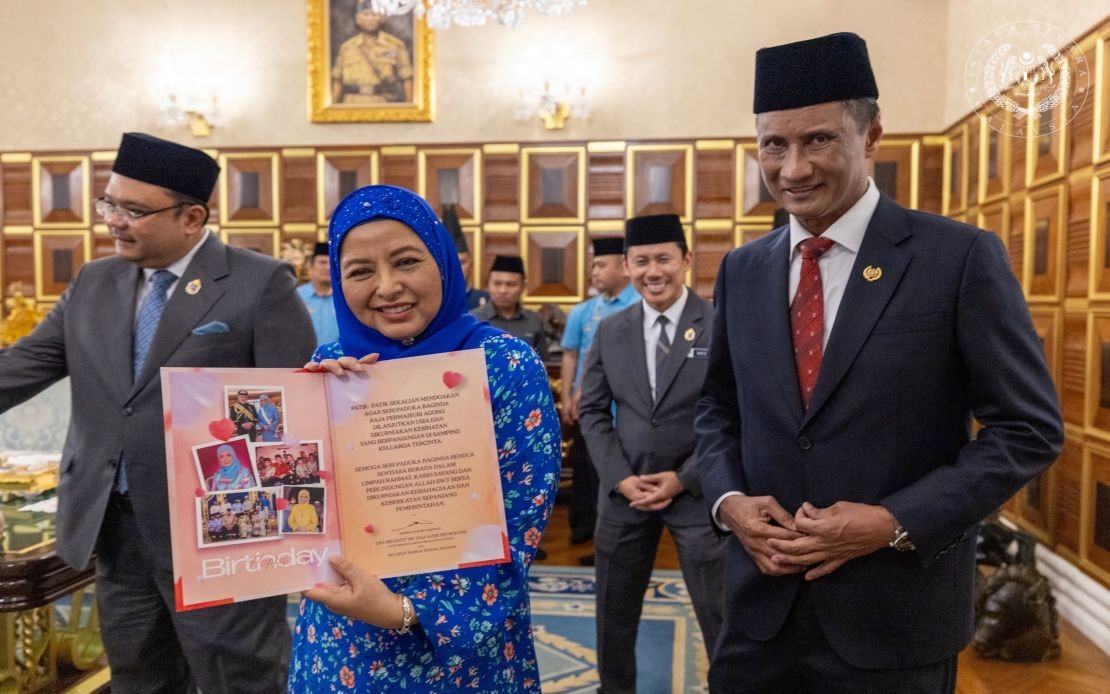
Her Majesty Raja Zarith Sofiah, Queen of Malaysia, marked another year of her life with a formal royal ceremony at Istana Bukit Serene in Johor, where senior officials from the royal household paid their respects and delivered birthday greetings on Wednesday. The occasion brought together key figures from Istana Negara to extend the institution's collective appreciation for the Queen, underscoring the ceremonial traditions that characterise the Malaysian monarchy's daily functioning.
The gathering included Tan Sri Dr Azmi Rohani, who holds the prestigious position of Comptroller of the Royal Household, and Datuk Azuan Effendy Zairakithnaini, serving as Datuk Paduka Maharaja Lela, or Grand Chamberlain. These senior positions within the palace hierarchy represent the administrative and ceremonial backbone of Istana Negara, the official seat of the Malaysian monarchy. Their presence alongside the Queen reflected the formal nature of the celebration, emphasising protocol and respect within Malaysia's constitutional monarchy framework.
Also attending the birthday reception was Puan Sri Dr Noor Azizah Abdul Latif, wife of the Comptroller, broadening the circle of well-wishers from within the palace establishment. The inclusion of spouses in such occasions demonstrates how palace ceremonies often extend beyond purely official duties to encompass broader family and institutional networks that support the royal household's operations.
The presentation of gifts held particular symbolic significance within the context of royal celebrations in Malaysia. The Queen received a specially prepared cake alongside yellow glutinous rice, both items offered by the senior management and broader staff contingent of Istana Negara. These gifts, whilst modest in material terms, represent the formal acknowledgement by palace employees of their sovereign's birthday, a tradition that reinforces institutional loyalty and the hierarchical respect inherent to palace culture.
Yellow glutinous rice, known as pulut kuning in Malay, carries cultural weight within Malaysian tradition, often prepared for celebrations and significant occasions. Its presentation alongside a birthday cake symbolised the blending of local customs with contemporary ceremonial practices, reflecting how the Malaysian monarchy incorporates both traditional and modern elements into its public and private observances.
Through Tan Sri Dr Azmi Rohani, the entire Istana Negara establishment transmitted formal wishes for the Queen's continued health, well-being and happiness. Such messages, delivered through official channels during structured ceremonies, serve multiple functions within institutional settings: they reaffirm institutional values, demonstrate unity within the palace hierarchy, and provide official documentation of the monarchy's wellbeing and activity.
The confirmation of this event through Sultan Ibrahim Sultan Iskandar's Facebook page highlights how contemporary Malaysian royalty utilises social media platforms to communicate with the broader public about official activities and family moments. This digital transparency represents a marked shift from previous decades, when royal activities remained largely confined to traditional media channels and official announcements. The use of the King's personal social media account to document the Queen's birthday celebration reflects evolving approaches to royal communication in Southeast Asia's increasingly digital landscape.
For Malaysian citizens and regional observers, such occasions provide glimpses into the operational rhythms of the monarchy. The formal structure of birthday receptions, the careful documentation of attendance, and the public sharing of celebratory moments all contribute to a broader narrative about Malaysia's constitutional monarchy and its adaptation to contemporary governance expectations. These ceremonies, whilst appearing routine, represent essential institutional practices that maintain continuity and predictability within the royal establishment.
The role of senior palace officials in such occasions extends beyond ceremonial nicety. The Comptroller of the Royal Household and the Grand Chamberlain are responsible for managing complex logistics, maintaining protocols, and ensuring that all aspects of royal life operate smoothly. Their participation in birthday celebrations reflects their core responsibility to support and honour the monarchy's members, making such events integral to their professional obligations.
Regionally, Malaysia's approach to royal celebrations offers insight into how constitutional monarchies function across Southeast Asia. Unlike absolute monarchies, Malaysia's system requires careful balance between ceremonial respect for the institution and public accountability. Birthday celebrations for senior royal figures, conducted with formality yet documented transparently, exemplify this balancing act. The public nature of such events, despite their official setting, reinforces the principle that even the monarchy's private moments occur within a framework of public awareness and institutional oversight.
The timing and location of this celebration at Istana Bukit Serene, the royal palace in Johor, also underscores the constitutional significance of the individual sultanates within Malaysia's federal system. Each state maintains its own royal household and ceremonial traditions, whilst the Yang di-Pertuan Agong and the Queen conduct additional responsibilities at the federal level. This layered approach to royalty reflects Malaysia's complex constitutional architecture, where nine hereditary rulers share sovereignty through a rotating system of federal monarchy.

