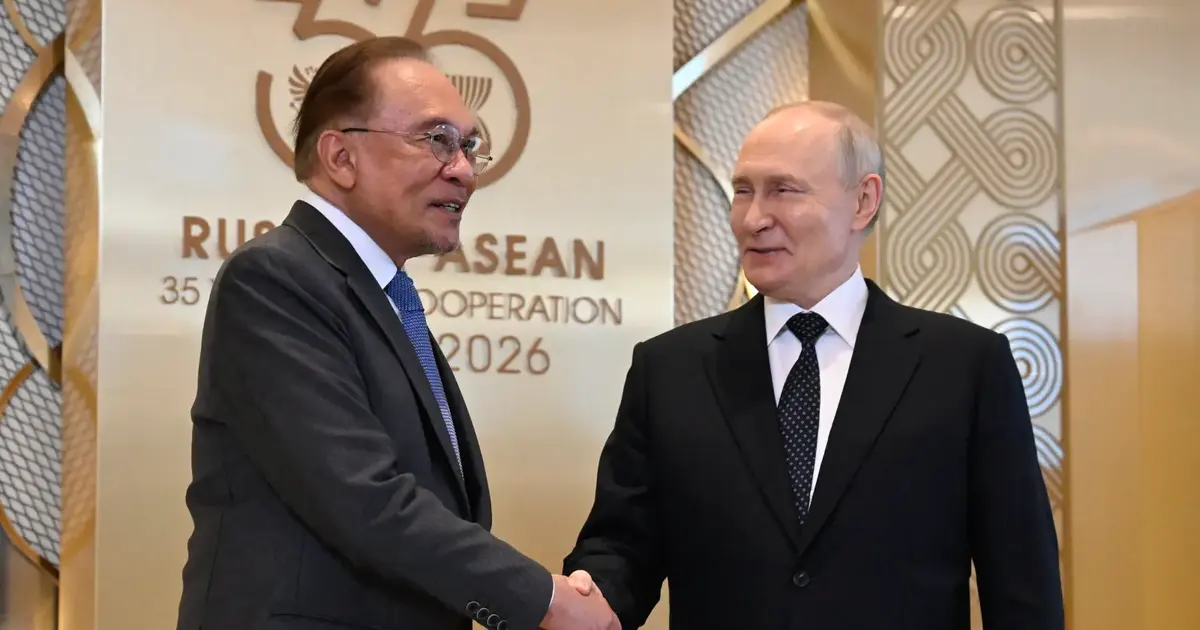
Prime Minister Anwar Ibrahim has secured a significant commitment from Russia to maintain steady supplies of oil and gas to Malaysia over the next two decades, marking a strategic partnership development in energy security during a period of global supply chain volatility. The assurance from President Vladimir Putin reflects deepening bilateral cooperation between the two nations at a time when energy markets remain sensitive to geopolitical disruption and pricing fluctuations.
Malaysia's energy landscape has become increasingly important to the broader Southeast Asian region, as the country balances its role as both an energy consumer and a producer with dwindling domestic reserves. The long-term supply commitment from Russia provides a degree of predictability for Malaysian policymakers planning industrial development and managing inflation pressures linked to energy costs. Such agreements typically involve complex pricing mechanisms and delivery schedules that extend well beyond immediate contract terms.
The timing of this arrangement carries particular significance given current global energy dynamics. Western sanctions against Russian energy exports have created both challenges and opportunities for non-Western nations seeking to establish or deepen energy partnerships. Malaysia's willingness to commit to a two-decade relationship demonstrates confidence in the stability of such arrangements and suggests that the country views Russia as a reliable counterbalance to traditional energy suppliers.
Beyond energy matters, Anwar Ibrahim is leveraging his regional diplomatic presence to expand Malaysian commercial opportunities throughout East Asia. The premier's concurrent engagement with Turkmenistan indicates a broader strategy of diversifying Malaysia's trading relationships and securing access to key export markets across the continent. China, Japan and South Korea collectively represent some of the world's largest and most economically dynamic markets, making successful export expansion there critical for Malaysian economic growth.
Turkmenistan's strategic position in Central Asia makes it a valuable diplomatic hub for Malaysian interests seeking to penetrate Asian supply chains and investment networks. The country serves as a gateway to energy resources and serves as a crossroads for trade connecting Europe, the Middle East and East Asia. By engaging Turkmenistan directly, Malaysia signals its intent to play a more active role in transcontinental commerce rather than remaining confined to Southeast Asian regional markets.
For Malaysian exporters, particularly those in manufacturing, petrochemicals and technology sectors, improved market access in China, Japan and South Korea could substantially increase revenue streams and provide valuable foreign currency earnings. These three economies have sophisticated supply chain networks and considerable purchasing power, making them attractive destinations for Malaysian goods and services. Competition for market share in these countries remains intense, but government-level diplomatic engagement can help Malaysian companies overcome entry barriers and establish long-term trading relationships.
The dual-track approach—securing energy supplies while simultaneously opening export pathways—reflects sophisticated economic statecraft by the Malaysian government. By addressing both import and export dimensions of trade simultaneously, policymakers can improve the overall balance of payments position and reduce vulnerability to external economic shocks. This strategy also supports domestic employment by encouraging manufacturing expansion oriented toward export markets.
Energy security remains a fundamental concern for Malaysia, which despite its offshore petroleum and natural gas resources faces gradually declining production rates from maturing fields. Importing nations in Southeast Asia cannot simply rely on abundant regional supplies indefinitely, making long-term import agreements with distant suppliers increasingly necessary for industrial planning. The 20-year timeframe allows Malaysian utilities and energy-intensive manufacturers to make capital investments with confidence about future fuel availability.
Russia's positioning as a long-term energy partner to Malaysia also reflects Moscow's broader strategic interests in Asia-Pacific. With European markets becoming less accessible due to sanctions, Russian energy companies have increasingly turned toward Asian buyers willing to purchase their output. Malaysia represents one of several Southeast Asian nations cultivating energy partnerships with Russia, suggesting a broader pattern of energy realignment in the region away from traditional Western suppliers.
The commercial implications for Malaysian businesses extend beyond direct energy costs. Stable energy pricing reduces uncertainty in industrial planning and allows manufacturers to offer more competitive pricing to international customers. When companies can reliably forecast utility expenses, they invest more confidently in expansion, research and workforce development. This indirect benefit of energy security agreements can stimulate economic activity across multiple sectors.
Malaysia's active diplomatic engagement in both energy and trade matters demonstrates how emerging market economies can leverage geographical position and non-alignment as strategic assets. Rather than remaining passive consumers of international agreements negotiated by larger powers, the Malaysian government is proactively constructing bilateral relationships that serve national economic interests. This approach requires skilled diplomatic personnel and consistent policy frameworks that maintain relationships across different international alignments.
The announcement also carries implications for Malaysia's position within ASEAN and global trade dynamics. As the region increasingly focuses on securing its own energy future and expanding export competitiveness, bilateral initiatives like those pursued by Anwar Ibrahim contribute to broader Southeast Asian economic resilience. The successful conclusion of both energy and trade negotiations during this visit would validate Malaysia's approach to diversified international engagement and provide a template for other regional nations pursuing similar objectives.

