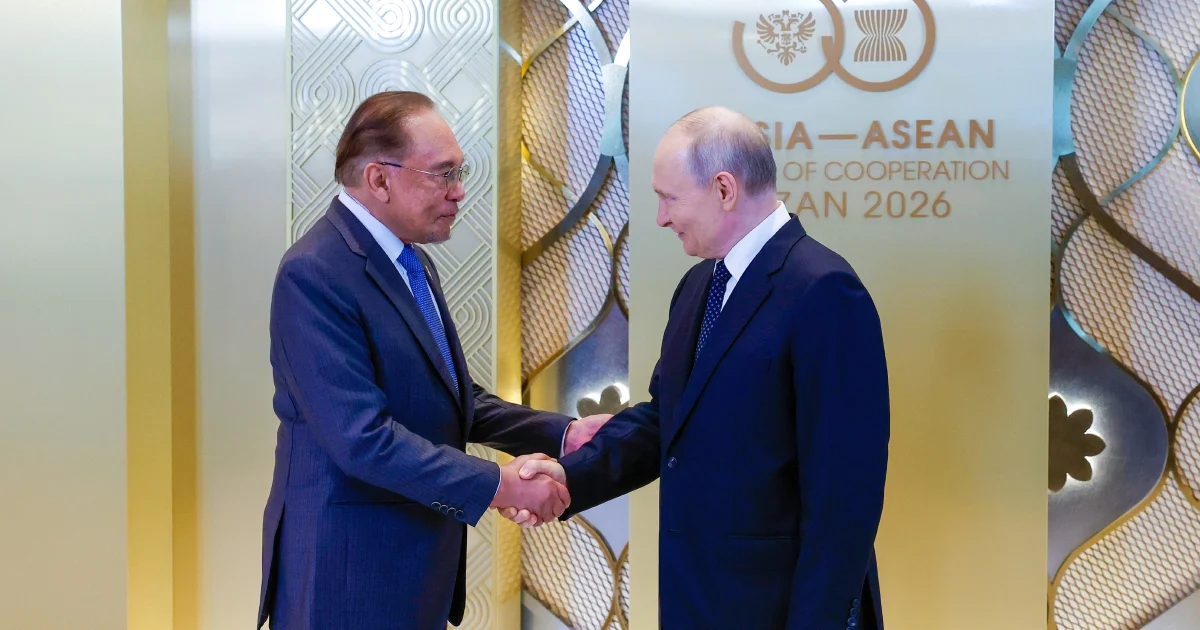
Malaysia is moving decisively to anchor its energy security through expanding relationships with major global suppliers, Prime Minister Datuk Seri Anwar Ibrahim revealed during remarks in Bintulu, signalling a strategic shift toward geographic diversification in fuel procurement. The assurance from Russian President Vladimir Putin underscores a growing alignment between Kuala Lumpur and Moscow on energy cooperation, reflecting Malaysia's pragmatic approach to reducing dependencies and hedging against future supply uncertainties in an increasingly volatile geopolitical landscape.
The emphasis on long-term arrangements marks a departure from reliance on a narrow set of traditional suppliers, a vulnerability that many Southeast Asian nations have grappled with during recent global energy disruptions. By engaging with Russia as a counterweight to existing partnerships, Malaysia is effectively expanding its optionality—a critical posture for any developing nation dependent on hydrocarbon imports for economic stability and industrial competitiveness. Anwar's articulation of this strategy during his Bintulu visit, a region integral to Malaysia's energy infrastructure, underscores the government's recognition that energy security is now a cornerstone of national economic resilience.
The timing of Putin's commitment carries geopolitical significance beyond simple commercial transaction. Russia, facing Western sanctions stemming from its invasion of Ukraine, has actively sought new markets and trading partners in Asia to offset losses in European sales. Malaysia represents a strategically important destination within the Southeast Asian sphere—a region that has historically maintained non-aligned positioning and demonstrated openness to engaging multiple global powers. This mutual interest creates the foundation for sustained collaboration that transcends temporary political fluctuations.
For Malaysia specifically, diversifying energy sources addresses multiple strategic objectives simultaneously. The nation remains energy-intensive across manufacturing, petrochemicals, and increasingly, semiconductor production. Securing additional supplies from Russia alongside existing arrangements with Middle Eastern producers, Australia, and potentially other sources creates redundancy in supply chains—an invaluable safeguard against disruption from weather events, geopolitical flare-ups, or market manipulation. When one supplier faces constraints, others can compensate, buffering Malaysia's industrial base from external shocks.
The Bintulu announcement also reflects evolving realities in global energy markets post-2022. The Ukraine war disrupted conventional patterns of energy trade, fragmenting the world into competing blocs with divergent supply networks. Malaysia, like many Asian economies, has benefited from this fragmentation by accessing Russian energy at discounted rates while maintaining relationships with traditional Western suppliers. This balancing act requires sophisticated diplomatic navigation, which Anwar's government has demonstrated considerable skill in executing.
Beyond crude oil and gas, Russia possesses substantial coal reserves and nuclear technology expertise—resources potentially relevant to Malaysia's evolving energy mix. As Southeast Asia confronts climate commitments while maintaining industrial growth, partnerships spanning multiple fuel types offer flexibility in transitioning away from fossil fuels without sacrificing economic momentum. Russian technical cooperation in nuclear energy, should Malaysia pursue such expansion, could complement renewable energy investments already underway.
The agreement also carries implications for ASEAN's broader energy architecture. Southeast Asia collectively faces similar supply pressures and geopolitical uncertainties. Malaysia's successful engagement with Russia may establish precedents that other regional economies could follow, gradually reorienting Asian energy flows eastward and reducing dependence on traditional Middle Eastern and American suppliers. This shift accelerates a realignment of global energy geography that has been underway since the 2008 financial crisis but has accelerated dramatically since 2022.
Domestically, the announcement provides political cover for Anwar's economic management narrative. Energy price stability and security are direct concerns for Malaysian households and manufacturers. By publicising commitments from major suppliers, the government signals competence in managing one of the economy's most critical inputs. Given Malaysia's inflation pressures and manufacturing competitiveness challenges, energy reliability directly translates into consumer prices and business viability.
However, deepening ties with Russia also introduce risks requiring careful management. The United States and European allies monitor Russian energy deals with particular scrutiny, and excessive dependence on sanctioned suppliers could eventually complicate Malaysia's trade relationships or diplomatic standing with Western partners. The government must maintain the equilibrium it has achieved—sufficient engagement with Russia to secure supplies and favourable pricing, without creating perceptions of geopolitical realignment that might trigger retaliation from Western trade partners critical to Malaysian prosperity.
Longer term, Malaysia's energy security strategy reflects the reality that no single supplier can or should dominate. The era of stable, predictable global energy markets has passed. Nations now operate within frameworks of strategic competition, supply volatility, and deliberate use of energy as geopolitical leverage. By articulating explicit partnership frameworks with Moscow, alongside existing relationships across the Middle East, Oceania, and elsewhere, Malaysia positions itself as pragmatic and commercially savvy—qualities essential for thriving within this new environment.
The Putin assurance ultimately represents more than bilateral commercial cooperation. It symbolises Malaysia's determination to manage its own strategic future through active engagement across the multipolar world, selecting partners based on mutual interest rather than ideological alignment or historical ties. In an era of fragmented global supply chains and competing great powers, this independence of action may prove as valuable as any single energy contract.

