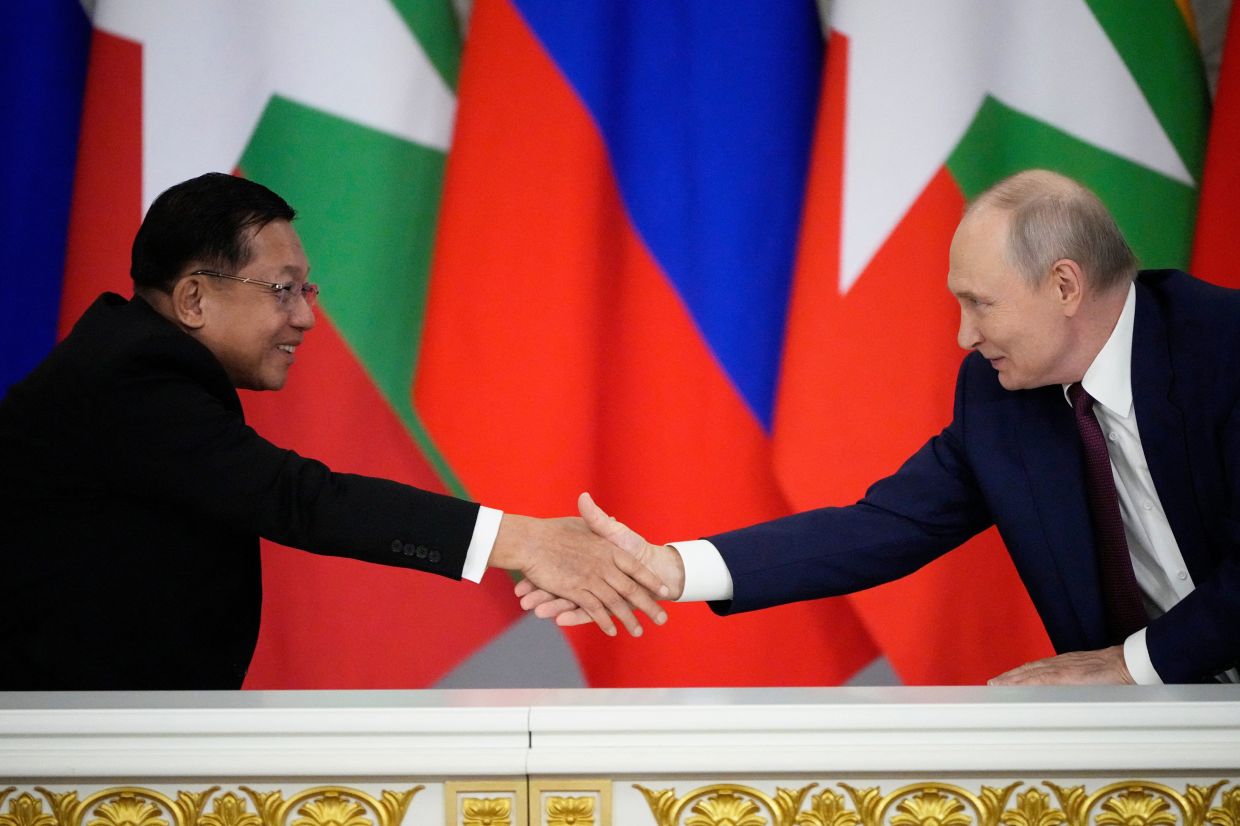
Russian President Vladimir Putin received Myanmar's leader Min Aung Hlaing in Moscow on Tuesday, underscoring Moscow's commitment to maintaining close relations with Southeast Asia's military-dominated government at a time when Western nations have largely shunned the country. The meeting, held at the Kremlin, represented the first official visit by Min Aung Hlaing since his formal ascension to the presidency in August, following elections that attracted significant international criticism for their legitimacy and transparency.
Putin characterised the bilateral relationship as having developed an "especially trusting" foundation in recent years, a remarkable statement given the geopolitical isolation Myanmar's military rulers have faced since the 2021 coup that deposed democratically elected leader Aung San Suu Kyi. The Russian president's emphasis on trust reflects Moscow's strategic positioning as perhaps the most prominent major power willing to maintain substantive engagement with Myanmar's junta, a distinction that carries particular significance as Myanmar navigates intensifying regional and international pressure regarding its governance and human rights record.
The Kremlin delegation that participated in the talks underscored the comprehensive nature of Russia-Myanmar cooperation, extending well beyond symbolic diplomatic gestures. Foreign policy officials, financial specialists, energy sector representatives, and senior defence ministry personnel all participated, signalling that Moscow views Myanmar as a critical partner across multiple strategic dimensions. This broad institutional engagement contrasts sharply with the measured or adversarial posture adopted by most Western democracies toward Myanmar's military administration.
Energy cooperation emerged as a central pillar of the discussions, with Putin outlining ambitious Russian infrastructure projects targeting Myanmar's southern regions. Moscow seeks to construct both a power generation facility and an oil refinery, while simultaneously positioning Russian entities to lead geological surveys and hydrocarbon extraction operations throughout the country. These ventures represent substantial long-term commitments that would deepen Myanmar's economic dependence on Russian expertise and capital, fundamentally reshaping energy sector dynamics in a strategically important Southeast Asian nation.
Beyond conventional energy infrastructure, Russia is also pursuing more advanced technological partnerships through its state nuclear corporation Rosatom, which is collaborating with Myanmar to develop a small-scale nuclear power plant. While officially framed as supporting civilian applications in healthcare, agriculture, and industrial sectors, such nuclear cooperation signals Russia's confidence in deepening its technological relationship with Myanmar despite the governance concerns raised by international observers. This nuclear dimension adds particular weight to the partnership, as it represents precisely the kind of strategic technology transfer that Western nations typically restrict to allies with robust governance standards.
Military cooperation constitutes perhaps the most historically significant element of the Russia-Myanmar relationship. Russia has functioned as Myanmar's primary advanced weapons supplier since the 2021 coup, with a United Nations report from May 2023 documenting more than US$400 million in military sales during the post-coup period. This sustained provision of sophisticated defence systems—occurring precisely when most Western military suppliers have halted exports to Myanmar—has cemented Russia's position as the junta's most reliable security partner, a role that carries strategic implications throughout the Indian Ocean region and broader Indo-Pacific security architecture.
The timing of Min Aung Hlaing's Moscow visit reflects his broader diplomatic offensive to secure greater international legitimacy following the disputed August elections. His administration has orchestrated a carefully sequenced diplomatic calendar, visiting China, India, Laos, and Thailand in recent months while simultaneously attempting to improve relations with the United States and the Association of Southeast Asian Nations. These parallel tracks suggest Myanmar's military leadership recognises the unsustainability of indefinite isolation, yet remains unwilling to accede to international demands for political liberalisation, creating a delicate equilibrium that Russia's continued diplomatic engagement helps sustain.
The composition of Min Aung Hlaing's delegation underscores the bureaucratic depth of this bilateral relationship. A high-level ministerial contingent accompanied the Myanmar leader, including multiple cabinet members and notably the head of Myanmar's Space Agency, suggesting that even emerging technological frontiers like space exploration may become areas of Russia-Myanmar cooperation. The delegation's participation in the Myanmar-Russia Business Forum alongside formal state meetings indicates that commercial entities and state organs are equally mobilised in advancing the bilateral partnership.
Moscow's willingness to engage so prominently with Min Aung Hlaing stands in marked contrast to the stance adopted by most major democracies, which have imposed targeted sanctions, suspended military assistance, and diplomatically isolated Myanmar's junta. For Southeast Asia, Russia's deepening Myanmar engagement presents a complex challenge: it demonstrates how authoritarian nations can leverage geopolitical competition to provide alternative sources of support for isolated regimes, potentially reducing international leverage for political reform. The energy, nuclear, and military dimensions of Russia-Myanmar cooperation collectively suggest that Myanmar's strategic orientation is solidifying around partnerships with nations willing to ignore governance concerns in pursuit of geopolitical advantage.
Putin's articulation of "good prospects" for liquefied natural gas cooperation hints at even more expansive commercial possibilities, potentially positioning Myanmar as a crucial node in Russia's Asian energy strategy as European markets remain unavailable due to Western sanctions. For Malaysian policymakers and regional observers, Russia's Myanmar engagement exemplifies how great power competition can fundamentally alter Southeast Asian geopolitical alignments, with significant implications for regional security arrangements, economic integration patterns, and the enforcement of international norms regarding democratic governance and human rights.

