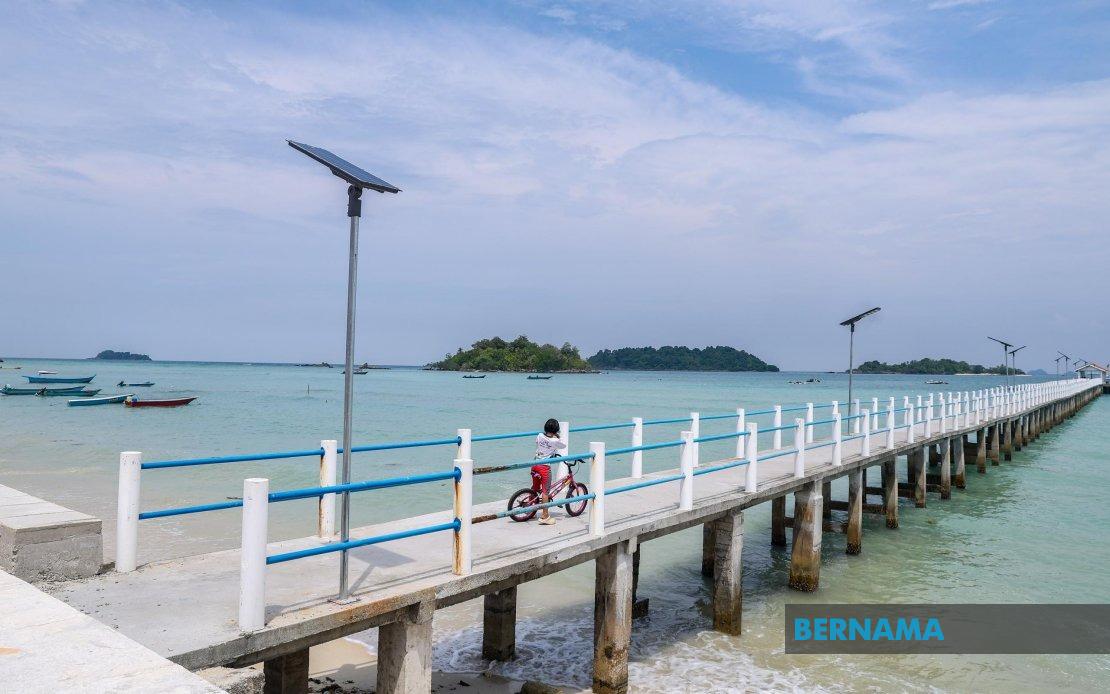
As Johor voters prepare to elect 56 state representatives on Saturday, the small island community of Pulau Tinggi in Mersing district faces a mounting infrastructure crisis that has been largely overlooked by policymakers. The approximately 150 residents split across Kampung Pasir Panjang and Kampung Tanjung Balang are calling on the newly elected Tenggaroh state representative to make critical jetty repairs and housing assistance their immediate priority, issues that have festered for years despite formal requests submitted to authorities.
The centrepiece of the community's appeals is the crumbling Kampung Pasir Panjang jetty, a vital access point for both tourism and the local fishing economy that has progressively deteriorated since around 2017. What began as minor wear and tear has evolved into a structural liability that poses genuine safety risks to the fishermen, traders, and tourists who depend on it daily. Despite the obvious hazards, some residents have continued using the facility out of necessity, a testament to how essential the jetty remains to island life. Village chief Rossana Hussin, who assumed her role in 2024, emphasises that the upgrade application, formally submitted to the Mersing District Office in March, received positive initial signals from officials—yet no meaningful action has materialised.
Beyond infrastructure decay, the housing predicament affecting Kampung Tanjung Balang underscores deeper structural inequalities in how development benefits are distributed to Malaysia's fishing communities. The majority of Pulau Tinggi's residents are B40 category fishermen, a classification that places them among the nation's lowest-income households. Many of these families live in homes requiring either major structural repairs or completion of unfinished construction—situations that have dragged on indefinitely. Hussain notes that targeted housing repair assistance would not only ease the immediate financial burden on struggling families but fundamentally improve their living standards and dignity. This is not merely a comfort issue; inadequate housing in remote fishing communities can perpetuate intergenerational poverty and limit opportunities for younger residents.
What makes the situation particularly pressing is that both applications have been pending formal action for months. The positive feedback reportedly received by the village administration suggests that government offices recognise the legitimacy and merit of these requests. Yet between formal acknowledgement and actual resource allocation lies a bureaucratic gap that has become all too familiar in Malaysia's peripheral regions. The timing of the Johor state election presents an opportunity—and, from the residents' perspective, a necessary pressure point—to move these projects from administrative queues into implementation.
Elder resident Mariam Mamat, 85, articulates another dimension of Pulau Tinggi's decline: demographic collapse driven by limited economic opportunity. She recalls when the island supported a much larger population, but successive generations have been forced to seek livelihoods elsewhere, with some settling in Felda schemes across the peninsula. This migration pattern reflects a broader challenge facing Malaysia's island and coastal communities, where lack of employment diversity drives young people toward urban centres. Without deliberate intervention to revitalise tourism infrastructure and create sustainable local economic opportunities, Pulau Tinggi risks becoming a shell of its former self, inhabited only by the elderly and those without means to leave.
The tourism sector, which could theoretically anchor Pulau Tinggi's economic future, remains underdeveloped precisely because foundational infrastructure is lacking. A functional, safe jetty is not a luxury but a prerequisite for tourist arrivals. Better accommodation options and improved facilities would further attract visitors. Investment in these areas could generate employment for younger residents in hospitality, guiding, transport, and services—employment that would make staying on the island economically viable. The irony is that modest infrastructure spending could unlock significant returns through sustained tourism activity, yet the initial capital investment remains unmobilised.
The incoming state representative for Tenggaroh will inherit a community whose needs are clearly articulated and already documented within the bureaucratic system. What is required is not further needs assessment or feasibility studies but political will and executive action to unblock funds and commence implementation. Johor's development narrative has often centred on major urban and industrial zones, yet sustainable state prosperity depends on attending to peripheral communities whose infrastructure deficits have become chronic.
For Pulau Tinggi's residents, the state election represents a democratic moment to demand accountability and commitment from their elected representative. The residents are not requesting novel programmes or untested initiatives; they are asking that applications already submitted and approved in principle be progressed. This is a test of whether elected state officials will genuinely prioritise the welfare of smaller, less visible constituencies or whether development remains concentrated in areas with greater political visibility and commercial significance.
As approximately 2.7 million eligible voters across Johor cast their ballots on Saturday, the outcome will determine whether Pulau Tinggi's jetty finally receives the upgrade its deteriorating condition demands and whether fishing families gain access to the housing assistance they have formally requested. The island community's appeals are neither extravagant nor unreasonable—they reflect fundamental expectations about infrastructure safety and housing dignity. How the new state government responds will reveal whether commitment to inclusive development extends beyond urban constituencies to embrace the island's marginal communities.

