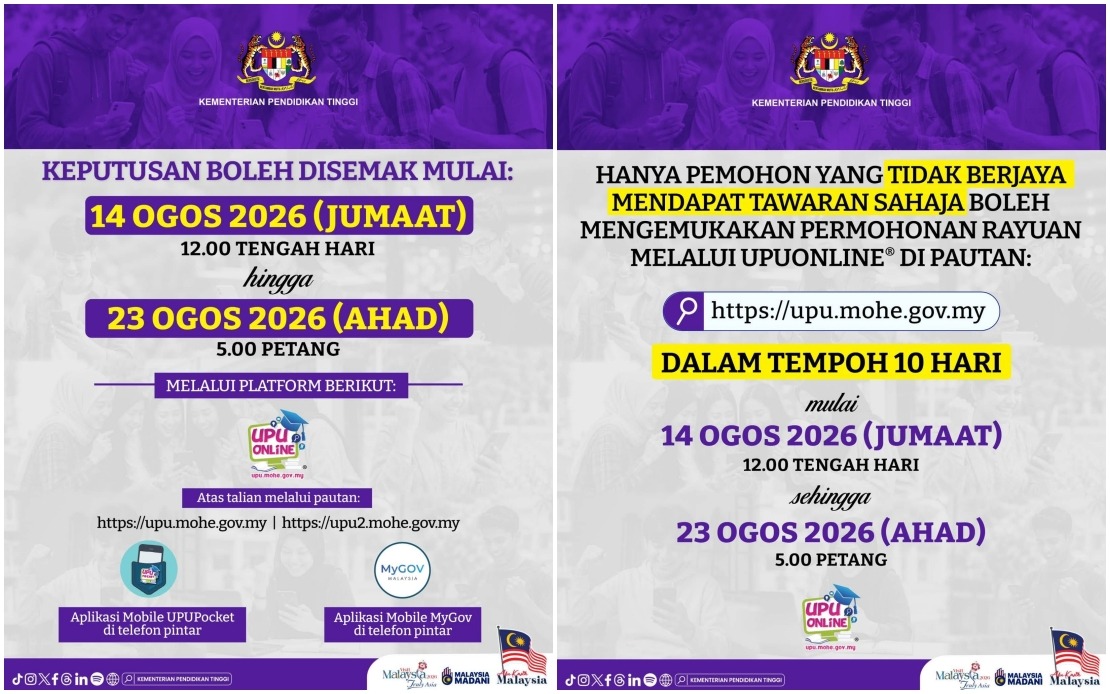
Hundreds of thousands of Malaysian STPM graduates and equivalent qualification holders will discover their university futures on August 14, when the Ministry of Higher Education releases the results of the 2026/2027 academic session admissions to public universities. The announcement comes via the centralised UPUOnline portal, marking the culmination of weeks of anticipation for school leavers seeking places at Malaysia's nine public universities.
The results window opens at noon on August 14 and remains accessible until 5 pm on August 23, giving applicants a full nine-day period to review their outcomes and make crucial decisions. This extended timeframe reflects the ministry's recognition that students and families require adequate time to process offers, compare options, and prepare for the next phase of their educational journeys. Multiple access points have been established to ensure digital inclusivity across the country, with candidates able to log in through the primary UPUOnline portal at https://upu.mohe.gov.my, the secondary portal at https://upu2.mohe.gov.my, or via the dedicated UPUPocket mobile application and the integrated MyGov mobile platform.
Once applicants have reviewed their results, the confirmation phase begins on August 15 and extends through August 23. During this critical window, candidates must actively accept or decline their offers through their respective university websites. This confirmation step is essential—passive acceptance is not permitted under the current system. Universities will only issue formal offer letters to successful candidates who have explicitly confirmed their acceptance within the designated timeframe, providing official documentation that solidifies their admission status and enrollment requirements.
For students who have received offers but wish to explore further options, the system does permit appeals within a strictly limited window. Unsuccessful applicants have precisely ten days, from August 14 to August 23, to submit appeals through UPUOnline seeking alternative placements at public universities. However, the ministry has explicitly cautioned that appeal selections will depend entirely on available vacancies within specific study programmes following the completion of new student registrations. This means that while the appeal process offers hope to disappointed applicants, available spaces may be severely limited, particularly in high-demand programmes and universities.
The ministry has been unambiguous about one critical constraint: once the initial offer has been made for the 2026/2027 academic session, that placement decision is final and binding. Students cannot subsequently request transfers to different study programmes or different universities after accepting their initial offers. This policy, while providing certainty for university planning purposes, means that applicants must carefully evaluate their offers before confirmation, as changing their minds about their chosen programme or institution after acceptance is not permitted under current regulations.
For Malaysia's education sector, this admission cycle represents an important transition point in the higher learning landscape. The public university system continues to serve as the primary gateway to degree-level education for the majority of Malaysian students, with roughly 40 per cent of STPM holders traditionally securing places at public institutions. The remaining cohort typically progresses to private universities, international institutions, or vocational and technical training pathways, reflecting Malaysia's increasingly diverse tertiary education ecosystem.
The August 14 results release carries particular significance for students planning their futures against a backdrop of evolving employment trends and industry demands. Malaysian universities have intensified efforts to align curriculum offerings with the needs of a rapidly transforming economy, particularly in technology, healthcare, engineering, and green energy sectors. First-time university applicants examining their offers will be evaluating not only institutional prestige and location but also the real-world relevance and career outcomes associated with their chosen programmes.
Regional competitors have also intensified recruitment efforts among top-performing Malaysian students, with Singapore, Australia, and the United Kingdom consistently attracting high-achievers seeking alternative pathways. The quality and relevance of public university offerings therefore remain crucial factors in retaining domestic talent and ensuring that Malaysia continues developing its intellectual capital domestically.
For families navigating the admission process, the consolidated timeline provides a structured but demanding sequence of deadlines. Parents and students must remain actively engaged from August 14 through August 23, carefully reviewing options and taking action within specified windows. Missing the August 23 confirmation deadline means forfeiting the offer entirely, with no provision for late submissions. Similarly, students hoping to appeal unsuccessful outcomes must act swiftly, as the ten-day appeal window closes on the same August 23 date.
The ministry's emphasis on digital access through multiple platforms acknowledges the reality that Malaysian students inhabit varied geographic and technological contexts. Rural applicants, urban professionals, and those with inconsistent internet connectivity all require flexible access mechanisms. The availability of dedicated mobile applications reflects the ministry's recognition that smartphone adoption now exceeds 80 per cent even in rural Malaysian communities, making app-based access a critical inclusion strategy.
For international observers, Malaysia's centralised admission system demonstrates a coherent attempt to manage demand at scale while maintaining transparency and preventing endemic corruption that plague university admission processes in numerous developing economies. The standardised timeline and public portals create accountability mechanisms that constrain informal negotiations and side channels.
As August 14 approaches, thousands of Malaysian households will experience the characteristic mixture of hope, anxiety, and anticipation that accompanies major educational transitions. For some, the results will confirm paths aligned with years of academic preparation. For others, the outcomes will prompt difficult conversations about alternative futures. The systematic, transparent process established by the Ministry of Higher Education aims to ensure that this pivotal moment in young Malaysians' educational journeys proceeds fairly and comprehensively.

