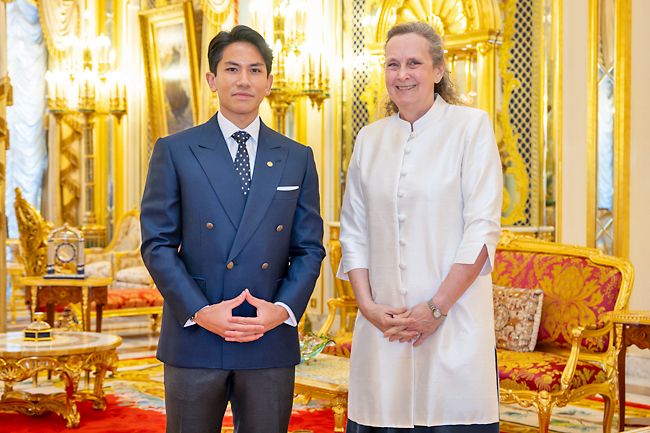
His Royal Highness Prince 'Abdul Mateen, who holds the portfolio of Minister of Foreign Affairs, received outgoing United States Ambassador Caryn R McClelland for a farewell audience on Saturday, June 20, at the official residence of Istana Nurul Izzah in Bandar Seri Begawan. The ceremonial meeting marked the conclusion of McClelland's diplomatic posting to Brunei Darussalam, one of Southeast Asia's smaller but strategically important monarchies.
During the audience, Prince Mateen conveyed formal appreciation for the ambassador's contributions throughout her tenure, recognising her efforts in advancing the established relationship between the two nations. The prince emphasised the value of maintaining the enduring friendship and strategic cooperation that has long characterised ties between Brunei Darussalam and the United States, underscoring the importance of continuity in bilateral engagement during diplomatic transitions.
McClelland's period of service saw substantive progress across multiple dimensions of the US-Brunei partnership. The two countries expanded their cooperative framework significantly, with particular emphasis on defence and security matters—a sphere where Washington maintains active engagement throughout Southeast Asia. Educational exchanges formed another pillar, reflecting America's soft power initiatives in the region and providing opportunities for Bruneian students and academics to pursue advanced studies and research collaborations in the United States.
Trade and investment relations also experienced tangible growth during her ambassadorial tenure. These economic dimensions remain particularly consequential for Brunei, a resource-rich nation seeking to diversify its economy beyond hydrocarbon exports and develop stronger commercial partnerships with major trading partners. American investment and commercial presence contribute to broader development objectives in the sultanate, whilst also enabling US businesses to tap into Southeast Asian markets and supply chains.
People-to-people exchanges constituted a significant component of diplomatic outreach during McClelland's posting. Cultural programmes, educational sponsorships, and community engagement initiatives served to build grassroots understanding and strengthen social bonds between American and Bruneian citizens. Such interpersonal connections often prove durable and valuable, creating networks that transcend formal government-to-government relations and foster long-term goodwill.
The timing of McClelland's departure and the formal farewell reception reflect diplomatic protocol and the professional standards governing ambassadorial transitions. Her predecessor had presented official credentials to His Majesty Sultan Hassanal Bolkiah, Sultan and Yang Di-Pertuan of Brunei Darussalam on May 24, 2022, marking the formal commencement of her ambassadorial authority. The subsequent period of service included navigating the post-pandemic diplomatic landscape and maintaining engagement across the bilateral agenda despite evolving global circumstances.
Brunei's foreign policy orientation demonstrates careful calibration of its international relationships. The sultanate maintains strong ties with major powers including the United States whilst simultaneously preserving its historical connections with neighbouring Southeast Asian nations and other regional partners. American diplomatic presence in Bandar Seri Begawan reflects mutual interests in regional stability, maritime security, and counterterrorism cooperation—issues of paramount concern throughout the Indo-Pacific.
The defence and security dimension of US-Brunei cooperation reflects broader American strategic interests in Southeast Asia. The region's strategic location, vital shipping lanes, and geopolitical significance position it as a key arena for great power competition and multilateral engagement. Brunei's participation in various bilateral and multilateral defence dialogues with Washington contributes to regional security architecture and demonstrates the sultanate's role as a responsible stakeholder in maintaining stability and freedom of navigation.
Educational partnerships between the United States and Brunei extend beyond formal government agreements, encompassing Fulbright scholarships, university partnerships, and scientific collaborations. Such initiatives generate human capital investments and strengthen institutional connections that often endure across generations. For Malaysian and Southeast Asian observers, these multilateral educational networks represent important mechanisms for knowledge transfer and capacity building within the region.
As McClelland's tenure concluded, the transition presented an opportunity to assess the trajectory of US-Brunei relations and their implications for the broader Southeast Asian context. Brunei's strategic position within ASEAN and its role in regional forums such as the East Asia Summit make its bilateral relationships with major powers consequential for regional diplomatic architecture. The continuation and strengthening of American engagement reflects mutual commitment to regional prosperity, rules-based order, and peaceful resolution of disputes.
The formal nature of the farewell audience, conducted at Istana Nurul Izzah with Prince Mateen's personal participation, signified the importance both nations attach to diplomatic relations and ceremonial recognition of service. Such protocols underscore the professional standards governing international affairs and the respect accorded to outgoing diplomatic personnel. For McClelland, the recognition acknowledging her contributions represented official acknowledgment of her efforts in advancing bilateral objectives during her assignment.

