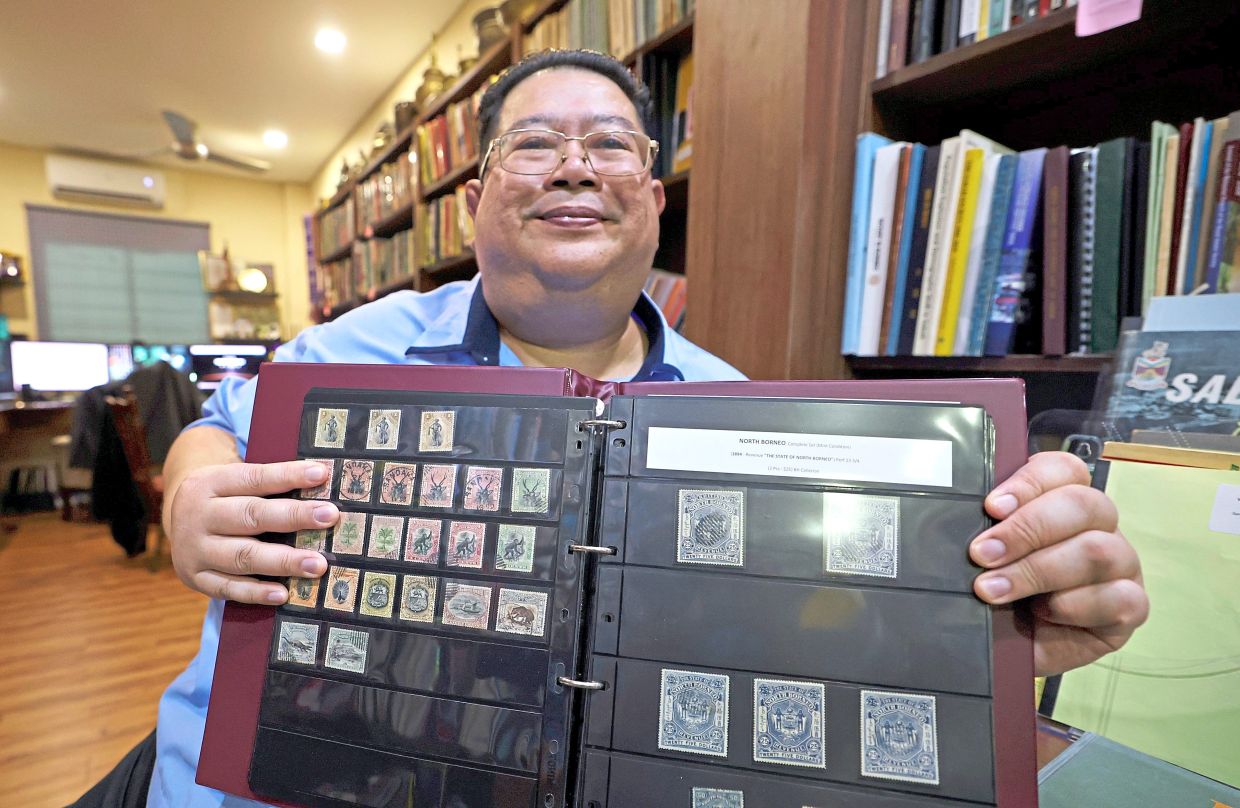
As digital communication dominates modern life, the remarkable story inscribed on North Borneo's postage stamps risks fading into obscurity. These philatelic artefacts, issued between 1883 and 1963, constitute far more than decorative ephemera—they represent a tangible chronicle of Sabah's transformation under British rule and the territory's emergence as a distinct entity within the region. Yet with each passing year, these century-old treasures become increasingly difficult to locate, and a generation growing up in the age of email and messaging apps shows diminishing interest in the hobby that once captivated collectors worldwide.
Dr Shari Jeffri, a 56-year-old philatelist and founder of the Borneo History Association, has emerged as a leading voice in the preservation movement. He characterises the stamp collection spanning the colonial period as a "living archive" whose value extends well beyond monetary worth—these miniature canvases encode narratives of governance, commerce, natural resources, and cultural representation that might otherwise remain hidden in dusty historical records. For Jeffri, the imperative to conserve and transmit this material legacy to future generations has become increasingly urgent as the collector community shrinks and younger Sabahans remain largely unexposed to the appeal of philately.
A systematic survey conducted by Bernama across antique dealers in Kota Kinabalu revealed a troubling scarcity trend. North Borneo stamps have largely vanished from routine circulation and private collections, with surviving specimens commanding prices that fluctuate dramatically based on age, physical condition, and rarity. One notable discovery during the survey was an album containing several significant specimens, including a six-cent denomination from the 1954-1961 series depicting Queen Elizabeth II alongside a Dusun woman, and a ten-cent issue that captured the logging activities then defining Sabah's economic landscape. These stamps illustrate how postal services functioned as unexpected repositories of cultural and economic representation.
Jeffri's personal journey into philately mirrors a broader pattern of family stewardship across collecting communities. His fascination with stamps originated through an inheritance from his grandfather, who accumulated a collection during the 1920s while employed at the Recreation Club Jesselton in Kota Kinabalu. That ancestor's initial exposure came through observing British officers engaging in the hobby, a common pathway through which stamp collecting spread across colonial territories. Though Jeffri encountered philately at age seven, he did not pursue it seriously until secondary school, when he began the meticulous work of cataloguing and safeguarding his inherited materials—a commitment that evolved into a lifetime of historical research tracing how stamp designs reflected and documented North Borneo's development.
Among Jeffri's most treasured possessions are two two-cent stamps from the inaugural 1883 issue, each bearing a brown sailing boat design and complete postmarks that attest to their journey through the historical postal system. For serious philatelists, possessing examples from this foundational series represents more than collecting achievement; it constitutes essential historical documentation. As Jeffri emphasises, every stamp transcends its original functional purpose as proof of postage, instead functioning as a capsule preserving the aesthetic, political, and commercial preoccupations of its moment. The 1883 issue, marking the genesis of postal communication infrastructure in the territory, carries particular weight in any comprehensive collection.
During nearly four decades as an active collector and researcher, Jeffri has traced the evolution of North Borneo's postal designs with scholarly precision. The British North Borneo Chartered Company initiated stamp production in 1883, maintaining this monopoly for approximately 52 years until the territory's political status shifted. Early designs deployed symbolic imagery—lions, boats, tigers—alongside the Latin motto Pergo et Perago ("I undertake and I achieve"), deliberately constructed to introduce the distant territory to international audiences and project an image of civilisation and order. From 1894 onwards, designers increasingly featured Borneo's native flora, fauna, and wildlife, reflecting a compositional strategy that emphasised the territory's natural resources and ecological distinctiveness.
The 1935 series marked a significant turning point in how North Borneo represented itself through postal imagery. These designs projected a more authentic and self-conscious expression of Sabah's identity, utilising denominations spanning from two cents to one dollar. The progression across these denominations traced an economic hierarchy while simultaneously distributing regional imagery and cultural references across the postal system. High-value stamps circulated internationally on commercial correspondence, serving as miniature ambassadors disseminating representations of Borneo to foreign merchants and officials—a subtle but significant dimension of imperial communication strategy.
The technical and material aspects of these stamps contain crucial information for specialists evaluating authenticity and historical significance. Jeffri explains that the paper composition and adhesive properties employed during different periods serve as diagnostic markers, enabling experts to distinguish genuine issues from reproductions or forgeries. Stamps bearing complete postal cancellations command premium valuation among collectors and historians alike, as the cancellation marks document precise temporal and spatial information—the mailing date, originating post office, time of posting, and destination intelligence. These postmarks transform individual stamps into data points within a broader communications infrastructure, revealing patterns of colonial commerce, administrative correspondence, and personal connection.
The conservation challenge confronting contemporary stewards has become increasingly acute. The primary preservation enemy is not theft or neglect but rather the slow degradation caused by acid-containing album materials and environmental exposure. Jeffri emphasises that proper storage in acid-free albums represents the essential baseline protection, preventing the gradual fading and deterioration that renders these artefacts illegible and scientifically compromised. This technical requirement extends beyond casual hobby practice into the realm of archival professionalism, demanding knowledge and resources that individual collectors may lack.
Jeffri's expertise developed through sustained engagement with international specialists and authoritative references. He studied philatelic methodology under Singaporean experts Voon Kyam Foh and Tan Chun Lim, accessing knowledge networks that connect regional collectors and authenticate findings. Consultation with specialised catalogues such as the Commonwealth & British Empire Stamps reference guides provides standardised frameworks for identification and valuation. This transregional knowledge exchange demonstrates how serious collectors function within international scholarly communities that transcend political boundaries.
The broader challenge confronting preservation efforts reflects generational shifts in how young Sabahans engage with material history. In an era when postal communication has largely yielded to instantaneous digital alternatives, the tangible artefacts of earlier communicative systems risk becoming invisible—physically present in archives and private collections yet culturally disconnected from contemporary experience. The stamps remain enduring witnesses to Sabah's past, encoding narratives of colonial administration, economic development, and cultural identity that documentary archives and published histories often marginalise or overlook. Yet without active preservation efforts and intergenerational transmission of knowledge, these philatelic treasures risk becoming orphaned objects whose historical significance becomes progressively obscured. The work undertaken by dedicated researchers like Dr Shari Jeffri represents not merely hobby enthusiasm but rather a conscious assertion that these miniature historical documents deserve sustained conservation and scholarly engagement.

