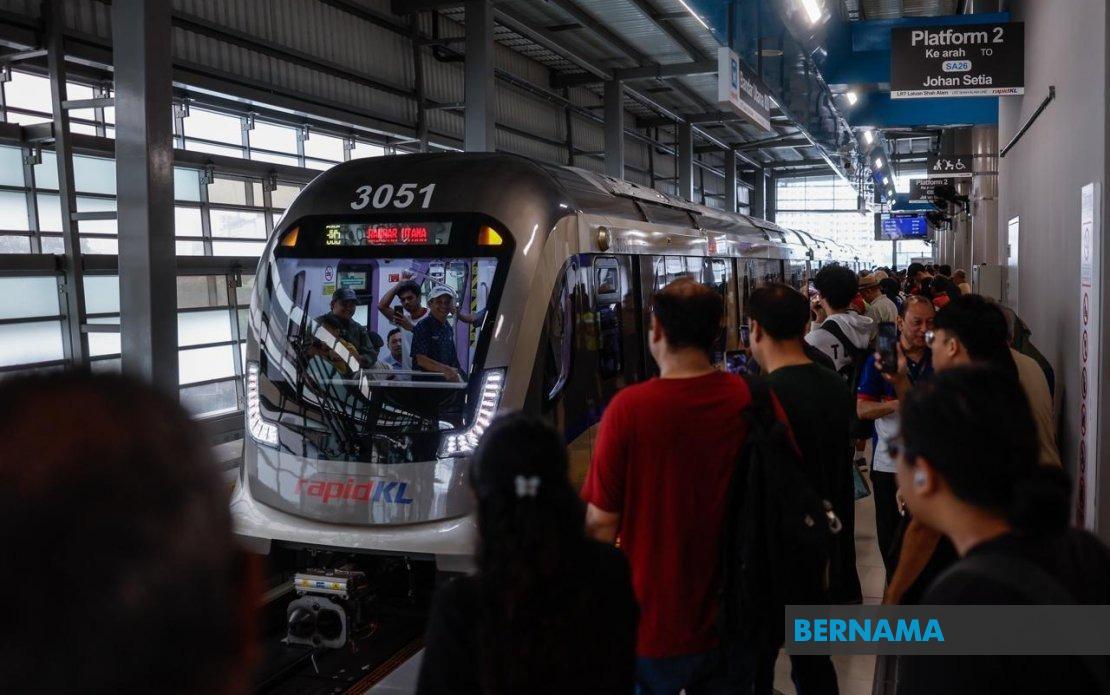
The Light Rail Transit 3 Shah Alam Line commenced operations on June 29, with Prasarana Malaysia Berhad projecting a measured start of between 5,000 and 10,000 passengers on its opening day. The transport operator's cautious forecast reflects the reality that new public transport infrastructure typically experiences a gradual adoption curve before reaching full operational capacity. Prasarana president and chief executive officer Amir Hamdan explained that ridership figures are expected to climb progressively, reaching a target of 67,000 daily passengers within the first year as the travelling public becomes increasingly familiar with the service and integrates it into their regular commute patterns.
The Shah Alam Line commenced service at 6 am, with early reports indicating considerable enthusiasm among commuters testing the new route. Amir noted that the opening day witnessed predominantly positive responses, with passengers expressing satisfaction about the ability to commute to their workplaces in greater comfort while avoiding the congestion that typically plagues the surrounding road network. Social media activity reflected this optimism, suggesting that many early adopters viewed the service launch as a welcome addition to the Klang Valley's public transport infrastructure. The executive emphasised that this initial response phase represents an important baseline from which to measure the line's eventual uptake.
Operations throughout the first day proceeded without significant disruptions, with Prasarana reporting that all facilities functioned reliably across the network. Train frequency during peak hours was maintained at approximately eight-minute intervals, a spacing that the operator deemed manageable given the nascent stage of the service. The smooth operational commencement reflects extensive preparation and testing conducted before the official opening. Interchange stations including Glenmarie 2, which connects to the existing Kelana Jaya Line, and Bandar Utama, linking to the Kajang Line, are receiving particular attention from Prasarana as these junctions will be critical to the system's overall effectiveness.
Prasarana's operational strategy during this initial phase prioritises observing user behaviour and experience across multiple touchpoints. The operator is closely monitoring how passengers interact with automatic ticket gates, ticketing machines, and passenger flow dynamics within station environments. This data-gathering approach will inform decisions regarding potential service enhancements in the coming weeks and months. Amir indicated that Prasarana remains flexible in its capacity planning, with mechanisms in place to incrementally increase train frequency should demand warrant such adjustments. The organisation is also prepared to position standby trains along certain routes during peak hours if congestion becomes evident.
One notable consideration currently under observation involves the potential introduction of women-only coaches, a feature implemented on some other Malaysian transit lines. Amir stated that while no decision has been made to introduce such dedicated facilities at this stage, Prasarana will conduct comprehensive studies incorporating ridership data and passenger feedback to guide any future policy changes. This measured approach acknowledges that women's safety and comfort remain important considerations for public transport planning while avoiding premature implementation of facilities before understanding actual demand patterns.
The financial incentive for adoption cannot be overlooked in assessing early ridership figures. Prime Minister Datok Seri Anwar Ibrahim announced that all LRT3 Shah Alam Line services would operate free of charge for the first month, running from the opening day through July 31. This promotional period extends to feeder bus services operated by Prasarana, effectively providing a comprehensive first-month trial for potential regular users. The promotional pricing strategy is designed to overcome initial hesitation and encourage trial usage among commuters who might otherwise require additional persuasion to shift from established transportation habits.
For Malaysian readers and the broader Southeast Asian context, the Shah Alam Line represents a significant infrastructure expansion within the Klang Valley metropolitan area, which has experienced sustained population growth and increasing traffic congestion over recent years. The line's successful integration into the existing network depends substantially on its ability to attract commuters away from private vehicle use, thereby reducing strain on an increasingly congested road system. The project's implementation reflects broader governmental objectives to develop public transport capacity as an alternative to continued automobile dependency.
The line's connectivity to existing transit infrastructure enhances its strategic importance. By linking multiple MRT and LRT lines through interchange stations, the Shah Alam Line increases the utility of the entire system for users making multi-leg journeys across the metropolitan region. This network effect means that the line's success should be measured not merely by direct ridership on its own trains but by its contribution to overall system efficiency and attractiveness. The gradual adoption pattern that Prasarana anticipates aligns with how passengers may require time to discover optimal route combinations and adjust their commuting patterns accordingly.
Prasarana's transparent communication regarding the gradual growth trajectory demonstrates realism in expectations management. Rather than projecting unrealistic first-day figures that might create perceptions of failure, the operator has publicly acknowledged that new infrastructure requires a maturation period. This approach provides valuable context for both policymakers and the travelling public, establishing reasonable benchmarks against which future performance can be evaluated. The pathway from 5,000 to 10,000 daily riders on opening day toward the 67,000 daily target represents a growth rate that, while ambitious, appears grounded in comparable experiences with other transit system launches.
The opening of the Shah Alam Line also carries implications for broader Malaysian infrastructure development and public-private sector collaboration in transport. The project demonstrates continued investment in regional transit capacity despite challenging economic conditions in recent years. For commuters in Shah Alam, Subang, and surrounding areas, the new service offers genuine alternatives that may influence residential and employment location decisions over time. As the line matures beyond its initial launch phase, comprehensive ridership and usage pattern data will provide valuable insights for planning future transit expansion within the Klang Valley and potentially informing infrastructure approaches in other Malaysian metropolitan areas.

