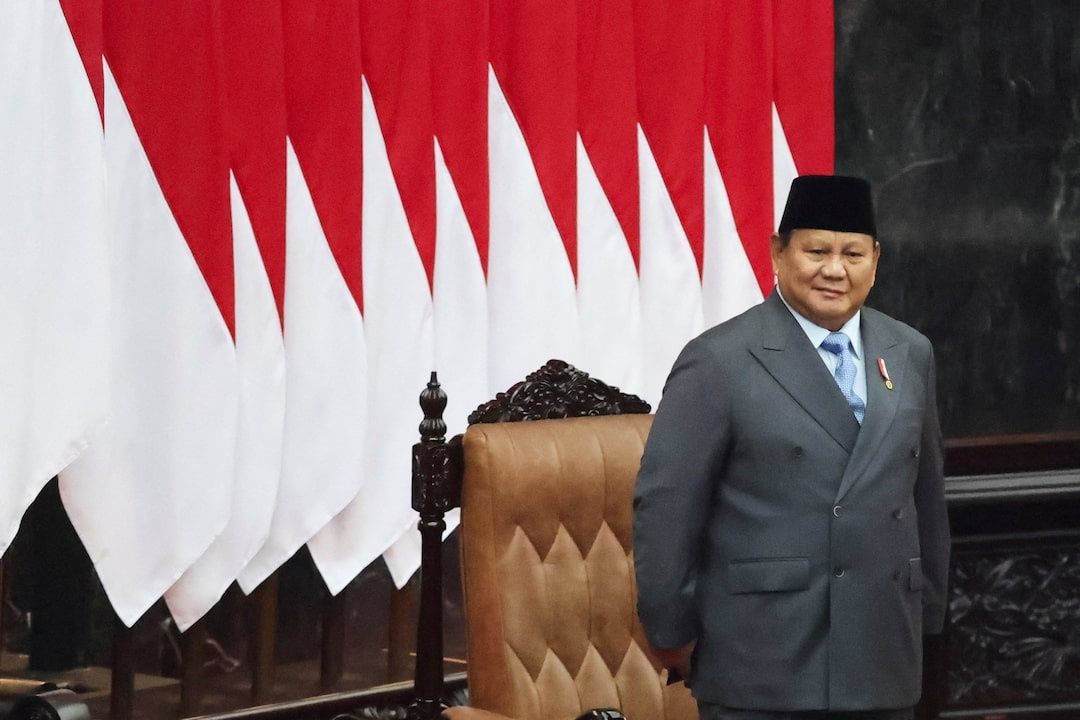
Indonesian President Prabowo Subianto will unveil his administration's 2027 budget proposals on Friday, marking a critical moment for his presidency as approval ratings have collapsed and global investors grow increasingly cautious about his government's economic trajectory. The presentation comes amid a challenging first year in office that has seen the Indonesian rupiah weaken significantly, stock market underperformance, and persistent questions about fiscal discipline and central bank autonomy. What was meant to be a sweeping reform agenda built on anti-corruption pledges and the promise to accelerate economic growth from 5 per cent to 8 per cent has instead given way to economic headwinds and policy uncertainty that threatens to undermine investor confidence in Southeast Asia's largest economy.
Prabowo's journey from military strongman to elected president promised much when he took office in October 2024 following an overwhelming electoral victory. Beyond economic growth targets, he campaigned heavily on a distinctive pledge to distribute free meals to millions of schoolchildren, positioning himself as a leader attuned to ordinary Indonesians' welfare concerns. These ambitious commitments resonated with voters seeking both stability and tangible improvements in living standards. However, the intervening months have exposed the gaps between campaign rhetoric and governing reality, forcing the administration to implement painful budget cuts to flagship programmes and navigate a series of implementation stumbles that have dented public confidence.
The deterioration in public support has been dramatic. Recent polling data shows Prabowo's approval rating has plummeted 30 percentage points in just eight months, falling to 51 per cent. This decline reflects not merely statistical movement but a fundamental cooling of enthusiasm among segments of the electorate that backed his election. Economists and analysts attribute this sharp reversal primarily to economic conditions that have worsened rather than improved, alongside growing dissatisfaction with law enforcement outcomes and questions about whether his administration can deliver on its promises. The erosion of support matters because it constrains the political capital available to push through difficult but necessary reform measures that markets expect.
Central to investor anxiety is the rupiah's sustained weakness and the Jakarta stock exchange's underwhelming performance throughout 2024 and into 2025. Rather than the stability and growth trajectory that Prabowo's election victory initially appeared to promise, international markets have instead witnessed currency depreciation and equity market stagnation. These developments undermine confidence in Indonesia's macroeconomic management and raise questions about whether Prabowo's administration possesses the expertise and discipline to navigate commodity-dependent growth challenges. When a president's flagship economic promises founder on basic currency and asset price indicators within months of taking office, investor scepticism naturally follows.
The fiscal dimension adds another layer of concern. Indonesia's budget deficit is tracking toward the 3 per cent constitutional ceiling that represents the legal limit on deficit spending, having reached approximately 2.8 per cent of GDP in 2025. This trajectory leaves minimal room for economic shocks or the kind of discretionary spending that populist governments often favour to maintain political support. Irman Faiz, an economist at Bank Danamon, characterises the 2027 budget presentation as one of the most crucial credibility tests for global investors in years, particularly given Indonesia's track record of policy surprises that have repeatedly caught markets off guard. The shrinking tolerance for uncertainty among investors means that Prabowo's presentation will be scrutinised with unusual intensity.
The elephant in the room concerns Prabowo's May announcement of plans to centralise exports of critical natural resources under a new state-run entity called Danantara Sumberdaya Indonesia. This proposal sent shockwaves through commodity markets because it appeared to signal a dramatic shift toward state intervention in traditionally private-sector-led industries. The announcement lacked clarity about whether the entity would actually control export flows or merely supervise them, creating a period of acute uncertainty about Indonesia's commodity trading future. Yose Rizal Damuri, executive director of the Center for Strategic and International Studies, notes that despite subsequent clarifications suggesting a more limited supervisory role, the entity's precise responsibilities remain opaque and investors are hoping Friday's budget address will finally provide definitive clarity.
Commodities traders and palm oil analysts internationally remain particularly focused on Danantara Sumberdaya Indonesia's eventual operational scope. Indonesia's palm oil industry represents a major global commodity player, and policy uncertainty around export mechanisms can ripple through international agricultural markets and affect pricing across Southeast Asia. The ambiguity surrounding whether the new entity represents genuine export control or merely a supervisory apparatus has created an ongoing drag on investor confidence in Indonesia's commodity sectors. Clarification on this front would provide markets with the certainty needed to price risk appropriately and restore some confidence in Indonesia's policy consistency.
Beyond commodity policy specifics, Prabowo faces the broader challenge of addressing fundamental economic anxieties that have driven his approval rating collapse. The free meals programme, positioned as a flagship social initiative, has itself become a source of controversy rather than political credit, having been subject to budget cuts and allegations of mismanagement. This represents a particular embarrassment for a president who campaigned partly on welfare expansion and targeting poverty. Arya Fernandes, head of politics and social change at CSIS, observes that Prabowo must convincingly address citizen concerns about economic conditions and demonstrate that his priority programmes can deliver meaningful results despite budgetary constraints. This task is complicated by the fact that Indonesia's fiscal ceiling limits the resources available for new or expanded social spending.
The schedule itself carries symbolic weight. Prabowo will deliver a morning address about broader policy directions as part of Indonesia's Independence Day commemoration, then present the 2027 budget in the afternoon. This sequencing allows him to frame budget proposals within a nationalist narrative while addressing economic fundamentals. However, this rhetorical framing cannot substitute for substantive policy solutions to the rupiah weakness, stock market stagnation, and fiscal pressures that have accumulated since October 2024. The budget presentation represents an opportunity to signal that his administration has absorbed lessons from its difficult first year and intends to prioritise macroeconomic stability and fiscal responsibility alongside the populist commitments that brought him to power.

