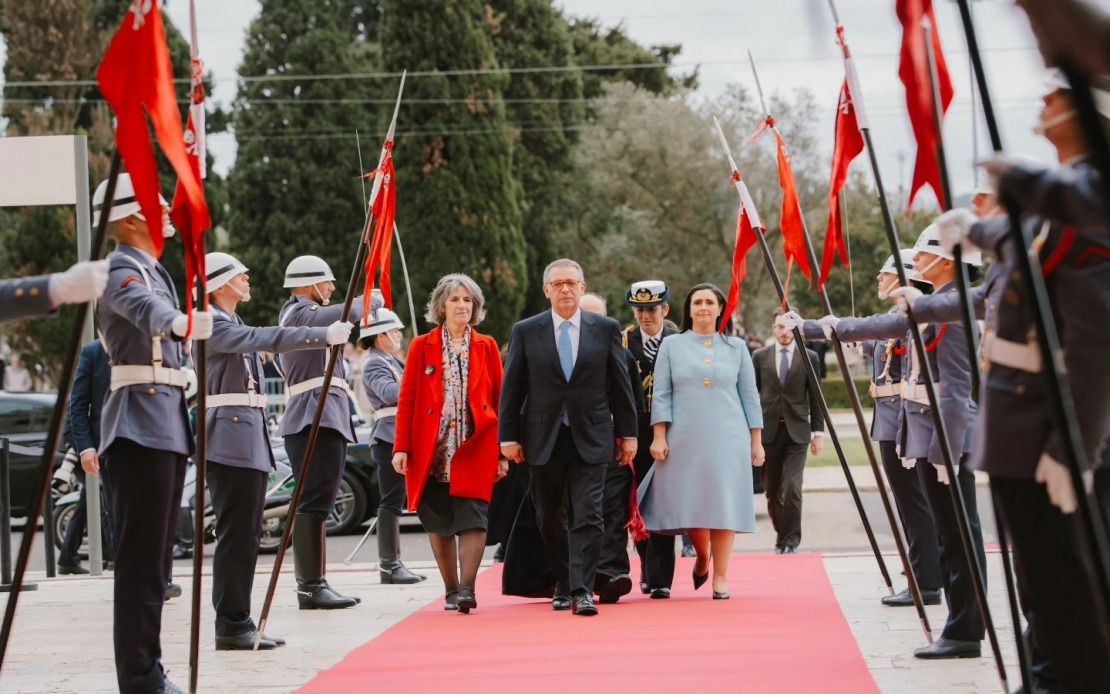
Portugal has joined a growing list of European democracies imposing restrictions on facial coverings worn in public spaces, with President Antonio Jose Seguro signing the controversial legislation on Tuesday. The decision marks a significant policy shift for the southern European nation and reflects broader ideological tensions within the continent over religious expression, security concerns, and women's autonomy. Seguro's approval of the measure, which originated from proposals by the right-wing Chega party, comes after what officials describe as substantial amendments refined during parliamentary deliberation.
The Portuguese presidency justified its endorsement by invoking multiple justifications spanning social cohesion, national security frameworks, and principles of equality. According to a statement from Belem Palace, the presidential residence in Lisbon, Seguro framed the uncovered face as fundamental to how Portuguese society functions—positioning facial visibility as essential infrastructure for interpersonal trust and civic participation. This framing suggests the administration views public face-covering restrictions not merely as security measures but as prerequisites for maintaining what it characterises as the foundational bonds connecting citizens within a shared community.
The presidential statement articulated a particular emphasis on gender equality considerations, asserting that permitting only women to obscure their entire faces creates an unacceptable asymmetry between men and women. Portuguese officials contended that such differentiation contradicts the principles of parity and equal dignity that they argue define modern European democracy. This reasoning attempts to reframe the prohibition as a progressive stance defending women's liberation rather than as a restrictive measure, though this interpretation remains deeply contested.
Seguro's decision additionally cited precedents established by the European Court of Human Rights regarding face coverings, attempting to ground the policy within existing jurisprudence. The president suggested that judicial rulings on this issue have consistently balanced collective social needs against individual rights claims, and that the Portuguese law aligns with this established constitutional framework. By invoking European judicial authority, the Portuguese government sought to present its action as legally sound and consistent with continental standards.
Yet the law has immediately attracted censure from international human rights organisations operating in Portugal. Amnesty International Portugal released a formal criticism characterising the prohibition as discriminatory and fundamentally threatening to the religious freedoms and personal autonomy of Muslim women who voluntarily choose facial coverings for reasons of faith or cultural practice. The human rights body contends that the legislation conflates voluntary religious expression with coercive practices, and that this conflation obscures the agency of women who embrace such traditions through genuine conviction rather than external compulsion.
Portugal's position within the European landscape on this issue reflects a continent-wide pattern of intensifying restrictions, though with varying scope and justifications. France implemented one of Europe's most stringent prohibitions against face-covering garments in 2011, targeting specifically the niqab and burqa in all public settings. Belgium, Austria, Denmark, and the Netherlands have followed with their own versions of comparable restrictions, though some apply limitations to particular venues or contexts rather than adopting blanket public prohibitions. This cascade of legislative action suggests growing political momentum among European states toward tighter regulations, driven by coalitions combining security-focused conservatives with politicians emphasising cultural integration.
For Malaysia and the broader Southeast Asian region, Portugal's action carries particular significance given the substantial Muslim populations across the area and the ongoing regional dialogues regarding religious expression within secular constitutional frameworks. Malaysia's own experience with face-covering debates—including discussions surrounding the niqab and hijab in various institutional contexts—demonstrates how similar tensions between individual religious liberty and state-defined public norms generate sustained political controversy. The Portuguese case exemplifies how even established democracies with robust institutional protections can move toward restrictions that Muslim communities perceive as threatening their religious autonomy.
The timing and framing of Portugal's law also merit examination within the context of rising far-right political movements across Europe. The Chega party's origination of this proposal reflects a broader pattern wherein anti-immigration and cultural-nationalist political forces have successfully elevated restrictions on Islamic religious expression into mainstream policy agendas. Portugal's mainstream political establishment ultimately accommodated these proposals through parliamentary refinement, suggesting how proposals originating from ideologically contentious sources can achieve broader legitimacy through institutional processes.
The implications for civil liberties jurisprudence remain unsettled, particularly regarding whether courts across Europe will eventually converge on shared standards or whether fragmented approaches will persist. Different European nations have reached divergent conclusions about where to balance collective social interests against minority religious rights, creating an unstable patchwork of continental policy. For observers in Malaysia and other diverse democracies, monitoring how European courts ultimately adjudicate challenges to these restrictions offers instructive lessons about judicial reasoning on religious liberty in secular contexts.
Critical legal scholars argue that face-covering bans represent a form of what might be termed regulatory erasure—transforming religious or cultural practices into matters of administrative violation rather than engaging substantively with the theological or philosophical convictions motivating such expression. Under this analysis, laws like Portugal's effectively marginalise certain forms of Islamic devotion by rendering them legally incompatible with public existence, rather than neutrally accommodating diverse practices within shared civic space. This tension between regulatory prohibition and authentic religious freedom protection will likely generate continued litigation and political contestation across European nations in coming years.

