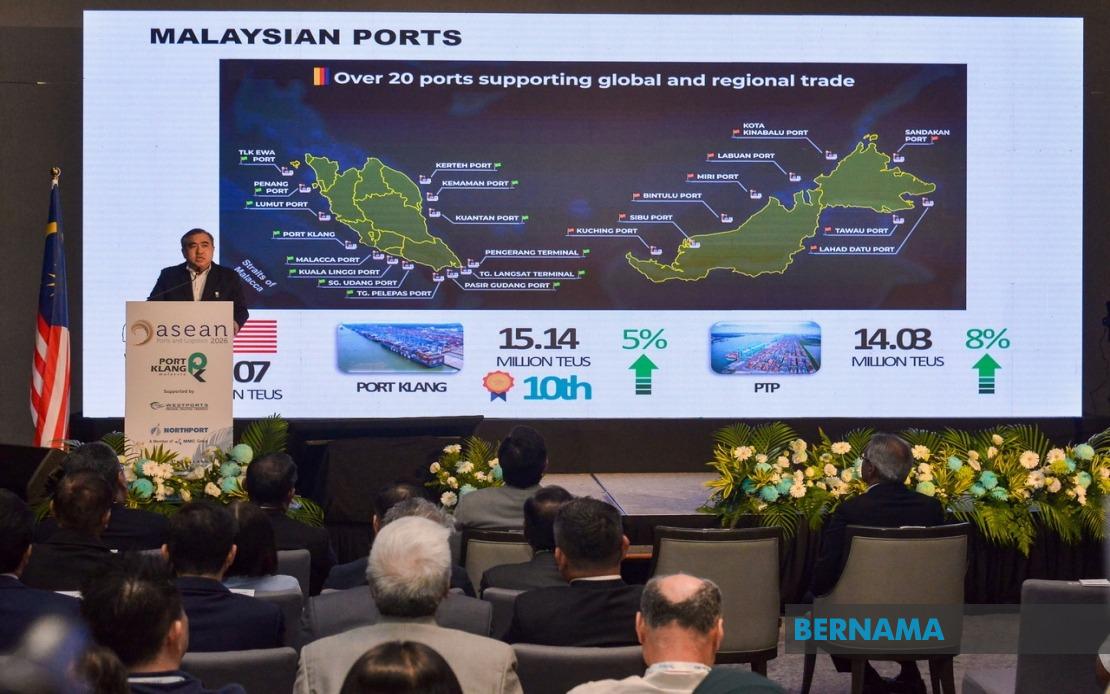
Malaysia is positioning itself as a dominant force in Southeast Asian shipping through an ambitious two-decade transformation of Port Klang, beginning with the construction of a third container terminal on Carey Island. Transport Minister Anthony Loke unveiled the infrastructure strategy at the ASEAN Ports and Logistics Conference and Exhibition in Kuala Lumpur on July 8, framing the initiative as essential to maintaining the nation's competitive edge in global maritime commerce over the next three decades.
The scope of the challenge facing Malaysian port operators has become increasingly evident in recent years. Port Klang, currently the region's workhorse facility, manages approximately 20 million twenty-foot equivalent units (TEUs) annually—a substantial volume by any standard, yet dwarfed by Singapore's Tuas Port, which boasts a capacity of up to 60 million TEUs per year. This threefold differential underscores why Loke emphasizes the urgency of expansion: without significant infrastructure investment, Malaysia risks ceding container traffic and the valuable transshipment business to neighbouring competitors who can offer superior handling capabilities and faster turnaround times.
The phased development strategy reflects both the scale of ambition and the practical constraints of executing such a complex undertaking. Rather than attempting a single, disruptive construction effort, the Carey Island project will unfold in phases over nearly two decades, allowing Port Klang to maintain operational continuity whilst progressively adding terminal capacity. This measured approach proves particularly prudent for a facility handling vital regional trade flows, where shipping delays cascade across supply chains throughout Southeast Asia and beyond.
Planning for this transformation commenced in 2018 with comprehensive feasibility studies, which have now concluded successfully. In March this year, the government formally approved the project's fundamental framework, and by early July, the Cabinet granted in-principle approval for implementation under a public-private partnership model. This PPP structure distributes financial risk and leverages private sector expertise, a pragmatic approach for infrastructure of this magnitude and duration. However, Loke acknowledged that administrative obstacles remain unresolved, particularly concerning land acquisition and coordination with the Selangor state government. These bureaucratic hurdles, whilst seemingly technical, represent the type of delays that frequently derail major infrastructure initiatives in Malaysia and elsewhere in the region.
The geopolitical context lending urgency to Port Klang's expansion extends beyond simple capacity comparisons with Singapore. Recent tensions in West Asia have fundamentally altered maritime shipping patterns, creating an unexpected opportunity for Malaysian and broader ASEAN ports. Shipping companies and their customers increasingly favour routing cargo through safer waters, and Malaysia's geographical position along established trade corridors offers distinct advantages. Both Port Klang and Port Tanjung Pelepas recorded positive cargo growth during the first quarter of 2024, suggesting that the diversification of shipping away from conflict-affected regions is already materializing.
Loke characterized Malaysia's strategic advantage in these uncertain times as stemming from geography and reputation. The nation's location along major east-west shipping routes, combined with its stable political environment and reliable port infrastructure, makes Malaysian facilities natural alternatives for companies seeking to minimize security risks. The shift towards Malaysian ports represents more than temporary diversification; it reflects growing recognition that ASEAN's maritime infrastructure can absorb traffic currently concentrated at traditional Asian hubs. This rebalancing creates a window of opportunity for Port Klang to capture increased volumes before competitors expand capacity.
Yet realizing these opportunities demands that Malaysia strengthen its institutional frameworks governing maritime commerce. Loke called on ASEAN member states to collectively uphold neutrality and security principles within the Strait of Malacca, one of the world's most critical shipping passages. This diplomatic initiative, though framed in cooperative language, implicitly acknowledges that no single nation can guarantee maritime safety in an increasingly unstable environment. Malaysia's advocacy for coordinated ASEAN action reflects its stakes in maintaining a secure Strait of Malacca, through which roughly 40 percent of global maritime trade flows annually.
The Port Klang expansion project carries implications far beyond containerized cargo handling. Successful execution would signal Malaysian competence in delivering complex, long-duration infrastructure projects—a capability that investors and trading partners assess carefully when evaluating the country's investment climate. The project's public-private partnership model will test whether Malaysia can effectively coordinate government authority with private sector efficiency, a combination that proves elusive in many developing economies. Success would provide a template for future infrastructure initiatives across ports, rail, and telecommunications sectors.
From a broader Southeast Asian perspective, Port Klang's modernization represents competition with Singapore that benefits the region's overall competitiveness. A genuinely competitive, world-class Malaysian facility forces Singapore's ports to innovate and maintain efficiency standards, whilst offering shippers genuine alternatives rather than a monopolistic environment. This competition within ASEAN ultimately strengthens the region's position against external competitors whilst improving service quality and reducing costs for merchants throughout the supply chain.
The timeline Loke articulated—near-completion within two decades—positions the third terminal to serve Malaysia's shipping needs through the mid-2040s, when container volumes are expected to grow substantially. Current projections suggest that global maritime trade will continue expanding, particularly along Asian corridors where population growth, industrialization, and rising consumption patterns fuel container demand. By that juncture, Port Klang's enhanced capacity should position Malaysia to capture a proportionate share of this growth.
Resolving the land-related issues currently slowing project momentum remains the immediate priority. These disputes, likely involving existing concessions, protected areas, or compensation claims, demand careful negotiation to prevent the kind of drawn-out legal disputes that have delayed other Malaysian mega-projects. Loke's optimism about moving "very soon" once these matters are settled suggests the government has identified a pathway forward, though Malaysian infrastructure history counsels patience regarding timelines for resolving land-related impediments.
The Port Klang Third Terminal ultimately represents Malaysia's bid to transition from regional participant to regional leader in maritime logistics. Success would validate the nation's strategic positioning within ASEAN supply chains and affirm its capacity to execute infrastructure ambitious in scale and duration. As regional geopolitics continue reordering shipping patterns and global supply chains seek alternatives to congested hubs, Malaysia possesses both opportunity and responsibility to translate geographical advantage into institutional capability.

