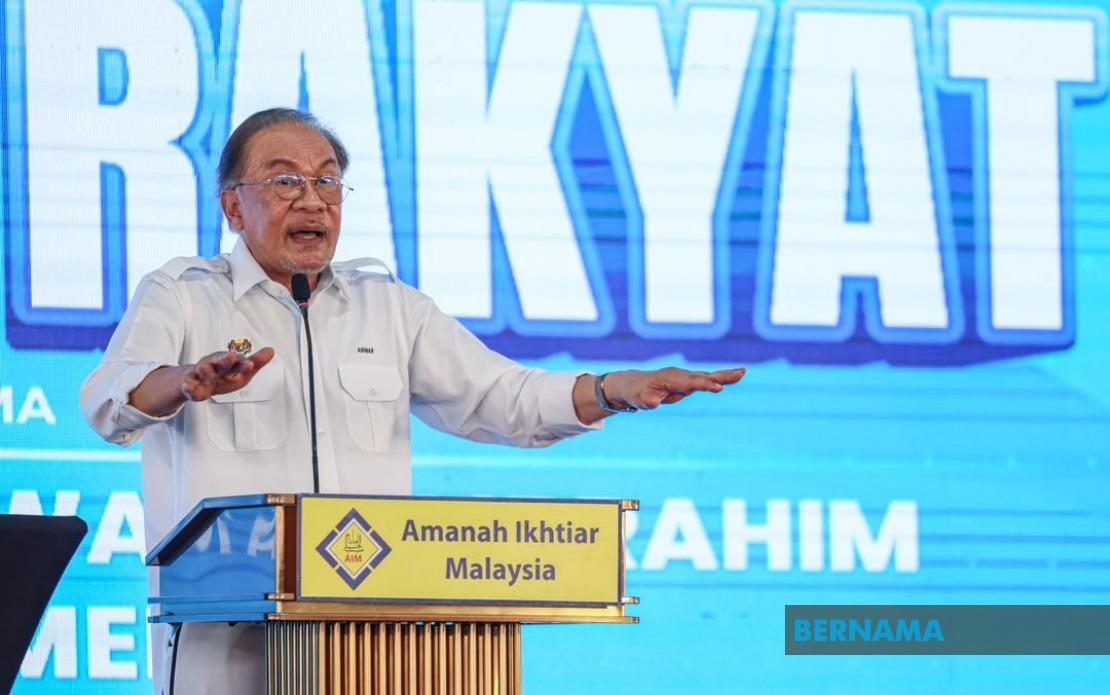
Prime Minister Datuk Seri Anwar Ibrahim asserted at a campaign event in Batu Pahat on Thursday that political opponents have begun coordinating their efforts to destabilise his government precisely because the MADANI administration refuses to tolerate corruption or the misuse of public resources. Speaking at a meet-and-greet gathering for the Senggarang state constituency during Johor's electoral campaign, Anwar contended that his government's rigorous enforcement mechanisms against those who pilfer state funds or exploit official positions for personal enrichment have created considerable discomfort among certain political quarters.
The Prime Minister, who also chairs Pakatan Harapan, articulated that the unease stemmed from the administration's transparent commitment to accountability at all governance levels. He argued that opposing factions recognised the government's determination to protect public assets and prevent leaders from leveraging their authority to acquire property, secure lucrative contracts, obtain equity stakes, or accumulate personal wealth through questionable means. This principled stance, Anwar suggested, has prompted his adversaries to join forces in attempting to remove him from office.
Anwar emphasised his personal adherence to these anti-corruption principles, citing his extensive visits to Johor during his tenure as Prime Minister without accepting land allocations, project contracts, or share holdings in the state. He stressed that such integrity must become the fundamental expectation for all elected representatives across Malaysia. By establishing clear boundaries between public duty and private gain, Anwar argued, Malaysia could build the trust necessary for sustainable development and effective governance.
Despite acknowledging the political pressures confronting his administration, Anwar indicated he remained undeterred by these opposition manoeuvres. The government's operational philosophy remained steadfast: preventing those in positions of authority from exploiting their power for personal advantage, regardless of the political consequences. This unwavering commitment to ethical governance, he asserted, would ultimately serve the nation's long-term interests.
Addressing the immediate context of Johor's state elections, Anwar appealed to voters to grant Pakatan Harapan the mandate to govern the state, positioning such an outcome as essential for comprehensive transformation focused on improving living standards and ensuring clean administration. He argued that governmental alignment between federal and state levels would enable more efficient implementation of development initiatives and welfare programmes, creating synergies currently impossible under divided governance structures.
While acknowledging the substantial investment in Johor's infrastructure—with development projects valued at billions of ringgit—Anwar contended that fundamental concerns affecting ordinary citizens remain inadequately addressed. The persistent unaffordability of housing for the middle and working classes, inadequate road networks, insufficient religious facilities, and limited support mechanisms for vulnerable populations represent critical gaps that require renewed attention from a responsive state government.
The Prime Minister critiqued the concentration of economic benefits within a narrow elite, arguing that wealth creation without broad-based distribution undermines social cohesion and perpetuates inequality. Johor, despite its economic advantages, should leverage its resources to improve conditions across all demographic segments rather than allowing prosperity to accrue disproportionately to favoured individuals and corporations.
Anwar also defended Pakatan Harapan's coalition with the Democratic Action Party, refuting suggestions that partnership with DAP compromised commitments to Malay-Muslim interests. Drawing on his three-and-a-half-year record, he noted that DAP representatives serving in the Cabinet had never obstructed programmes benefiting Malays or advancing Islamic causes. This empirical record, he argued, should dispel concerns about potential conflicts arising from multiethnic coalition governance.
The Prime Minister remarked on the extraordinary enthusiasm displayed by supporters in Senggarang, noting that their willingness to endure intense heat to attend the campaign event demonstrated genuine grassroots backing for Pakatan Harapan's agenda. Such commitment, he suggested, reflected public recognition of the government's genuine commitment to addressing ordinary citizens' concerns rather than merely pursuing partisan advantage.
Anwar concluded by urging residents across Senggarang, Rengit, and Penggaram constituencies to mobilise fully behind Pakatan Harapan candidates in the state election. The campaign context involves 172 candidates contesting 56 state seats, with polling scheduled for July 11 and early voting commencing on July 7. For Malaysian observers, this election represents a critical test of whether voters prioritise anti-corruption governance and inclusive development over traditional political affiliations, with implications potentially extending beyond Johor to shape federal political dynamics.

