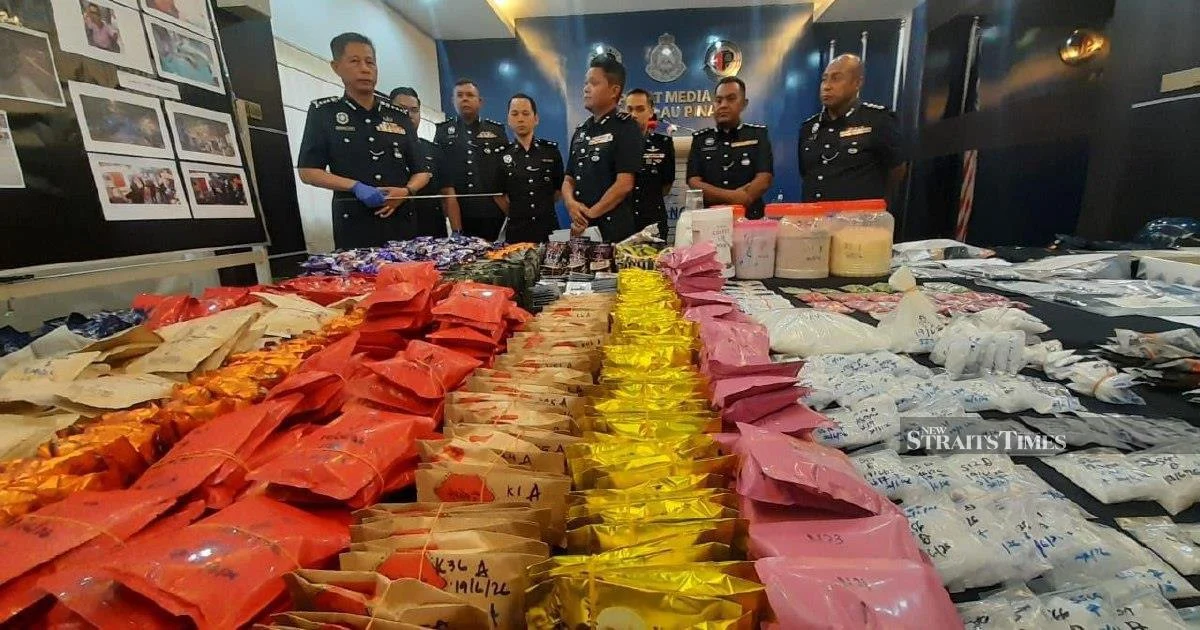
Law enforcement in Penang has moved against a major drug trafficking operation, executing a raid on a Butterworth condominium that exposed an extensive processing and distribution network worth nearly RM10 million. The operation culminated in the arrest of a romantic couple implicated in running the illicit enterprise from their residential premises, marking a substantial blow to drug trafficking activities in the northern state.
The discovery of such a sophisticated drug operation within a residential condominium highlights the evolving methods employed by trafficking networks to conceal their activities. By operating from a private dwelling rather than more conspicuous locations, the suspects attempted to evade detection whilst managing what appears to have been a well-established supply chain. The choice of a condominium—a residential setting with legitimate tenant circulation—provided them cover within an environment where suspicious activity might more easily blend into routine building movements.
The RM9.7 million drug seizure places this incident among the significant narcotics busts documented in Penang in recent years. The magnitude of the haul suggests the operation was neither small-scale nor purely for personal consumption, but rather part of a commercial trafficking enterprise supplying customers across a wider market. The sophisticated nature of processing operations, when combined with the quantity seized, indicates the couple possessed both the knowledge and infrastructure necessary to produce and distribute controlled substances at scale.
For Malaysian law enforcement, such operations represent an ongoing challenge in the region's battle against drug trafficking. Penang, positioned strategically along trafficking routes between Southeast Asia and international markets, has long served as a focal point for both local drug problems and transnational smuggling networks. The Butterworth case demonstrates that organised drug activity persists even within urban residential complexes where one might expect heightened visibility and community awareness.
The implications of this bust extend beyond the immediate arrests. The arrest of a couple engaged in drug production together suggests either strong personal bonds exploited by traffickers, or a collaborative criminal partnership where both parties held substantial investment in the operation's success. Understanding the dynamics of such relationships often provides investigators with leads to upstream suppliers and downstream distribution networks that may still be operational.
The raid's success points to enhanced intelligence-gathering capabilities within Penang's enforcement agencies. Whether the operation was uncovered through tip-offs, surveillance, financial monitoring, or community reporting remains to be clarified, but the targeted nature of the intervention suggests investigators possessed actionable information about the specific location and operation details before executing the search warrant.
From a public health perspective, the removal of RM9.7 million worth of drugs from circulation prevents these substances from reaching streets and communities throughout Penang and potentially other states in the northern corridor. Drug manufacturing facilities often distribute their products widely through established networks, meaning the seized quantity likely represented several months or more of supply to an established customer base.
The condominium setting also raises concerns about whether other residents were aware of the operation or whether chemical processes used in drug manufacturing posed environmental and safety hazards to neighbouring units. Drug labs often employ volatile and toxic substances, creating risks not only for those directly involved but for anyone sharing the building infrastructure, including ventilation systems and water supplies.
Penang police's capacity to identify, locate, and execute such operations demonstrates the ongoing commitment of state law enforcement to combat organised drug trafficking. The arrest comes as Malaysian authorities continue emphasising drug enforcement as a national priority, with significant resources dedicated to interdicting large-scale operations before they can establish deeper roots within communities.
The case will likely proceed through the courts, where prosecutors will present evidence gathered during the raid and subsequent investigation. The quantity of drugs seized, combined with the processing equipment and distribution infrastructure presumably discovered, should provide substantial grounds for serious charges under Malaysia's dangerous drugs legislation, which carries severe penalties including lengthy imprisonment.
For Malaysian readers and Southeast Asian observers, this bust underscores the persistent reality that drug trafficking networks continuously adapt their methods, personnel, and locations to evade law enforcement. The use of residential properties, often inhabited by couples rather than larger criminal organisations, represents an evolution in how traffickers attempt to maintain lower profiles whilst sustaining profitable operations.
The Butterworth operation's exposure also serves as a reminder to residents that suspicious activities—unusual visitors, chemical odours, excessive security measures, or late-night activity in residential units—warrant reporting to authorities. Community vigilance remains an essential complement to police investigations in disrupting drug networks before they can expand further.

