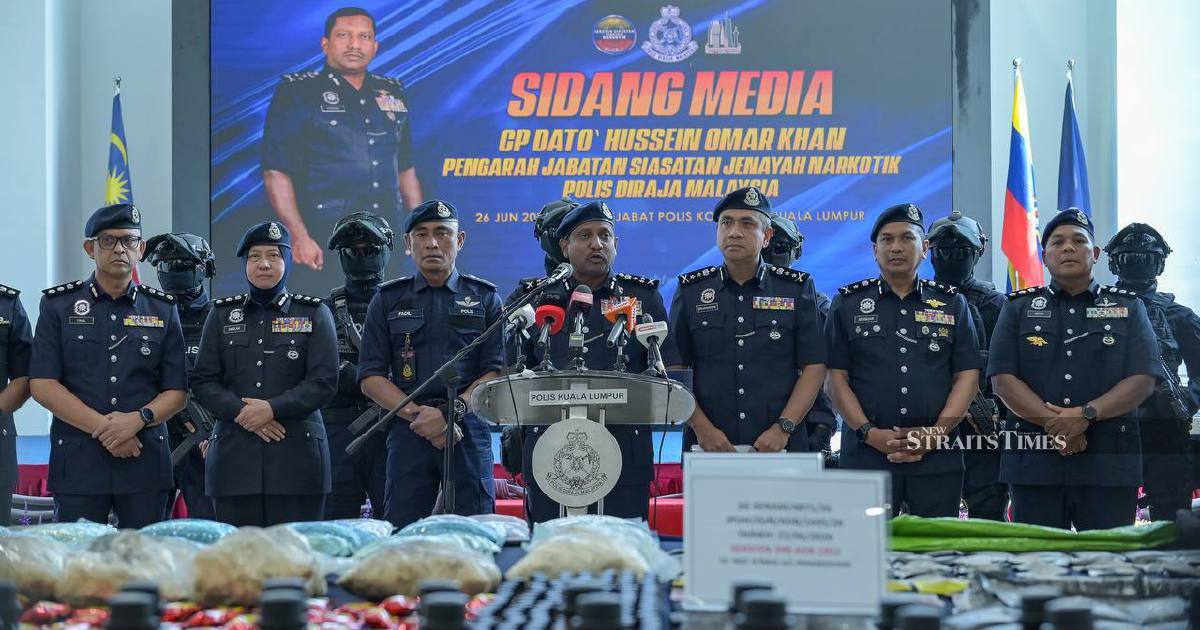
In a major blow to drug trafficking operations affecting Malaysia, police have successfully intercepted what appears to be a large-scale distribution network, recovering contraband estimated at RM135.63 million during coordinated enforcement actions in Cheras on June 20. The operation resulted in the arrest of seven suspects, marking a significant disruption to criminal activities that authorities say were aimed at flooding the domestic market with dangerous substances. The multi-pronged raids demonstrated the continued capability of law enforcement to penetrate and dismantle sophisticated trafficking organisations operating within the Klang Valley.
The seizures recovered during the three concurrent raids encompassed various categories of controlled substances, though specific details regarding the breakdown of drug types remain integral to understanding the sophistication of the operation. The scale of the haul suggests this was not a typical street-level distribution ring but rather an intermediary hub in a larger supply chain. Drug enforcement specialists note that such quantities typically indicate operations focused on wholesale distribution rather than retail sales, pointing to the organised nature of the trafficking scheme and its potential reach across multiple states.
Cheras, a district in Kuala Lumpur known for its dense residential areas and strategic transportation links, has historically been identified as a focal point for organised crime activities including drug trafficking. The location's proximity to major highways and accessibility from multiple entry points makes it an attractive operational base for criminal syndicates seeking to establish distribution networks. Law enforcement agencies have intensified surveillance and intelligence gathering in such high-risk areas as part of broader efforts to combat the supply side of Malaysia's persistent drug problem.
The apprehension of seven individuals provides investigators with multiple leads for further inquiries into the organisational structure and supply sources of the network. Police typically employ such arrests to map connections between mid-level distributors and their suppliers, particularly those controlling import routes into Malaysia. The intelligence gathered from detained suspects frequently yields information about storage facilities, financial transactions, and client networks, enabling authorities to launch subsequent operations targeting other components of trafficking organisations.
The stated objective of flooding the local market represents a escalation in trafficking tactics observed in recent years. Criminal syndicates have increasingly adopted aggressive market capture strategies, attempting to saturate specific regions with low-priced narcotics to establish customer bases and eliminate competition. Such approaches create acute public health challenges and contribute to rising addiction rates, placing additional strain on rehabilitation and social services already stretched across Malaysia's urban centres.
The RM135.63 million valuation reflects the street-level retail value of the seized substances rather than acquisition costs, indicating the significant profit margins that drive trafficking activities. Understanding these economics helps explain the persistence and sophistication of trafficking networks despite enforcement efforts. For criminal organisations, the potential returns justify substantial investment in logistics, corruption, and violence required to maintain supply chains and distribution networks.
This operation exemplifies the sustained focus by Malaysian law enforcement on disrupting drug supply chains rather than purely targeting end-users. Police strategy increasingly emphasises interdicting consignments and dismantling distribution networks as more effective approaches than enforcement against individual consumers. The June 20 raids align with this intelligence-led policing model, where sustained investigation culminates in coordinated strikes against identified criminal operations.
The success in Cheras carries implications beyond the immediate recovery and arrests. Each major seizure removes narcotics from circulation and temporarily disrupts established distribution patterns, forcing trafficking organisations to reassess operational security and supply routes. The publicity surrounding substantial seizures also serves public awareness functions, reinforcing the risks of trafficking involvement and signalling law enforcement capacity.
Regional trafficking networks supplying Malaysia face mounting pressure from coordinated enforcement across Southeast Asia. Source countries and transit nations have intensified border controls and drug interdiction operations, creating bottlenecks in traditional supply routes. Malaysian law enforcement's domestic operations complement these regional efforts, creating layered obstacles to drug movement and distribution. Intelligence sharing between Malaysian agencies and international partners increasingly enables authorities to identify suspicious transactions, chemical precursor movements, and financial flows associated with major trafficking operations.
The broader context of drug enforcement in Malaysia demonstrates both achievements and ongoing challenges. While seizures and arrests continue, the availability of various narcotics remains stubbornly consistent across major urban areas. This suggests that despite successful interdictions, sufficient supply continues reaching markets, indicating the scale of trafficking activity exceeds the rate of enforcement-driven disruption. Addressing this supply-demand imbalance requires sustained investment in enforcement capabilities, international cooperation, and complementary demand-reduction initiatives.
The detention of the seven suspects initiates investigative processes that typically extend over months as authorities pursue financial trails, communication records, and organisational relationships. Information extracted from these cases frequently contributes to broader understanding of trafficking networks' structure and operation, informing subsequent intelligence priorities. Successful prosecutions resulting from this operation will require coordination between investigation teams, prosecutors, and courts, with cases potentially establishing legal precedents relevant to future trafficking prosecutions.
Future law enforcement priorities in Cheras and similar high-risk zones will likely emphasise sustained surveillance and intelligence development rather than one-off operations. The scale of the June 20 seizures suggests underlying distribution infrastructure remains in place, with other operators potentially seeking to occupy the void created by this disruption. Maintaining operational tempo and detection capability in known trafficking hotspots represents an ongoing challenge requiring adequate resourcing and strategic focus from enforcement leadership.

