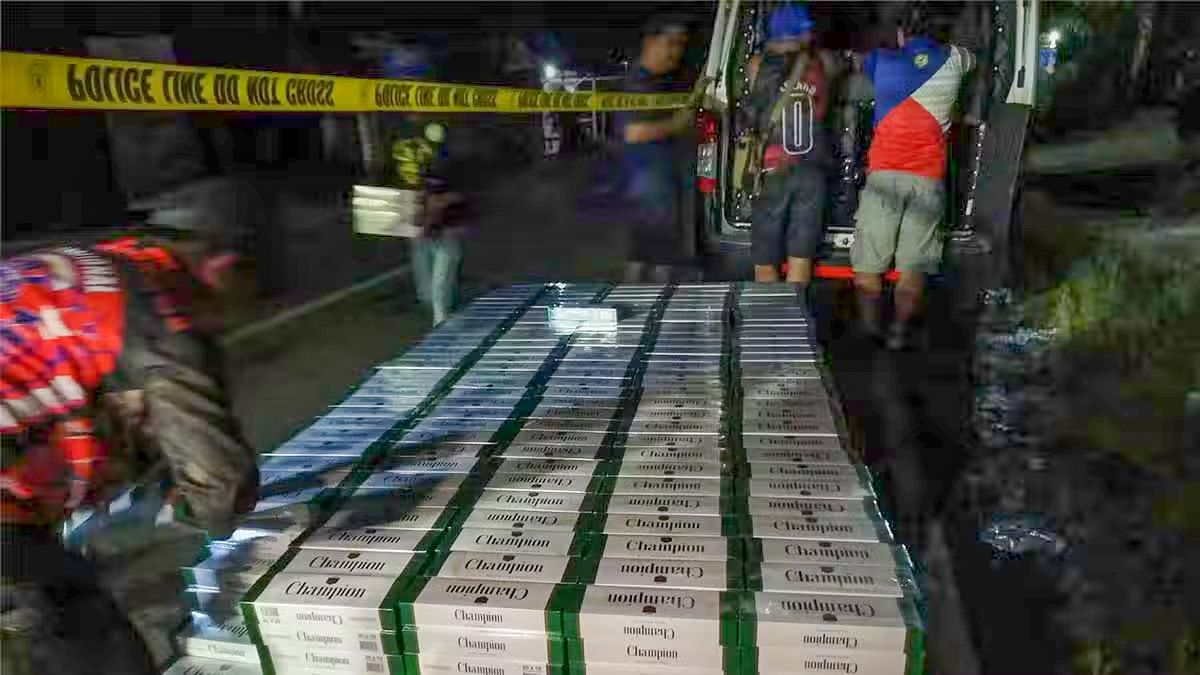
Law enforcement officers in Zamboanga del Norte apprehended a policeman and a businessman following the discovery of nearly P1.9 million in contraband cigarettes during a late-night checkpoint operation conducted in Barangay Gatas, Kalawit, on Friday, July 31. The operation highlighted the ongoing struggle against cigarette smuggling networks that continue to operate across the southern Philippines despite intensified enforcement efforts by multiple government agencies.
Lt. Col. Edwin Verzon, commanding officer of the Zamboanga del Norte 2nd Provincial Mobile Force Company, detailed how personnel from his unit collaborated with other law enforcement officers to conduct the checkpoint. At approximately 10.05pm, operatives flagged down a white Nissan van as it approached their position. Rather than complying with the inspection, the vehicle's driver immediately accelerated and attempted to elude the checkpoint, a response that immediately triggered suspicion among the officers.
The attempted evasion prompted pursuit operations, with law enforcement personnel tracking the van over a short distance before successfully intercepting it. The decision to flee from a routine checkpoint rather than submit to inspection proved costly for the occupants, as it provided authorities with probable cause to conduct a thorough search of the vehicle and its contents.
Both suspects have been identified as residents of Zamboanga City. The first individual is a 34-year-old police officer assigned to Police Station 10 under the Zamboanga City Police Office, stationed in Barangay Talon-Talon. The second is a 36-year-old businessman domiciled in Barangay Tumaga. The involvement of an active police officer in what appears to be an organized smuggling operation raises serious questions about corruption within law enforcement and suggests potential coordination between uniformed personnel and criminal networks engaged in contraband trafficking.
A comprehensive search of the van's interior revealed 1,630 reams of cigarettes that had been deliberately concealed within the vehicle. The sheer quantity of cigarette reams discovered indicates this was no small-scale operation but rather part of a calculated smuggling enterprise designed to move substantial quantities of contraband across provincial boundaries.
The Bureau of Customs conducted a valuation assessment of the seized cigarettes based on standardized price indices used to determine the economic impact of smuggled goods. According to BOC calculations, the contraband cigarettes carry a market value of P1,867,980, reflecting both the commercial significance of the seizure and the substantial tax revenue loss that such operations represent to the Philippine government.
Cigarette smuggling remains a persistent challenge for authorities throughout Southeast Asia, particularly in regions with porous borders and competing supply networks. The scale of operations often dwarfs the enforcement resources available to interdiction teams, creating an asymmetric enforcement environment where organized smugglers continuously adapt their tactics to evade detection. The involvement of active-duty police personnel in facilitating these operations suggests that criminal organizations have successfully penetrated law enforcement institutions, a development that complicates efforts to dismantle smuggling networks.
The economic implications of cigarette smuggling extend beyond simple tax evasion. Illegal cigarettes typically circumvent quality control standards, carry no tax revenue for governments, undercut legitimate business enterprises, and frequently generate funds that support broader criminal enterprises. In the Philippine context, cigarette smuggling operations often intersect with organized crime groups operating in Mindanao, making the suppression of such activities both an economic and security imperative.
The arrest of an officer from Police Station 10 likely triggers internal investigations within the Zamboanga City Police Office, as institutional corruption of this nature demands thorough review of operations and personnel assignments. Such cases often reveal broader corruption networks rather than isolated misconduct, potentially implicating multiple individuals across different enforcement agencies.
The checkpoint operation that led to this seizure exemplifies the tactical approach adopted by provincial mobile force units in Mindanao, where strategic positioning at known smuggling routes has yielded increasingly significant interdictions. However, the fact that the van driver immediately attempted evasion suggests that smuggling organizations maintain intelligence networks that monitor checkpoint locations and may be relying on corrupted officials to provide advance warning of enforcement activities.
Looking forward, this case underscores the critical importance of coordinating anti-smuggling efforts across multiple agencies while simultaneously strengthening internal police oversight mechanisms. The P1.9 million seizure, while significant, represents only a fraction of the cigarettes estimated to flow through Philippine ports and borders annually, indicating the scale of work that remains before organized smuggling operations can be effectively contained.

