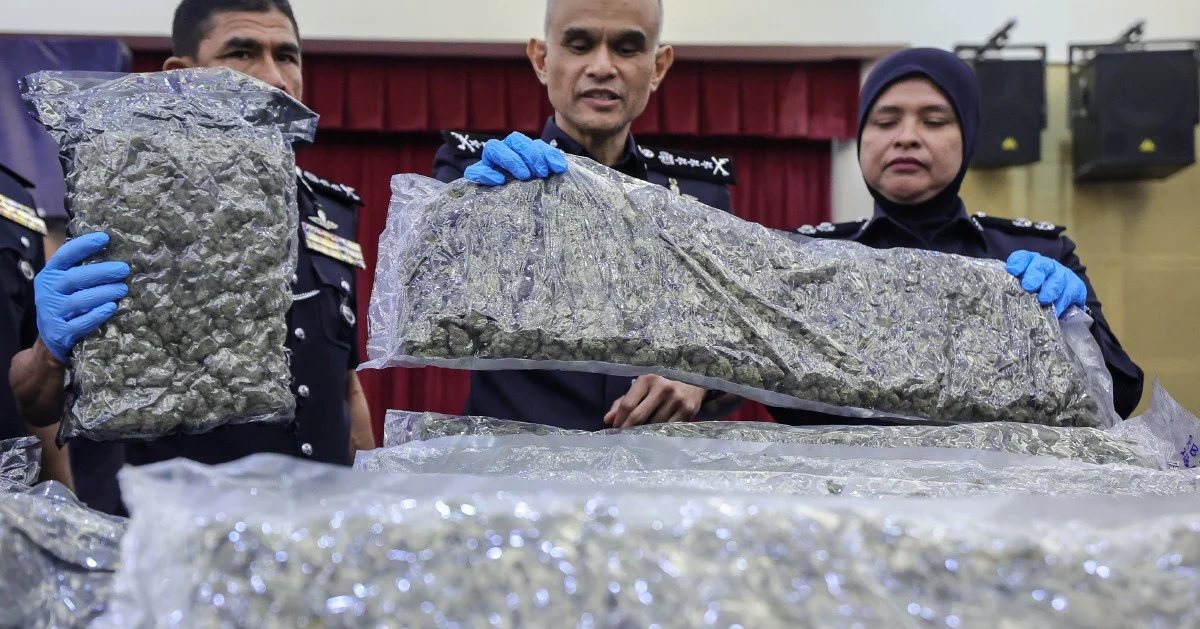
A major drug interdiction operation at Malaysia's primary international gateway has yielded a substantial haul of contraband, underscoring the persistent vulnerability of the country's aviation infrastructure to sophisticated smuggling networks. Since the start of 2024, authorities working at Kuala Lumpur International Airport have intercepted over 650 kilogrammes of cannabis buds, culminating in the apprehension of 38 suspects—a mix of Malaysian citizens and foreign nationals implicated in an organized drug trafficking syndicate. The enforcement action reflects intensifying police efforts to dismantle supply chains that exploit KLIA's high passenger throughput and complex cargo operations.
The scale of the seizure highlights a troubling pattern in Southeast Asia's drug trafficking landscape, where cannabis—once perceived as a secondary concern compared to methamphetamine and heroin—has emerged as a significant commercial commodity. The 650-kilogramme interception represents a commercially substantial payload, suggesting involvement of professional smuggling organizations rather than petty courier operations. Such quantities typically indicate transnational trafficking networks with access to cultivators, logistics coordinators, and distribution networks spanning multiple countries. The involvement of foreign nationals in the 38 arrests reinforces the international dimension of the operation, pointing to supply sources beyond Malaysia's borders and potential distribution mechanisms across the region.
KLIA's strategic position as Southeast Asia's busiest airport has long rendered it an attractive target for smugglers seeking to move narcotics across international borders. The airport processes hundreds of thousands of passengers monthly, with baggage and cargo volumes that present genuine screening challenges despite technological advances in detection systems. The airport's dual role as both a passenger hub and a major freight distribution center creates multiple vulnerability points where contraband can be concealed within legitimate shipping containers, checked luggage, or body carriers. The volume of personnel employed across ground handling, security, and logistics operations simultaneously multiplies potential infiltration vectors for corrupt facilitators who may assist trafficking operations.
The diversity of the arrested group—encompassing both local and foreign participants—illuminates the compartmentalized structure through which modern trafficking organizations function. Typically, such networks employ specialized operatives at distinct stages: international suppliers, border crossing facilitators, airport insiders, ground-level couriers, and street-level distributors. Each component operates with limited knowledge of the broader network, reducing security risks through compartmentalization. The apprehension of 38 individuals suggests police investigations have penetrated multiple layers of this hierarchy, potentially disrupting both upstream supply routes and downstream distribution channels. However, the arrest of mid-level operatives does not necessarily dismantle the networks entirely, as trafficking organizations possess built-in redundancy and can swiftly replace compromised personnel.
The timing of this operation, commencing in January, aligns with broader regional trends in drug interdictions. Southeast Asian law enforcement agencies have reported increased cannabis trafficking activity following crop failures in traditional opium-producing regions and the emergence of large-scale indoor cultivation facilities in countries including Thailand and Cambodia. The cannabis trade has attracted organized crime groups previously invested in other narcotics, particularly as regional attitudes toward the substance evolve and some jurisdictions implement medical legalization frameworks. This strategic shift reflects traffickers' adaptation to enforcement patterns and market dynamics, with cannabis offering lower-risk profit margins than heroin or synthetic drugs despite smaller street-level prices.
Malaysia's regulatory framework maintains stringent penalties for drug trafficking, with cannabis classified as a dangerous drug under the Dangerous Drugs Act. Trafficking offences involving quantities of this magnitude typically expose perpetrators to mandatory minimum sentences extending to decades of imprisonment, and potentially capital punishment in cases involving specified thresholds. The severity of Malaysia's drug laws theoretically serves as a deterrent, yet persistent smuggling attempts suggest that profit incentives substantially outweigh perceived legal risks for participating syndicates. This disconnect between deterrent severity and trafficking persistence raises questions about supply-side factors—including cultivation abundance in source countries and demand stability in destination markets—that perpetually regenerate trafficking incentives.
The police operation's success in identifying and apprehending 38 individuals reflects both enhanced intelligence capabilities and systematic coordination between KLIA security personnel, customs officials, and narcotics enforcement units. Such interagency cooperation represents a substantial administrative achievement in an environment where bureaucratic compartmentalization sometimes impedes information sharing. The involvement of international participants in the arrested group may also indicate cooperation with foreign law enforcement agencies, particularly those in source countries, suggesting evolution toward more sophisticated cross-border intelligence operations. Nonetheless, individual interdictions—however substantial—function primarily as tactical disruptions rather than strategic solutions to entrenched trafficking networks with deep financial resources and established distribution infrastructure.
The implications for Malaysian travellers and regional security extend beyond immediate drug enforcement considerations. Large-scale smuggling operations exploit airport infrastructure in ways that affect overall security protocols, potentially necessitating enhanced screening procedures that increase processing times and operational costs. The involvement of airport workers or other inside facilitators in trafficking networks additionally raises concerns regarding personnel security vetting and the vulnerability of critical infrastructure to infiltration by criminal elements. Regional cooperation mechanisms addressing aviation security and transnational organized crime require continuous strengthening to address these persistent vulnerabilities.
Looking forward, sustained suppression of trafficking through KLIA will demand continued resource allocation to detection technologies, intelligence operations, and inter-agency coordination. International cooperation with source countries—including collaborative efforts to address upstream cultivation, chemical precursor controls, and extradition procedures—remains essential for meaningful supply reduction. Simultaneously, demand-side interventions addressing substance use disorders and market factors influencing trafficking profitability merit parallel investment. The current operation, while tactically successful, exemplifies the ongoing challenge Malaysian and regional authorities face in countering sophisticated, well-capitalized trafficking networks whose adaptive capacity frequently matches enforcement innovation.

