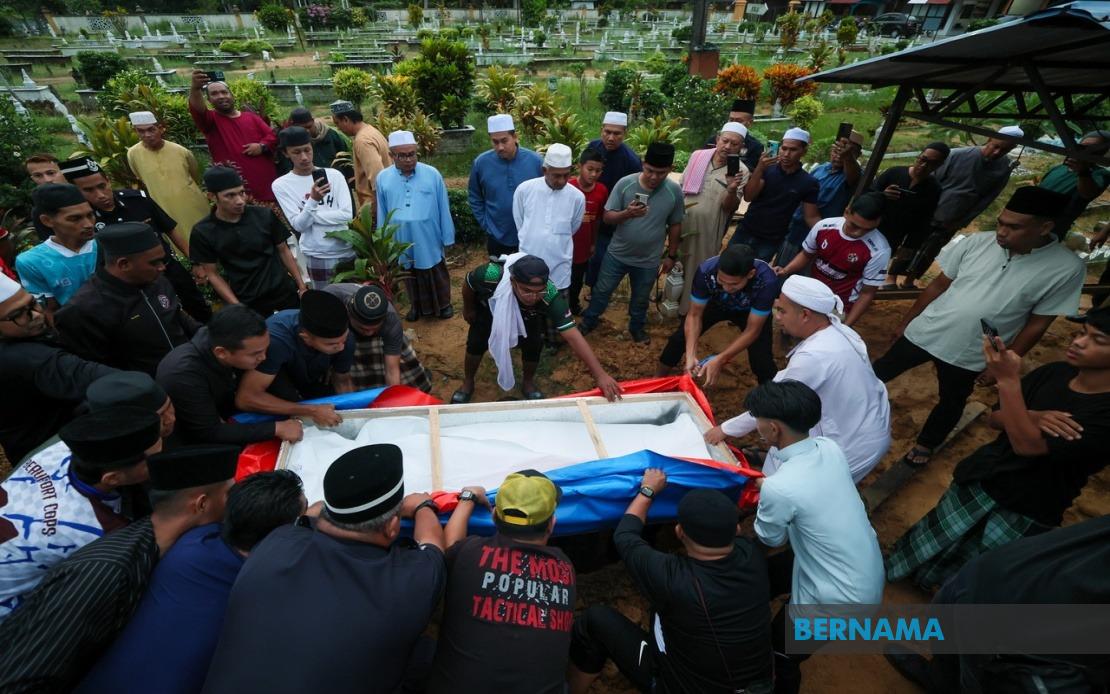
The funeral of Corporal Mohamad Nur Hafiz Rahim took place in Kota Bharu this morning, concluding a solemn chapter for the 29-year-old police officer whose life was cut short by a tragic workplace accident in Beaufort, Sabah. The officer, who is believed to have died from electrocution while performing routine duties at Weston Police Station, was interred at Kampung Pangkal Kuang Muslim Cemetery in Ketereh following prayers held at his family residence in Kampung Hutan Pasir.
The incident that claimed Mohamad Nur Hafiz's life occurred at approximately 5.50 pm when he and two colleagues attempted to relocate a 29-foot-long metal pole used for harvesting coconuts stationed outside the police station near Sekolah Kebangsaan Weston. The operation proved fatal, with all three officers succumbing to electrocution. His colleagues, Corporal Chiu Teck Siong aged 40 from Sarawak and Constable Muhammad Raimi Ismarubee aged 26 from Terengganu, also perished in what has become one of Malaysia's most serious workplace tragedies involving uniformed personnel in recent months.
Friends and family gathered at the cemetery as Mohamad Nur Hafiz's mortal remains were committed to earth, with the Royal Malaysia Police providing substantial support in coordinating logistics to transport the body from Sabah back to his native Kelantan. The speed and coordination with which the police force arranged his repatriation underscored the institution's commitment to honouring one of its own, a gesture that his family acknowledged with gratitude even amid overwhelming grief. His eldest sister, Nurlella Rahim, 34, expressed appreciation to the force for its assistance, noting that the vehicle bearing her brother's remains arrived at their family home at 4.45 am, facilitating the funeral arrangements.
The family portrait that emerges from Nurlella's recollections reveals a tight-knit household sustained by modern technology despite geographic separation. The five siblings maintained daily contact through video calls and a family WhatsApp group, a routine that underscores how contemporary communication tools have reshaped family bonds across Malaysia's vast distances. Nurlella herself resides in Ipoh, Perak, while Mohamad Nur Hafiz was stationed in Sabah, yet they managed to sustain meaningful connection through frequent virtual interactions and social media engagement, commenting on photographs and sharing moments in their respective lives.
The last interactions with Mohamad Nur Hafiz revealed glimpses of his ordinary life in the days preceding the tragedy. His mother received a video call from him on Thursday afternoon, during which he appeared fatigued and subdued, though he managed to smile and reassure her before attending to his work commitments. Remarkably, even during brief breaks from his duties, he would initiate video calls to maintain contact with his family members. These small gestures of connection paint a picture of a devoted son and brother whose commitment to maintaining family ties extended beyond the constraints of his posting in a distant state.
Nurlella's most recent conversation with her brother occurred on Sunday, a day suffused with ordinary family moments that would later assume poignant significance. During that interaction, Mohamad Nur Hafiz had taken his wife, Fatimah Shahira, and their young child to the beach, capturing what would prove to be among his final experiences as a father and husband. The seemingly mundane outing carried no premonition of the catastrophe that would befall him within days, highlighting how swiftly tragedy can disrupt lives and alter family trajectories irrevocably.
The electrocution incident at Weston Police Station has prompted immediate governmental scrutiny. Prime Minister Datuk Seri Anwar Ibrahim issued a directive for a comprehensive, transparent, and expedited investigation into the circumstances surrounding the deaths. Anwar emphasised via a Facebook statement the investigation's critical importance in establishing root causes and implementing procedural safeguards to forestall recurrence of similar tragedies. This commitment to investigative rigour reflects broader concerns about occupational safety standards within law enforcement agencies and the broader public sector.
The incident raises serious questions about workplace hazard management within police facilities nationwide. The operation of moving a 29-foot metal pole in proximity to electrical infrastructure suggests potential lapses in safety protocols, hazard assessment, or risk mitigation procedures. Whether the pole came into contact with overhead power lines, whether appropriate warnings and precautions were absent, or whether equipment maintenance standards proved inadequate will likely form central inquiries within the investigation framework. For Malaysian law enforcement institutions, which frequently undertake construction and maintenance activities on station grounds, the tragedy serves as a sobering reminder of latent dangers that routine tasks can harbour.
For Southeast Asian regional observers, the incident illuminates occupational safety challenges that persist across the public sector throughout the region, despite increasing awareness and regulatory frameworks. The deaths of three uniformed personnel in a single incident represents a devastating loss within Malaysia's police force, which comprises approximately 250,000 members. The ripple effects extend beyond institutional circles, resonating with families, communities, and wider public consciousness regarding the hidden hazards that first responders and service personnel navigate daily.
The bereavement affecting Mohamad Nur Hafiz's family members extends implications for spousal and parental support systems. His widow, Fatimah Shahira, now faces the prospect of raising their child without his financial contribution and parental presence, circumstances that may necessitate institutional or community support mechanisms. Similarly, his mother and siblings confront the sudden loss of a family member whose regular communications had anchored their dispersed household. Such personal tragedies, while intimate, collectively shape social welfare discussions regarding occupational fatalities and survivor compensation.
The investigation ordered by Prime Minister Anwar Ibrahim will likely influence future protocols governing maintenance activities, electrical hazard awareness, and emergency response procedures across police stations and government facilities. Training standards, equipment specifications, and supervisory oversight mechanisms may undergo revision based on findings. For other Southeast Asian nations grappling with similar institutional safety challenges, Malaysia's investigative response and subsequent policy adjustments may offer instructive precedents for strengthening workplace protection standards within security and emergency service sectors.
As Mohamad Nur Hafiz's family members process their loss, the broader institutional and policy responses initiated by national leadership will proceed in parallel tracks. The investigation promises to deliver factual clarity regarding how a routine operation transformed into a fatal incident, while structural reforms may ultimately prevent comparable tragedies. For his colleagues at Weston Police Station and throughout Malaysia's police force, his death will likely prompt renewed emphasis on safety consciousness and hazard recognition, ensuring that his sacrifice contributes meaningfully to institutional improvements that protect future generations of uniformed personnel.

