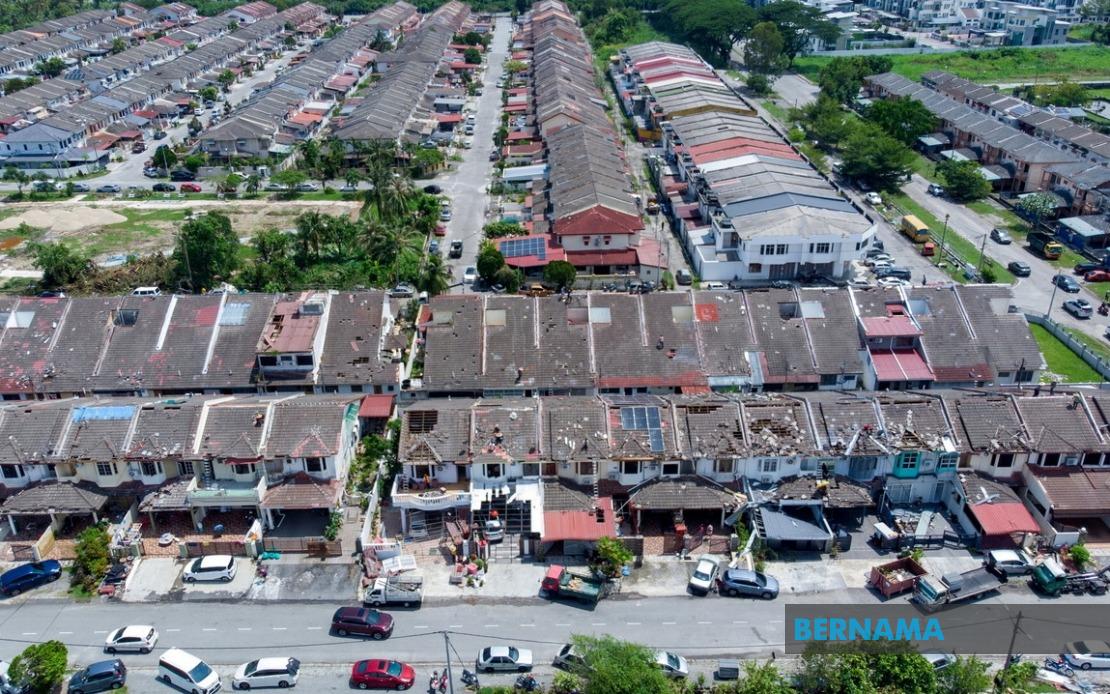
Authorities in Ipoh have implemented strict access controls across five separate zones within storm-ravaged Bercham, with police presence established to deter criminal activity in the wake of widespread destruction caused by the severe weather event that struck on Friday. The cordon operation reflects growing concerns that the chaos and darkness created by infrastructure damage could provide cover for theft and burglary as residents grapple with cleanup efforts.
ACP Muhammad Najib Hamzah, the Ipoh district police chief, acknowledged during a press briefing at Bercham police station that some discretion would be exercised for legitimate residents seeking to recover or salvage their possessions and undertake repair work. However, the police leadership made explicit their intention to tighten nighttime restrictions, particularly in areas such as Anjung Bercham where prolonged power outages have left neighbourhoods dark and vulnerable. The absence of street lighting and residential illumination creates conditions where illicit activity becomes difficult to monitor and easier to perpetrate undetected.
The rationale behind heightened vigilance during evening hours reveals a practical policing concern specific to disaster situations. When residents attempt to retrieve belongings or clean up after storm damage during darkness, police personnel at checkpoints face the challenge of distinguishing between legitimate salvage operations and criminal trespass. To address this verification challenge, officers will cross-reference claims of property ownership with residents' identity documents and conduct spot checks to ensure that only genuine property owners are conducting nighttime activities within the sealed zones.
Bercham comprises multiple residential pockets, each with distinct characteristics and damage profiles. The affected neighbourhoods include Anjung Bercham Utara, Taman Mujur, Kampung Bercham, Kampung Tersusun Tasek, Taman Pusat Bercham and Taman Indah Sakti. This geographical spread across six distinct residential zones explains why police established five separate sealed areas rather than a single perimeter, allowing authorities to concentrate resources and manage access points more efficiently. The localised approach also enables targeted support for residents seeking immediate access to their properties for emergency work.
As of the morning of the police briefing, 492 storm-related incident reports had been filed through Op Bencana, the national disaster operations system. Importantly, the police clarified that no deadline exists for victims to lodge damage or loss reports, removing temporal pressure from residents who may still be processing the scale of destruction or discovering additional damage as cleanup progresses. This open-ended reporting window is crucial in disaster contexts where full assessment of losses often emerges gradually over days and weeks.
The storm's intensity and impact have drawn attention from senior political figures. M. Kulasegaran, the Member of Parliament for Ipoh Barat and Deputy Minister in the Prime Minister's Department (Law and Institutional Reform), characterised the meteorological event as extraordinary and unprecedented, noting that more than 200 homes sustained damage. His assessment attributed the destruction to a rare landspout phenomenon, a localised rotating column of air that forms over land and produces concentrated, destructive winds. Such events are uncommon in Malaysian weather patterns, which typically experience tropical thunderstorms rather than the tight vortex dynamics that characterise a landspout.
The distinction between a conventional severe thunderstorm and a landspout is more than academic. Landspouts create damage patterns that differ from typical storm systems, with destruction concentrated along a narrow track rather than dispersed across a broader zone. This concentration explains why the impact was severe enough to warrant police cordoning and disaster response measures whilst remaining geographically limited to specific Bercham neighbourhoods. Understanding the meteorological nature of the event informs both immediate response strategies and longer-term building code considerations for the affected areas.
The police operation reflects broader disaster management challenges across Southeast Asia, where rapid urbanisation in cities like Ipoh has created dense residential zones with significant populations vulnerable to severe weather events. The decision to restrict movement demonstrates confidence in intelligence-led policing approaches that anticipate criminal opportunism during humanitarian crises. Malaysian police have increasingly adopted such preventative cordoning strategies in recent years following major flooding and storm events, recognising that professional criminals often migrate to disaster areas expecting overwhelmed local law enforcement.
Total economic losses from the Bercham storm have not yet been quantified, a common situation in the immediate aftermath of disaster events when damage assessment teams are still conducting surveys and compiling data. The eventual financial toll will encompass not only structural damage to homes but also loss of possessions, agricultural impact on surrounding farms, and the economic costs of disrupted business activity and utility restoration. Insurance claims data, when consolidated, will provide the clearest picture of insured losses, though many Malaysian households in such areas may carry limited or no property coverage.
The security measures now in place will likely remain operational until essential infrastructure repairs, particularly electricity restoration, are substantially complete. The return of reliable lighting to neighbourhoods dramatically reduces the vulnerability window that criminals exploit. Simultaneously, as residents complete their initial cleanup and salvage operations, the operational burden on police checkpoints should decrease, allowing gradual normalisation of access. The phased approach reflects practical recognition that disaster response is not a discrete event but a transitional process requiring sustained but gradually diminishing intervention.

