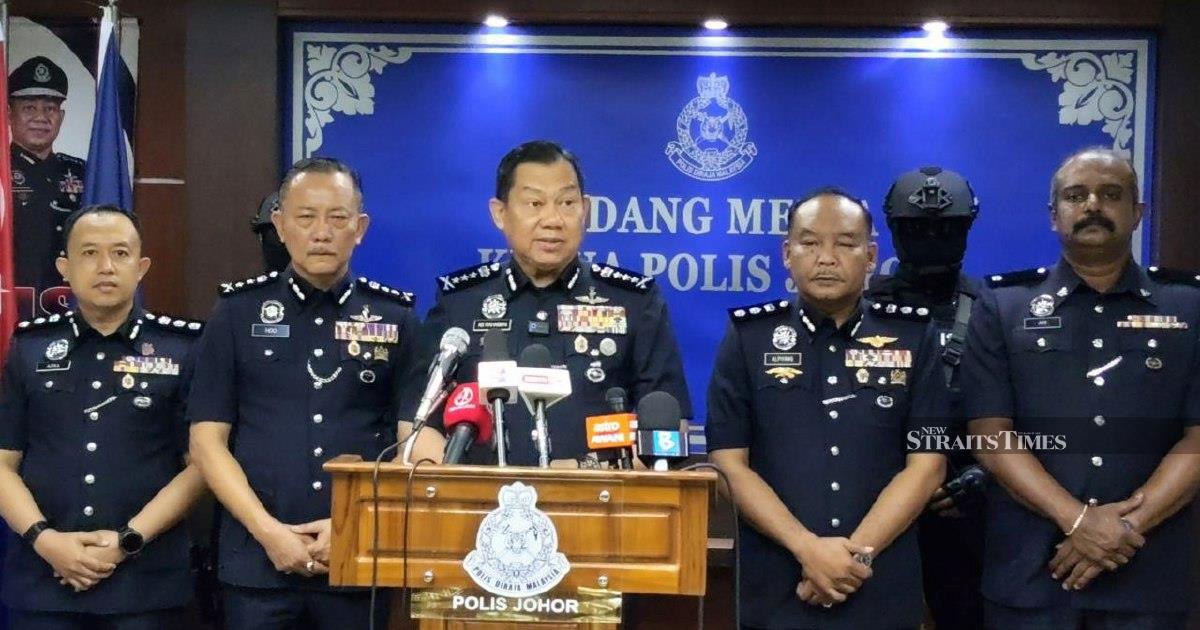
A coordinated law enforcement operation in Johor Baru has resulted in the seizure of more than 60 kilogrammes of methamphetamine and the arrest of eight suspects, signalling intensified efforts by police to dismantle high-level drug trafficking networks operating across the state. The haul, valued at RM3.04 million, underscores the scale of organised narcotics distribution in Malaysia's southern border region, where smuggling routes from neighbouring countries continue to fuel illegal drug markets.
Among those detained in Saturday's raids was a school dropout employed as a transporter—a common operational model employed by criminal syndicates to reduce their own exposure to arrest. By recruiting vulnerable youths with limited educational prospects, trafficking networks shift legal liability and street-level enforcement pressure away from senior organisers and financiers. The inclusion of this teenage suspect in the bust reveals how drug syndicates systematically exploit Malaysia's marginalised youth, channelling them into high-risk roles that carry severe criminal penalties.
Johor Baru, strategically positioned adjacent to Singapore and with direct access to maritime smuggling routes through the Straits, remains a critical logistical hub for regional drug trafficking operations. The concentration of seizures and arrests in the state reflects both the volume of contraband transiting through the area and the sophisticated distribution infrastructure required to supply downstream markets across Peninsular Malaysia. Law enforcement agencies have progressively tightened interdiction efforts along major trafficking corridors, yet the persistence of large hauls indicates that criminal networks continue adapting their methods faster than preventive capabilities can fully respond.
Methamphetamine, commonly known locally as "syabu," remains the dominant drug of abuse across Malaysia's urban centres and increasingly in smaller towns and suburban areas. The crystalline form's potency, relatively compact size for smuggling, and sustained demand across socioeconomic strata make it the primary focus of wholesale trafficking operations. Price points that have remained relatively stable despite periodic crackdowns suggest that supply remains adequate to sustain market competition among distributors and continued accessibility at street level.
The mechanics of this operation—from production or transshipment, through consolidation by mid-level organisers, to distribution by recruited couriers—illustrate the vertically integrated nature of modern drug syndicates. Each layer operates with compartmentalised knowledge of the full supply chain, a security mechanism that complicates law enforcement efforts to unravel entire networks from a single bust. The arrest of multiple tiers, however, does provide authorities with multiple investigative entry points and potential cooperating witnesses who might disrupt the chain of supply.
For Malaysian law enforcement, such operations validate the effectiveness of intelligence-led policing strategies that target known distribution nodes and high-risk transportation corridors. However, the regularity with which seizures occur at similar scales suggests that arrests of street-level and mid-tier participants, while publicly significant, may have limited impact on overall drug availability unless they extend to disrupting supply at source or dismantling financial infrastructure that sustains trafficking organisations. The eight arrests represent temporary removal of operatives that can often be replaced by recruitment of additional vulnerable individuals.
The case also highlights the distinction between street-level drug use and organised trafficking—a distinction that Malaysia's increasingly strict drug laws treat with vastly different severity. While possession of 60kg of methamphetamine carries capital-level penalties, those arrested include lower-level functionaries whose culpability, though legally substantial, reflects economic desperation rather than criminal enterprise. Prosecutorial decisions about whether to pursue all suspects at maximum severity or to encourage cooperation from lower-tier participants may determine whether this bust advances broader investigative goals.
From a regional security perspective, the sustained volume of narcotics flowing through Malaysia reflects production capacity in the Golden Triangle region and onward distribution networks that extend to Australia and other Pacific markets. Johor's position makes it both a transshipment point for other markets and a consumption centre in its own right, with border proximity ensuring that drug availability closely tracks regional production cycles and cartel marketing strategies. Interdiction alone, without addressing demand-side factors and economic alternatives to trafficking participation, remains insufficient to reverse long-term trends.
The timing and scale of this operation, publicised through police announcements, serve important deterrent and morale functions within law enforcement. However, they also prompt trafficking networks to revise operational procedures—altering routes, consolidation points, and personnel deployment strategies. The challenge for police oversight is maintaining sustained pressure across multiple simultaneous fronts without resources becoming depleted through reactive responses to successive crises.
For Malaysian communities, particularly in states like Johor where drug-related crime remains persistent, such operations provide interim reassurance that enforcement mechanisms remain engaged. Yet the broader trajectory of methamphetamine availability, combined with apparent recruitment of increasingly younger operatives into trafficking roles, suggests that structural interventions addressing root causes of supply-side participation and demand-side consumption require parallel advancement alongside enforcement operations.

